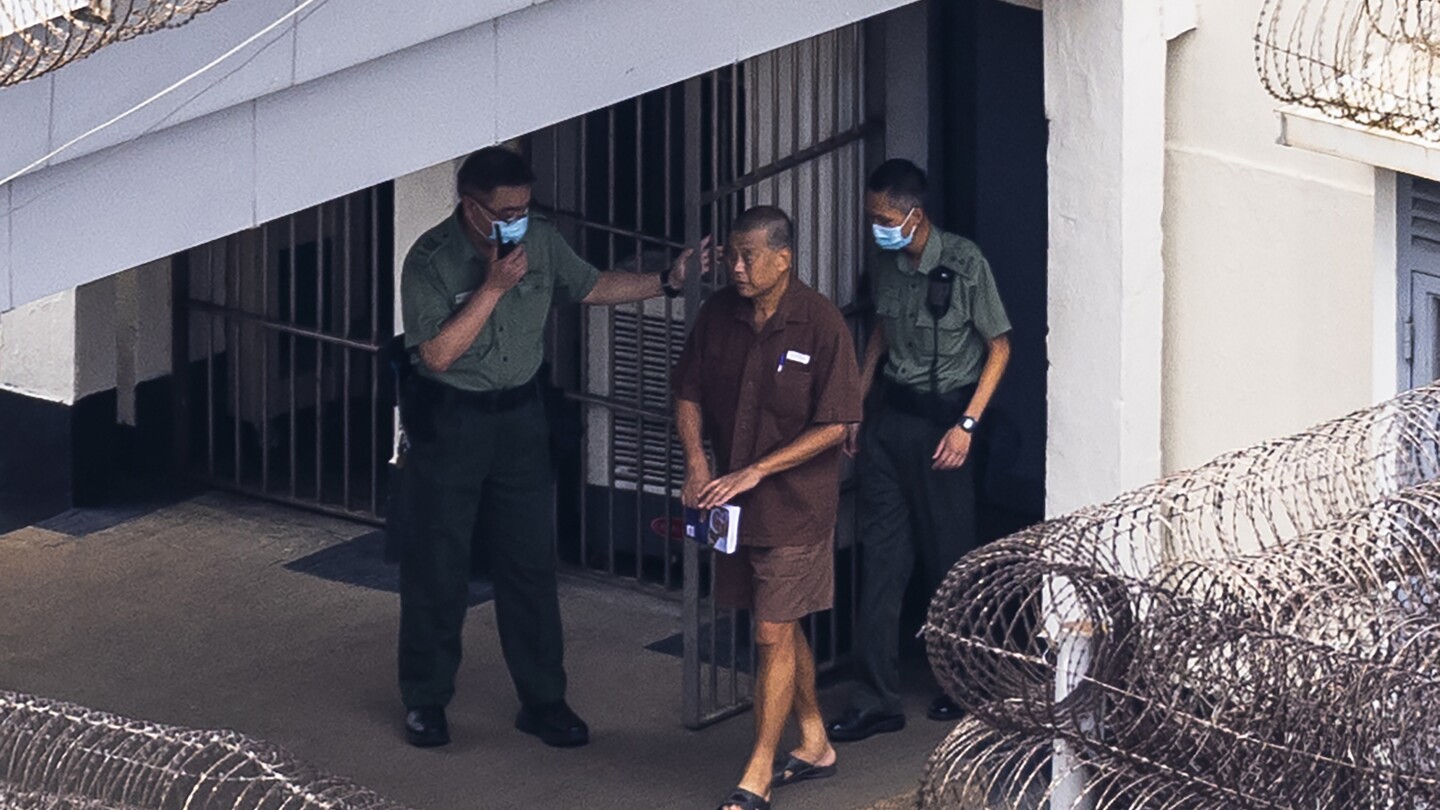
Hong Kong media tycoon Jimmy Lai was sentenced on Monday to 20 years in prison after being convicted on national security charges, bringing an end to the city’s highest profile national security trial.
Lai was found guilty of two counts of conspiracy to collude with foreign forces and one count of publishing seditious materials. The case has spanned nearly 5 years and is the most significant prosecution under the national security law imposed by Beijing.
The founder of the now shuttered Apple Daily newspaper was first arrested in August 2020 and convicted last year. His 20 year sentence falls within the harshest penalty band of 10 years to life imprisonment for offences deemed to be of a grave nature and is the most severe punishment imposed so far under the law.
The three national security judges said Lai’s sentence was increased because he was the “mastermind” and driving force behind what they described as “persistent” conspiracies to collude with foreign forces.
They cited prosecution evidence alleging that the conspiracies sought sanctions, blockades and other hostile actions from the US and other countries, involving a network of Apple Daily staff, activists and foreign individuals.
“In the present case, Lai was no doubt the mastermind of all three conspiracies charged and therefore he warrants a heavier sentence,” the judges said.
“As regards the others, it is difficult to distinguish their relative culpability.”
In addition to Lai, six former senior Apple Daily staff members, an activist and a paralegal were sentenced to prison terms ranging from 6 to 10 years.
The 78 year old, who holds British citizenship, has denied all charges, telling the court he is a “political prisoner” facing persecution from Beijing.
His case has drawn widespread international criticism, including from US President Donald Trump and British Prime Minister Keir Starmer, and has highlighted the prolonged national security crackdown in Hong Kong following the 2019 pro democracy protests.
Those concerns are linked in part to Lai’s international profile as a vocal critic of China’s Communist Party leadership and his political connections, particularly among US Republicans. Prosecutors referenced those ties during the trial.
During the height of the protests in July 2019, Lai met then US Vice President Mike Pence and then Secretary of State Mike Pompeo in Washington.
“The rule of law has been completely shattered in Hong Kong,” said Jodie Ginsberg, CEO of the Committee to Protect Journalists. “Today’s egregious decision is the final nail in the coffin for freedom of the press in Hong Kong.”
“The international community must step up its pressure to free Jimmy Lai if we want press freedom to be respected anywhere in the world.”
Lai arrived at court wearing a white jacket, holding his hands together in a praying gesture as he smiled and waved at supporters.
Human rights groups and supporters have renewed calls for his release, citing concerns over his health.
“The harsh 20 year sentence against 78 year old Jimmy Lai is effectively a death sentence,” said Elaine Pearson, Asia director of Human Rights Watch. “A sentence of this magnitude is both cruel and profoundly unjust.”
Beijing and Hong Kong authorities have insisted Lai received a fair trial and maintain that the national security law has been essential in restoring order to the city.
Dozens of Lai’s supporters queued for days to gain access to the courtroom, as heavy security was deployed around the area, including police officers, sniffer dogs and armoured vehicles.
“I feel that Mr. Lai is the conscience of Hong Kong,” said Sum, 64, who queued to attend the hearing.
“He speaks up for Hong Kong people and even for many wrongful cases in mainland China and for the development of democracy. So I feel that spending a few days of my own freedom sleeping out here is better than seeing him locked up inside.”
Starmer raised Lai’s case during a meeting with Chinese President Xi Jinping in Beijing last month, according to people briefed on the discussions. Trump also raised the case with Xi during a meeting in October.
Several Western diplomats said negotiations over Lai’s release were likely to intensify following sentencing.
Lai’s lawyer, Robert Pang, said he could not comment on whether his client would appeal, noting that Lai has 28 days to do so.
Judges said they were not inclined to reduce Lai’s sentence due to his age, medical condition or time spent in solitary confinement, but acknowledged he would face a “more burdensome” imprisonment than other inmates. They reduced the sedition sentence by 1 month and cut 1 year from each collusion charge.
Faridah Abdulkadiri
About the Author