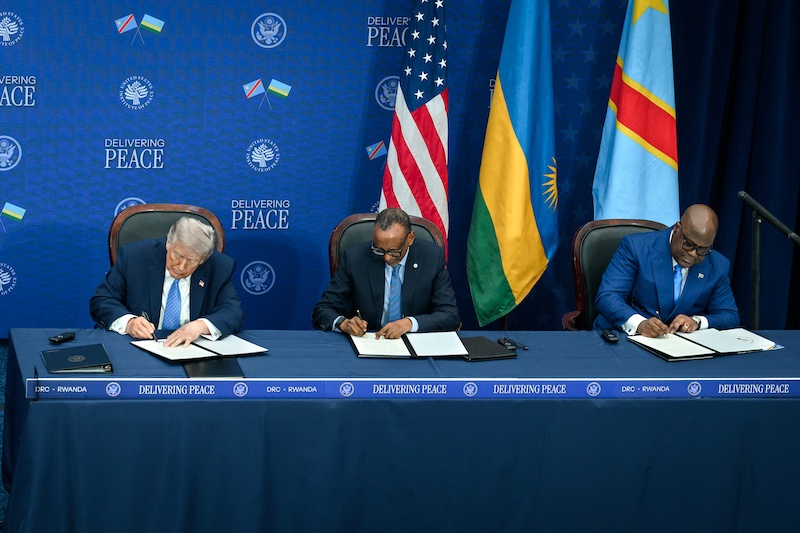
In a diplomatic milestone, the Democratic Republic of Congo (DRC) and Rwanda signed a peace agreement on June 27, 2025 in Washington, D.C., in a deal widely dubbed the “Washington Accord”.
Brokered by the United States, the accord aims to stem decades of conflict in eastern Congo and lay a foundation for security cooperation and economic integration. African leaders and international institutions have hailed it as a potential turning point for the Great Lakes region.
Yet optimism must be grounded in realism: without addressing deep structural challenges, the pact risks becoming another fragile ceasefire that fails to deliver lasting peace or equitable development.
AN AGREEMENT FRAMED BY HOPE
The accord’s architecture rests on two pillars: security commitments and economic cooperation. On security, Rwanda agreed to withdraw its troops from eastern DRC within 90 days and to cease backing non-state armed groups — a major grievance that has fueled violence for years.
Both states also committed to establishing a joint security mechanism to monitor compliance and oversee disarmament measures. On the economic front, the accord establishes a Regional Economic Integration Framework (REIF) designed to formalize mineral value chains, attract investment, and invest in cross-border infrastructure.
Leaders such as Kenyan president William Ruto have framed the agreement as not only a peace treaty but also as a foundation for regional economic transformation, enabled by initiatives under the African Continental Free Trade Area (AfCFTA).
This dual approach has drawn support from the United Nations and the International Contact Group for the Great Lakes, both emphasizing the accord’s potential to reduce hostilities and foster regional economic cooperation according to sources close the government of the Netherlands.
ROOT CAUSES, NOT JUST SYMPTOMS: THE STRUCTURAL DILEMMA
Yet beneath the ceremonial optimism lies a stark reality. Conflicts in eastern DRC are deeply rooted in governance weaknesses, fragmented local authority structures, and pervasive mistrust between communities and the state— conditions that any peace deal must confront or risk collapse.
Experts at Atlantic Council an American think tank warn that without significant reform, the accord could cement inequalities and sustain instability rather than resolve it. Fragile governance in the eastern DRC means weak institutional capacity to deliver justice, uphold contract transparency, or enforce agreements with armed actors.
These deficiencies not only erode public trust but also create fertile ground for armed groups like the M23 — notably not party to the Washington Accord — to continue violence and undermine peace efforts.
The legacy of Mobutu Sese Seko’s decay of state institutions continues to shape this context, with successive governments struggling to establish legitimacy and effective rule across the vast territory of the DRC. This historical backdrop reminds us that peace cannot be imposed from the outside; it must be grounded in strengthened local governance and societal reconciliation.
A central debate around the accord is its emphasis on mineral wealth as a driver of peace and prosperity. The Great Lakes region, especially eastern DRC, holds world-leading deposits of cobalt, copper, tantalum and other critical minerals essential to global technology and energy markets — resources that the United States and other global powers covet euro-news recently reported.
The accord’s economic agenda promises to formalize mineral supply chains and attract Western investment. Proponents argue this could deter illicit trade, boost local revenues, and generate jobs.
If coupled with formalized artisanal mining and improved governance reforms, it could help the DRC escape aspects of the “resource curse” — where natural wealth paradoxically fuels poverty, conflict, and corruption. But there is a critical caveat: investment centred on extraction alone will not deliver broad-based development.
Without parallel financing for infrastructure, human capital development, environmental protection, and meaningful community benefit- sharing, the benefits of mineral wealth will remain concentrated among elites and foreign companies. This dynamic replicates patterns that have historically fuelled local resentment and instability.

Further complicating the picture is China’s entrenched role in the DRC’s mining sector, with extensive joint ventures and processing links already shaping critical mineral supply chains.
Western efforts to insert new investment regimes through the accord may heighten geopolitical competition, with potential implications for policy coherence and state sovereignty.
INCLUSION AND LEGITIMACY: THE MISSING LINK?
Perhaps the most critical test of the accord’s durability is whether it engenders inclusive political processes.
Historically, peace processes that marginalize civil society or local communities — the very populations most affected by violence — lack legitimacy and sustainability. Analysts assert that excluding community voices from negotiation or implementation risks fueling resentment and undermining long-term stability.
One of the most consequential — yet least discussed — dimensions of the US-brokered Washington Accord between the Democratic Republic of the Congo (DRC) and Rwanda is the limited role of civil society and affected local communities in both the negotiation and anticipated implementation of the agreement.
Analysts and other policy institutions caution that this omission could prove fatal to the accord’s long- term credibility and effectiveness. The debate is not merely academic. It goes to the heart of why peace agreements in the Great Lakes region repeatedly struggle to move from paper to practice.
Exploring other peace attempts, experts have reached a safe argument over time, that, particularly in contexts like eastern DRC, where violence is hyper-localized and community-driven grievances are central to conflict dynamics.
In North Kivu, South Kivu, and Ituri, conflict is not experienced primarily as an interstate dispute between Kigali and Kinshasa. Instead, it manifests as: land disputes between communities, competition over artisanal mining sites, ethnic mistrust, and abuses by armed groups and state security forces alike.
From this perspective, a peace agreement that privileges state security concerns and mineral supply chains while sidelining civilian voices risks addressing symptoms rather than causes. It is, therefore, not a hastened conclusion of the “Washington Accord” to say, peace that is technocratic rather than socially grounded may reduce cross-border tensions but leave everyday insecurity intact.
WHY CIVIL SOCIETY MATTERS IN THE CONGOLESE CONTEXT
Civil society organizations (CSOs) in eastern DRC — including church networks, women’s associations, youth groups and customary leaders — have historically played critical roles in mediating local ceasefires, documenting human rights abuses, facilitating community reconciliation, and supporting reintegration of ex- combatants.
Excluding these actors sends a dangerous signal: that peace is an elite bargain rather than a social contract.
It is, therefore, wisdom, to know that communities that feel ignored may view the Washington Accord as another externally imposed arrangement, designed to secure minerals and geopolitical interests rather than justice and dignity for victims of violence.
A key concern raised in the debate is the risk of “spoilers” — armed groups, local power brokers, or disgruntled communities who actively undermine peace processes they perceive as illegitimate.
History offers sobering lessons:
• The 2002 Sun City Agreement ended Congo’s interstate war but failed to dismantle local militias.
• Subsequent deals neutralized elites while leaving community grievances unresolved.
• Armed groups often re-emerged under new names, exploiting local anger and exclusion.
The Washington Accord risks repeating this cycle if local populations see peace dividends flowing upward — to governments, foreign investors, and multinational corporations — while their own security, livelihoods, and land rights remain precarious. In such conditions, resentment becomes a recruitment tool for militias, not a foundation for peace.
STATE-CENTRIC PEACE VS. HUMAN SECURITY
Another dimension of the debate concerns how peace itself is defined. The Washington Accord largely reflects a state-centric security model: troop withdrawals, border stabilization, joint security mechanisms, protection of investment corridors.
While these are important, human security — freedom from fear, hunger, and exploitation — is what determines whether peace is real for ordinary people.
If civilians continue to face: predatory armed actors, abusive security forces, environmental destruction from mining and displacement without compensation, then peace will exist only in diplomatic communiqués, not in lived reality a cross section of local experts emphasized in my interviews for this article.
ECONOMIC PEACE WITHOUT SOCIAL JUSTICE?
The accord’s economic pillar — especially its emphasis on formalizing mineral extraction — has intensified concerns about exclusion Analysts caution that economic peace agreements that prioritize extraction over inclusion can deepen inequalities, particularly when: artisanal miners are displaced by industrial concessions, communities lack consultation or compensation, and environmental safeguards are weak or unenforced.
Without civil society oversight, transparency mechanisms risk becoming symbolic rather than effective. In the Congolese context, where public trust in institutions is already low, this could reinforce perceptions that peace is a cover for economic exploitation.
THE COUNTER-ARGUMENT: EFFICIENCY AND URGENCY
Supporters of the accord counter that inclusive negotiations are often slow, messy, and politically risky. Given the urgency of stopping violence and stabilizing borders, they argue that elite- level agreements are a necessary first step.
Some policymakers maintain that states must first stop fighting, security must precede participation, civil society inclusion can follow during implementation. Some practitioners acknowledge this logic but caution that post-agreement inclusion is rarely automatic.
Without formal guarantees, community participation often becomes an afterthought — underfunded, symbolic, and politically constrained.
A LESSON FROM HISTORY: MOBUTU’S LONG SHADOW
This debate must be understood against the deeper historical backdrop of the collapse of governance under Mobutu Sese Seko. Mobutu hollowed out state institutions, replaced citizenship with patronage, and disconnected power from accountability.
The result was a state that negotiated over its people, not with them — a pattern that continues to haunt peacebuilding efforts today. Against this backdrop the DR Congo Peace artchitects ought to bear in mind that peace agreements that replicate this top-down logic risk reproducing the very dynamics that generated conflict in the first place.
PEACE MUST BE PARTICIPATORY, OR IT WILL BE FRAGILE
The Washington Accord debate underscores a central truth: peace that excludes people is peace on borrowed time.
The Washington Accord offers a rare opportunity to reset regional relations and unlock economic potential in the Great Lakes. But its durability will depend not only on troop withdrawals or mineral frameworks — it will depend on whether Congolese communities see themselves reflected in the peace process.
For Uganda and the wider region, the lesson is clear: stability in the DRC cannot be engineered solely through diplomacy and investment. It must be rooted in legitimacy, inclusion, and social justice, or the cycle of conflict will inevitably resume — under new names, but driven by the same unresolved grievances.
This challenge is not merely procedural but existential: without grassroots support, disarmament, reintegration, and justice mechanisms are less likely to succeed, and peace dividends may fail to reach ordinary citizens.
HOPE ANCHORED IN REALISM
The Washington Accord is an undeniable diplomatic achievement with the potential to slow conflict, attract investment, and reset regional relations in the Great Lakes. Yet hope must be tempered with sober realism.
True peace requires more than signature ceremonies in Washington — it demands transformative reforms in governance, economic equality, and inclusive political participation.
For Ugandans and other East Africans, the stakes are high. A stable DRC promises enhanced regional security, expanded trade opportunities under the AfCFTA, and shared prosperity.
But if the systemic roots of conflict and poverty remain unaddressed, the accord risks becoming another chapter in the region’s long struggle with fragmentation, exclusion, and contested sovereignty.
As implementation unfolds, regional partners — including Uganda — must advocate for a peace that is both inclusive and equitable, ensuring that the promise of peace is matched by the reality of sustained development.
About the Author