NASA’s Artemis 2 mission has reached a critical phase as astronauts prepare to enter the Moon’s sphere of influence on a historic deep-space journey.
The four astronauts aboard NASA’s Artemis 2 mission have prepared to enter the Moon’s “sphere of influence”, after already capturing unprecedented views of the lunar surface never before seen by human eyes.
The crew received a ceremonial wake-up call from former astronaut, Charlie Duke, who walked on the Moon during the Apollo 16 mission in 1972.
Duke encouraged the astronauts, noting that people across the United States and the world were supporting them as they continue NASA’s Artemis programme, which builds on the legacy of the Apollo era.
Earlier, NASA released an image captured by the crew showing the Moon in the distance, with the Orientale basin clearly visible—a formation that has never before been observed directly by humans.
Mission officials said this moment marks the first time the entire basin has been seen with the human eye, even though it has been previously photographed by orbiting spacecraft.
The next major milestone is expected as the spacecraft moves into the Moon’s gravitational sphere of influence, where lunar gravity will begin to dominate over Earth’s pull.
NASA officials described the upcoming lunar flyby as a historic moment, marking the first crewed approach to the Moon in more than 50 years.
During the flyby, the astronauts will observe the Moon directly and carry out imaging tasks as the spacecraft passes around the far side.
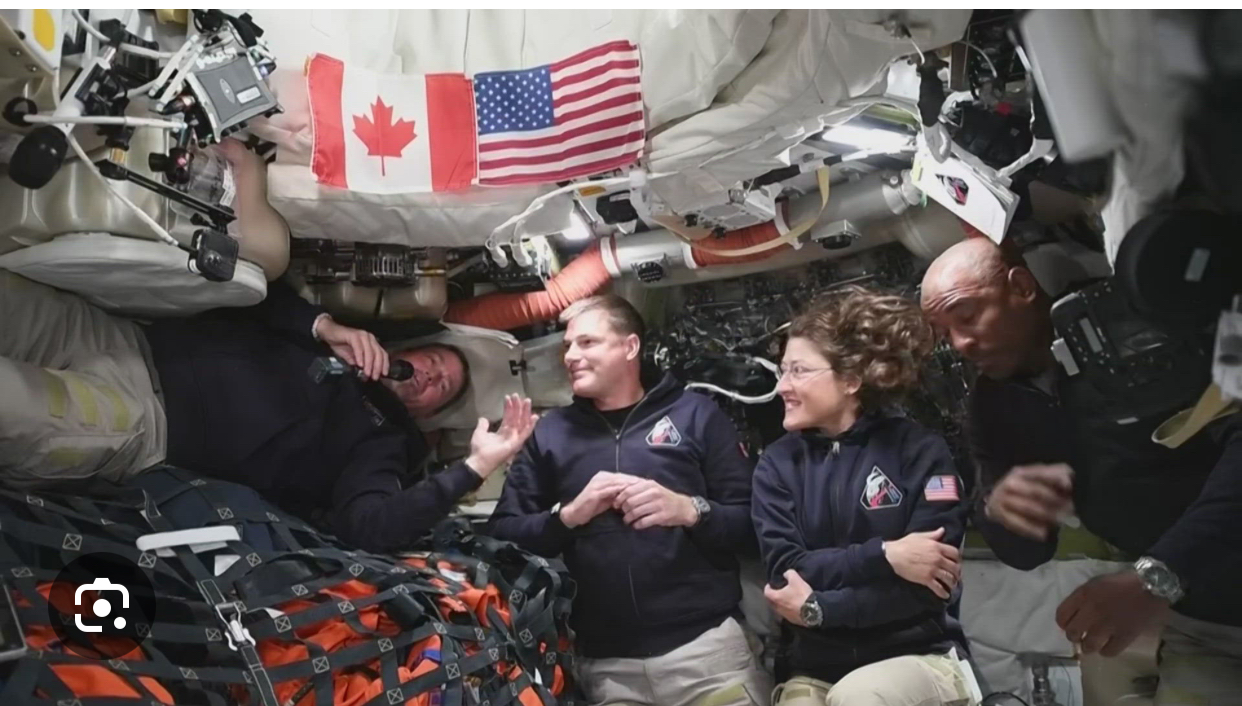
The crew; Christina Koch, Reid Wiseman, Victor Glover, and Canadian astronaut Jeremy Hansen, may also travel farther from Earth than any previous human spaceflight mission.
NASA said the astronauts have already completed manual piloting tests and reviewed their flyby procedures, including planned surface observations and photography tasks.
At the same time, engineers on the ground are closely monitoring the spacecraft’s life-support systems and overall performance.
Officials noted that this is the first time astronauts are operating aboard this specific spacecraft, making system data a key focus of the mission.
The crew also carried out testing of their bright orange survival suits, used during launch, re-entry, and emergency scenarios such as cabin depressurisation.
The exercises included suit pressurisation checks, mobility tests, and simulated procedures for eating and drinking while suited.
Although the mission does not include a lunar landing, it is expected to set a record for the farthest distance humans have travelled from Earth as the spacecraft swings around the Moon.
NASA said the coming hours will be critical as the Orion spacecraft completes its closest approach and gathers valuable data for future deep space missions.