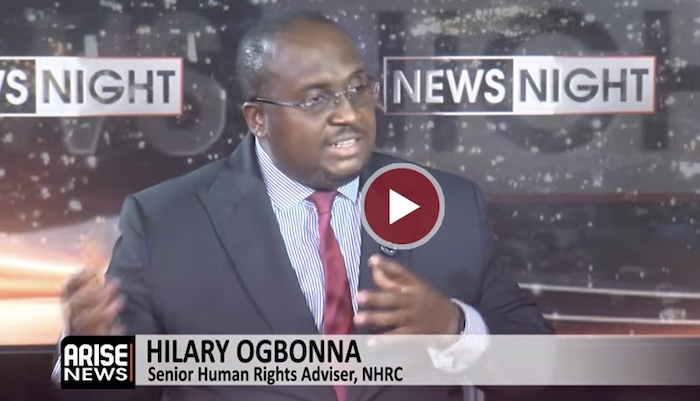

Senior Human Rights Adviser at the National Human Rights Commission, (NHRC), Hilary Ogbonna has said there has been a 5% rise in human rights violations recorded in the first quarter of 2026 compared to the same period in 2025.
He disclosed this while speaking in an interview with ARISE NEWS on Friday, where he discussed the commission’s recent records and the spike in rights violations in the first quarter of 2026.
“First is in comparison with the corresponding period in 2025. Because this is a similar quarter—first quarter versus first quarter. So what we saw within the first quarter of 2025 is lower than what we are having now, 5%.”
He added that the 650,000 cases recorded in the first quarter of 2026 are formal complaints received across the 36 states and the FCT, adding that the nature of human rights violations has changed significantly compared to previous years.
“Don’t forget that the 650,000 we are talking about are those who walked into our office in the 36 states and the Federal Capital Territory to lodge formal complaints. You just called 650,000—that’s the number—but what constitutes the 650,000 is how many women were abused, how many people were killed. So that constitutes the numbers. When you interrogate the components of the 650,000 that we have in 2026 and probably the 610,000 that we had in 2025 in the first quarter, you would see that the dynamism of the human rights violations within these two years has completely changed,” he explained.
Ogbonno explained that beyond the 650,000 formal complaints received, the NHRC also uses an observatory to track incidents like kidnappings and killings, including those not formally reported to the Commission, in order to support accountability.
“Those official 650,000 figures are formal complaints laid before us. Then there is the second aspect of the dashboard, which is our observatory. These are people who suffered kidnapping, people who were killed by non-state actors, including our esteemed armed forces members who were also killed within this period. Those ones don’t come to the Human Rights Commission to complain. But it is our duty to ensure that we report on those data, and for those places where people are supposed to be held accountable, it is our duty to ensure that they are held accountable, whether there was a formal complaint before us or not.”
The NHRC’s Senior Human Rights Adviser further explained that the NHRC’s approach to accountability depends on the severity of each case, noting that while some disputes can be resolved through mediation, serious violations are referred to the Attorney General for prosecution.
“We can bring in the offending party to the table to have a mediation kind of session, depending on the gravity of the crime. If it is a grave human rights violation, we don’t do that. We do two things: we package the report of our investigation to the Attorney General of the Federation or the Attorney General of the State for criminal prosecution,” Ogbonna explained.
Ogbonna maintained that the NHRC is actively pursuing accountability measures, noting that over 5,000 cases were concluded within the three-month period under review and that compensation will soon be paid to some victims.
“They are being taken every day. Today we reported, for instance, that within the three months under review, we concluded investigation in over 5,000 cases. And then in a few weeks’ time, we’ll be paying compensation to some victims of human rights violations. So we also pay compensations, depending on how large the violation is and how large we have quantified that violation and the monetary equivalent of the compensation. The ones we can’t pay, we definitely write to the government institution that is responsible for that violation.”
On cases of law enforcement misconduct, Ogbonna said they are treated as everyday human rights violations that are investigated by summoning the officers involved and subjecting them to the Commission’s process.
“Those ones we call the day-to-day human rights violations. They may not result in people being killed, but they leave permanent scars on the sensibilities of Nigerians. For those ones, we identify the police officer, we summon the police officer, and they go through our investigative process.
“At the conclusion of that investigation, a couple of actions are taken: recommendations for either prosecution—for instance, if it is torture, because torture is a crime—or if it is detention beyond the constitutional limit and we can trace this to the action of a particular police officer or officers. We then write to the Nigeria Police Force and the Police Service Commission to take the appropriate action based on our investigation,” he said.
On the proposed automated complaints portal by the NHRC, Ogbonna projected it will be a game-changer, allowing people to report human rights violations immediately, even from locations such as checkpoints, and significantly expanding access beyond state capitals to every part of the country.
“It would be a game-changer because even at a checkpoint, if your rights are being violated, the person you are driving with can actually lodge a complaint on the spot there. If you are alone, then you have to lodge the complaint after you leave the place.”
Adding, he explained that while the NHRC is currently based in state capitals, the system would expand access nationwide, potentially increasing the volume of reported cases significantly once fully operational.
“Right now, we are not in every local government; we are located in the state capitals. We are still making the efforts to go to local governments, but imagine with that portal—every local government, everywhere in Nigeria you are located, you should be able to reach us. We are even afraid that in 2025, we had almost 4 million—3.7 million—complaints; so imagine what will happen when that portal becomes operational. But really, this would be our gift to Nigeria,” he said.
Favour Odima