Screenshot

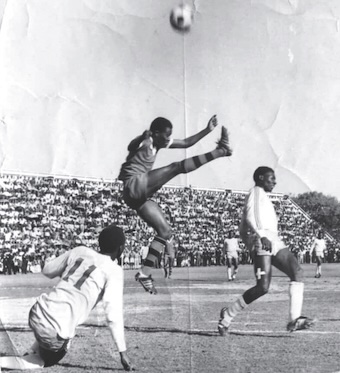
move during the 1975 Africa Cup of Nations qualifier game played at Nakivubo Stadium
Had Wednesday April 1, not been `Fools Day’, it would have gone by like any other day.
But it dawned on me that on that day, Nakivubo War Memorial Stadium (now Hamz Stadium) marked 100 years of existence. The facility is located in the heart of Kampala, in an area that was originally a swamp, before it was transformed into a place for major football, athletics, boxing, netball, motor-cross and weightlifting events.
This stadium was constructed on land donated by Ssekabaka Daudi Chwa II, the Kabaka of Buganda back in the 1920s. But the facility has evolved through different management teams since then; the latest being Kampala businessman Hamis Kiggundu who redeveloped it into a modern facility.
BACKGROUND OF NAKIVUBO
The story of how Nakivubo Stadium was constructed in a swamp is fascinating tale of intrigue and suspicion. When Nakivubo stadium was officially opened on Saturday, April 1, 1926, as a national sports centre, it was historical.
Apparently, the name Nakivubo emerged from a historical site in Malawi known as “Nakivumbo”. This is where a section of Ugandan soldiers camped during the second World War ll. However, the only down-turn was the fact that the actual stadium name was misspelled right from the word go, to Nakivubo instead of Nakivumbo.
This is an error that has never been corrected to this day. But before Nakivubo was constructed, there were three football pitches that were being used in the City: Shimon, Coronation Ground (now Old Kampala SS playground) and Wandegeya which is now Makerere University.
Because Nakivubo was located in a swamp, it was at a disadvantage here, especially during the rainy seasons. The grounds nearby, as mentioned above, were favoured ahead of Nakivubo.
For example, in November 1926, the Uganda Football Association Cup final match between Nsambya FC and Kings College Budo was switched to Wandegeya. The inaugural Gossage Cup (Cecafa) which had been scheduled to take place in 1926 at the newly built Nakivubo Stadium, was relocated to Nairobi, Kenya for the same reasons.
Yet, this would have provided Ugandans a chance to see their first ever national team in action in their own backyard. It was not easy for the contractors to make Nakivubo a tenable sports ground.
But they finally succeeded, surrounding it with reeds and bamboo, which in this case, worked as a wall fence. Notably, the construction work was engineered and managed by the Public Works Department (PWD) at the time. It was placed in the hands of a trustee committee.
INAUGURATION OF NAKIVUBO STADIUM
To mark the opening of the facility, was marked by the historical football match between the Uganda Cranes and the star- studded Uganda Kobs, which had been formed in 1921.
The Kobs side was purely dominated by the British living in Uganda: clad in a brown, black and white jersey. While the Uganda Kobs players wore football boots, Uganda Cranes players played barefooted.
The Cranes was selected from three clubs: Kings College Budo, Old Budonians, Mengo Old Boys, and Makerere College. The Kobs defeated the Cranes 2-1. This game was followed by the first Kabaka Cup final game played on November 8, 1927 between Mengo Central School and Makerere College.
This match attracted a non-paying crowd of 7000 spectators. Mengo Central School won by 4-3. But in 1928, Uganda hosted the Gossage Cup for the first time in Nakivubo, beating Kenya 4-0 in the final.
Four years later, on December 14, 1932, Uganda made history at Nakivubo Stadium, when they walloped Kenya 12-1 in the Gossage Cup final. This is marked out as Uganda’s biggest scoreline victory in international football.
But on November 29, 1941, Kenya defeated Uganda 4-1 at Nakivubo stadium for the first and only time, in the Gossage Cup. Some of the notable names on that Cranes team included: Samuel Mutiimba, Mohammad Kalaba, Paul Kabega, Gerald Inyalio (captain), Y. Nganda and Livingstone Nkwanga.
THE MILESTONE
As a major milestone, the stadium was rebranded in 1937 when a pavilion (for VIPs) and a balcony in form of a rostrum (a raised platform for public speaking and awards giving) were put in place.
The first teams to play in the refurbished venue was Old Timers Nsambya FC and Makerere College. The two sides contested in the final of the Kabaka Cup in August 1937. Nsambya defeated Makerere College 3-2. By 1953, a Trust Act to safeguard, protect, and develop Nakivubo stadium came into place.
This established a board of trustees under which the stadium is run: In honour of Uganda’s World War ii veterans, too!
To be continued next week!