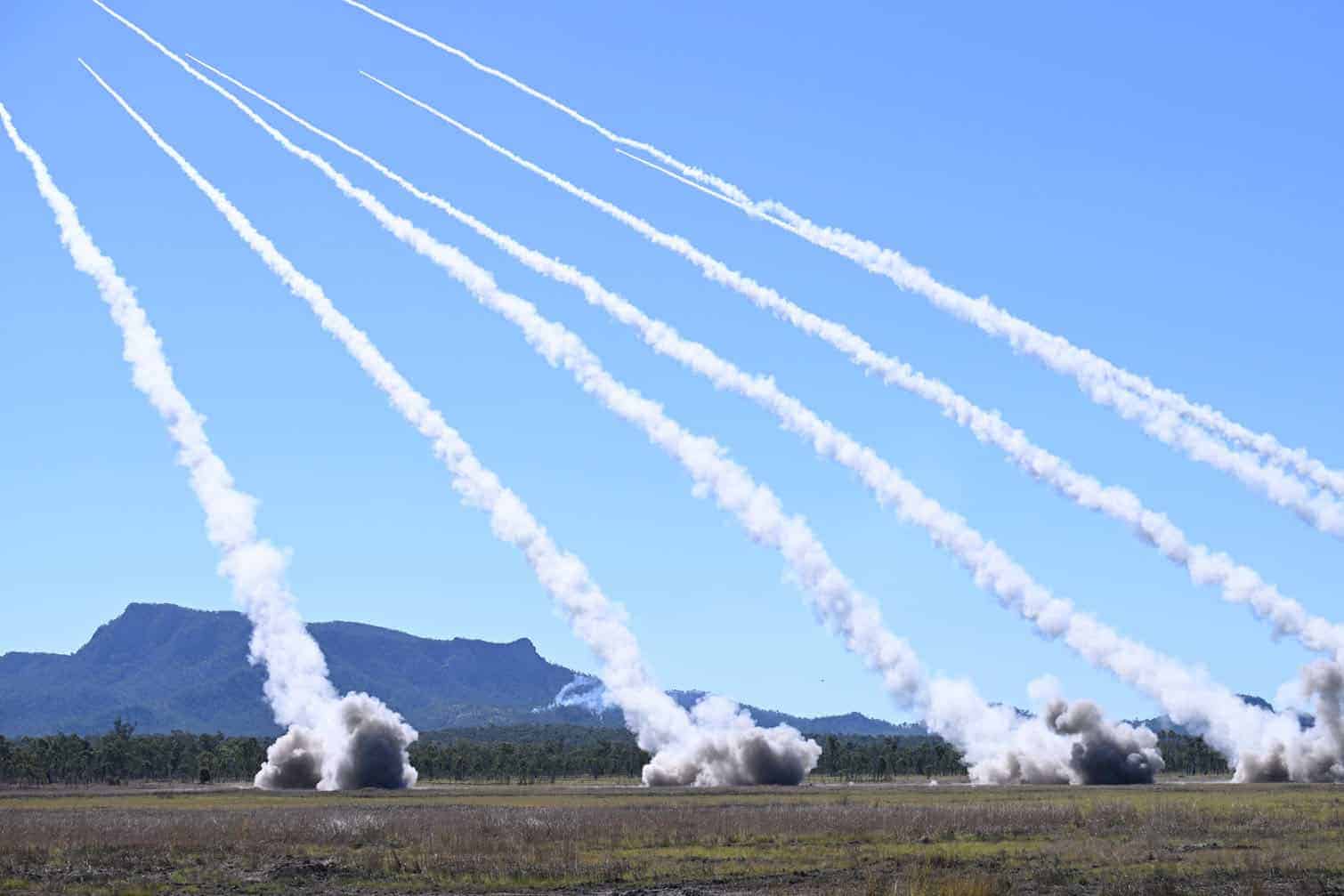
epaselect epa12236761 Australian and US HIMARS rockets are launched during the firepower demonstration as part of the Talisman Sabre 2025 joint military exercise at the Shoalwater Bay Training Area near Rockhampton, Australia, 14 July 2025. Exercise Talisman Sabre is the largest bilaterally planned, multilaterally conducted training activity between the Australian Defence Force, the United States military, and participating partner and observing nations. EPA/DEAN LEWINS AUSTRALIA AND NEW ZEALAND OUT
South Africa still exports billions in military weaponry, but concerns have been raised about whether they are falling into the wrong hands.
The joint standing committee on defence on Friday heard how much South Africa was generating from munitions contracts, as well as which regions around the world were the largest buyers.
The committee was again frustrated by the absence of Defence Minister Angie Motshekga, but Minister in the Presidency Khumbudzo Ntshavheni was on hand to answer pressing questions.
SA’s weapons export markets
Key information on sales and destinations was shared by the Directorate of Conventional Arms Control (DCAC).
The directorate stated that 187 permits or authorisations of use had been issued in 2024, with that figure rising to 197 in 2025.
Over those two years, weapons contracting permits through DCAC, Denel and Rheinmetall Denel Munition were valued at R110 billion.
The contracts include equipment, spares, weapons, and ammunition, with exported munitions valued at R4.6 billion over the two-year period.
Europe was the primary destination for exports, taking in 63% of all munitions and 77% of dual-use goods and technologies.
For munitions, the Americas received 2%, the Middle East 12% and Africa 11%.
On the dual-use and technology front, the Middle East received 5%, the Americas received 13%, and Africa received less than 1%.
‘Diplomatic implications’
Committee members questioned why the figures were broken down by geographic area and why the committee did not specify which country purchased the most.
Ntshavheni and DCAC were also asked if there were countries South Africa was not allowed to transact with.
The minister confirmed that such lists did exist and were curated with the assistance of the Department of International Relations and Cooperation and the State Security Agency.
Ntshavheni said she would submit the lists and details, but requested that it be submitted in writing outside of the committee.
‘There are countries that if we mention, because your meetings are open, that they will create a diplomatic problem for ourselves.
“In our own meetings, we deal with those openly because our meetings are closed meetings. If we are guaranteed that the reports will not be released, we can share with the committee the details of the countries which we are not allowed to trade with.
“We will need that assurance from the committee as it has diplomatic implications,” said Nthsavheni.
The minister was also asked whether South Africa sent inspectors to track exported munitions, and replied that the country did not send inspectors to war zones but relied on the United Nations to relay its reports.
Responsibility not to transact
Nthshavheni elaborated on South Africa’s responsibilities not to transact with nations engaged in warfare.
She explained that there were countries, specifically those at war, that were able to transfer weapons and munitions to war zones and had a history of violating export applications, which were avoided.
As part of the contracting permits, countries purchasing from South Africa were required to ask the seller’s permission for a third party to use the munitions.
“In terms of our requirements and the standard, when and if we approve and export of our – whether it’s munitions or weapons to your country – by law, and this is an international convention, you need to reapply to ourselves,” confirmed Ntshavheni.
The minister said if they had received such applications, they would have been denied.
Ukraine, Israel and Sudan
Committee members had a particular interest in Ukraine, Israel and Sudan, with the latter being subject to alleged involvement by the United Arab Emirates (UAE).
Ntshavheni confirmed South Africa had done business with the UAE and companies linked to the UAE, and through South Africa’s role in the African Union, it was monitoring the situation.
Rheinmetall Denel Munition is majority-owned by the German weapons manufacturer, but Denel has not used its 49% share to prevent the company from exporting to active combatants.
Nthsavheni noted that the German government had supplied weapons to Ukraine, but that Rheinmetall Denel was obliged to notify Denel where weapons were being sent.
“Specific to Rheinmetall Denel, we have not had an application for onward exportation to countries that are in conflict.
“We have not received any applications from Rheinmetall for onward exportation to Ukraine; similarly, we have not received those applications to Israel,” confirmed Ntshavheni.
NOW READ: Dirco reaffirms support for Iran, urges committee to ‘echo these sentiments’
About the Author