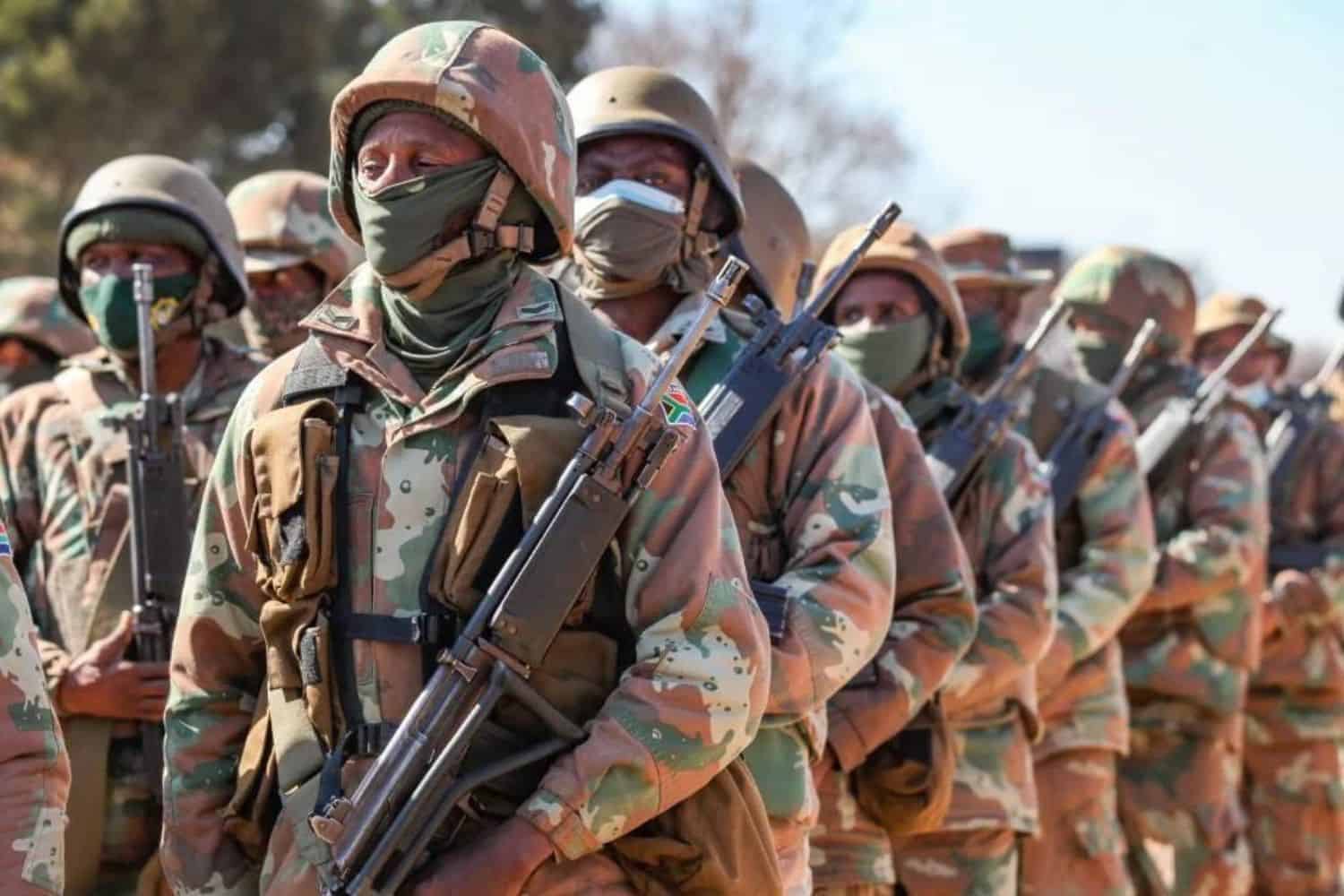
The window for the deployment of the South African National Defence Force (SANDF) is open and will not close until next year.
Officials from the South African Police Service (Saps) on Wednesday provided a joint parliamentary committee with a plan to crack down on organised crime, gangsterism and illegal mining across the country.
President Cyril Ramaphosa recently announced the deployment of the SANDF to crime hotspots in Gauteng, North West and the Western Cape, with the Eastern Cape later added to the list.
Saps ran the committee through the operational hierarchy and objectives of the deployment, which has been given a mandate to run from 1 March 2026 to 31 March 2027.
SANDF trained on civilian interaction
Major General Mark Hankel stated that the SANDF’s deployment was covered under section 201(2)(a) of the constitution and section 19(3)(c)(ii) of the Defence Act.
The primary objectives will be crime reduction, the arrest of offenders, and the recovery of firearms, explosives, narcotics and the “tools of trade”.
Ground forces will be commanded by a mission area joint operational centre and a tactical joint operational centre, which will be overseen nationally by the joint operational and intelligence structures.
Pre-deployment training will include joint exercises in which SANDF personnel will be trained on police force protocols and escalation procedures.
“Strategic guidelines have been developed in relation to rules of engagement and compliance to basic human rights and operational conduct of the deployed combined forces,” stated Hankel.
The statutory guidelines will cover strategic directions to commanders, clarification of roles and the proportionate compliance with the deployment’s constitutionality.
“Cognisance should be taken that although these guidelines may be construed as orders, a value judgement, based on appropriate training, is required in its application.”
Saps to handle detainment
Local teams will report weekly and quarterly to the national commanders, who will relay detailed reports to the government.
National Police Commissioner General Fannie Masemola said the SANDF deployment will run simultaneously with a revised policing strategy.
Masemola said Saps would be implementing a national organised crime model from 1 April.
“We will have dedicated teams dealing with specific crimes; small teams dealing with specific crimes such as carjacking, extortion, cross- border vehicle crime and drugs.
“The employment of the SANDF is to stabilise the areas while the rest of the teams will be dealing with the organised crime, with a view to dismantling those syndicates,” said the general.
Arrests will be conducted in terms of the Criminal Procedure Act, with any SANDF members effecting an arrest being required to hand suspects to Saps.
Police and SANDF will be prohibited from any discrimination, degrading, inhumane or cruel behaviour, or any arbitrary arrest or detention.
“The member who effects the arrest is legally expected to depose an arrest statement,” confirmed Hankel.
Further ‘transparency’ needed
The EFF’s Leigh-Ann Mathys began the question session with a blunt assessment, but welcomed the coming interventions.
“It is a sad moment for us that we have succumbed to the fact that Saps has failed and the fact that we have to bring in the SANDF. It is not a day we should be celebrating. Nonetheless, we are hopeful,” said Mathys.
Committee members Lisa-Marie Schickerling and Dereleen James asked if additional investigative resources would be invested in, as well as what recourse aggrieved citizens would have against poor soldier or police behaviour.
Masemola was non-committal on the issues, saying budget resources and existing complaint mechanisms would determine these outcomes.
The meeting was chaired by the DA’s Ian Cameron, who said the committee supported decisive action on the targeted crimes, but stressed the need for clear oversight.
“There must be transparency around Criminal Assets Recovery Account funding allocations, clarity on whether this deployment will truly be intelligence-led and prosecution-driven, and clear performance indicators to measure success, not just arrest numbers,” Cameron told The Citizen.
“We also need answers on whether Saps has the forensic and investigative capacity to handle the likely influx of evidence generated by these operations.
“Without proper investigative follow-through and prosecution, a military deployment risks becoming a temporary show of force rather than a lasting disruption of organised crime networks,” he concluded.
NOW READ: Will Ramaphosa’s decision degrade soldier morale? Professor explains why it could
About the Author