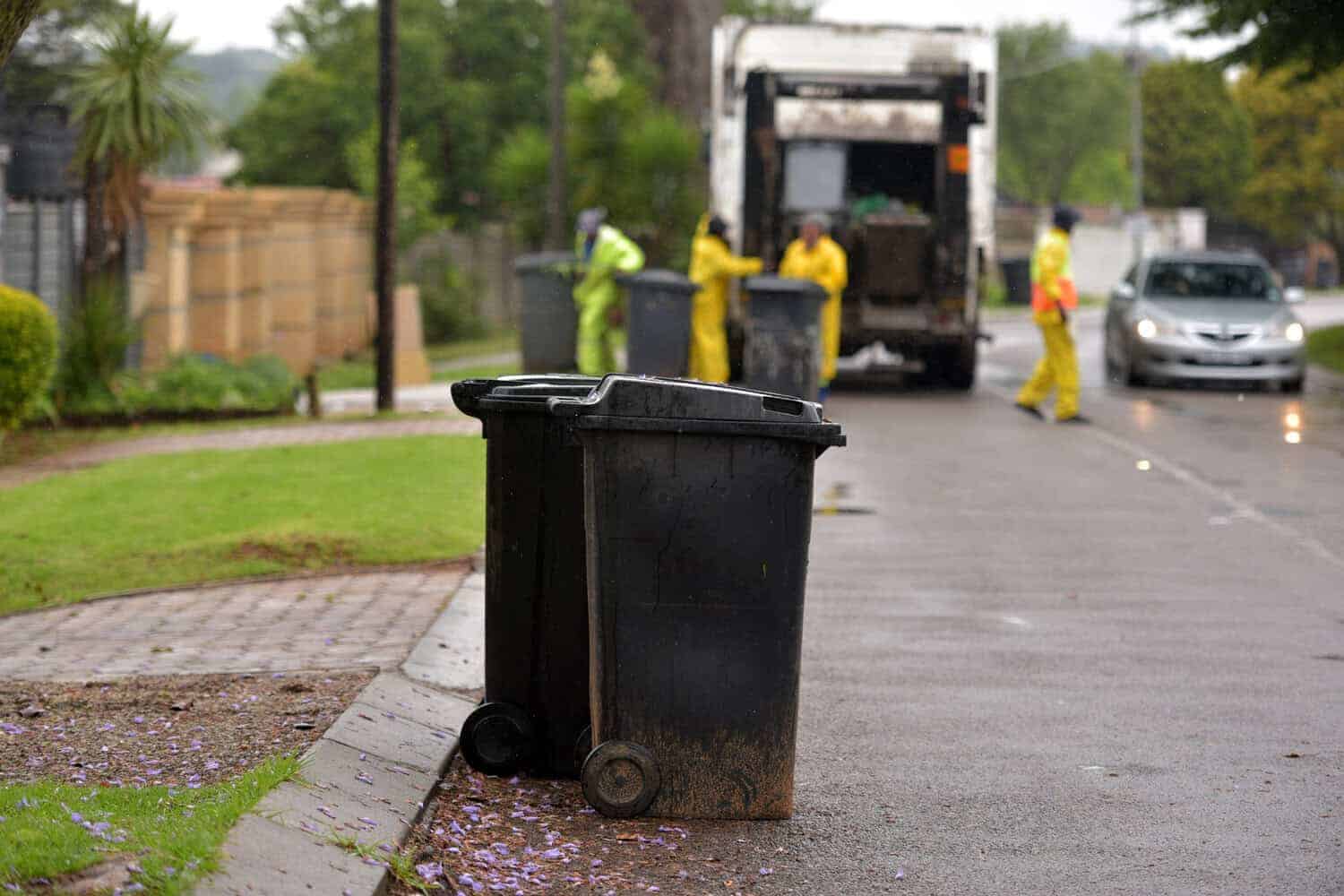
PIKITUP workers collect dustbins at the corner of Florin Rd, Roodepoort, 7 November 2022, as some areas have gone days as their rubbish bins were not collected.Picture: Nigel Sibanda
Johannesburg’s waste management capacity is near overflowing and doubts exist that disposal can keep pace with refuse accumulation.
The city’s waste management entity, Pikitup, is still lagging behind its collection schedule and one of the reasons for the backlog has no immediate resolution.
Of Johannesburg’s four landfills, only two are accepting new loads as the others have reached the limits of their ability to safely store trash.
As of last month, only Goudkoppies and Robinson Deep landfills were operational, with Marie Louise and Ennerdale landfills accepting builders waste at best.
Robinson Deep is located in Turffontein and Goudkoppies is in Klipspruit, leaving trash trucks from Midrand and the northern suburbs needing to travel up to 40km to be dumped.
‘Clear visibility’ of landfill issue
The city has been aware of the capacity deadlines for some time, having previously noted Ennerdale and Marie Louise’s capacities would be reached in late 2025.
Goudkoppies was previously given until March 2026, with Robinson Deep scheduled to reach capacity in June this year.
AfriForum last year warned that Gauteng could wholly run out of landfill space around the end of the decade, detailing its research in a report released last month titled Gauteng’s landfill time bomb.
“The metro had clear visibility of the remaining lifespan of its landfill sites. When that information was presented to parliament last year, it should have prompted urgent action.
“Instead, refuse collection is now disrupted because disposal capacity has not kept pace. This is not a sudden emergency, but the result of years of management failure,” stated AfriForum advisor for environmental affairs Marais de vaal.
National government assistance needed
Pikitup this week detailed its plans for Johannesburg’s landfills in a response to questions sent by The Citizen.
Challenges facing the city in creating new landfill space include budgetary limitations and the approval of environmental licences from the department of forestry, fisheries and environment (DFFE).
“Authorities are no longer eager to issue new landfill licences on the new virgin land, making it very difficult to establish new landfill sites in the city or the province,” Pikitup spokesperson Anthony Selepe told The Citizen.
In terms of new projects, a regional facility located in the north of Johannesburg is on the cards thanks to funding by the British government.
Dates and timelines were unavailable as feasibility studies were yet to be completed, but the site would be shared by the Johannesburg, Tshwane and Ekurhuleni municipalities.
This project is being led by the provincial government and the DFFE, with Selepe stressing the need for multi-department cooperation.
“Provincial and national government departments are required to support the city with regard to the design applications for the new cell for disposal, as well as to improve turnaround time on the approvals of the new designs.
“Also needed is policy and funding support for implementation of capital infrastructure projects to create new landfill cells and increase the capacity of landfills in Johannesburg,” Selepe said.
Asked whether waste could be sent outside of the province, Selepe reiterated the budgetary and operational limitations.
“Logistically, it would be very expensive because trucks will have to travel long distances to dispose. However, if the means of transport were rail, it may be viable,” he said.
In the more immediate future, Selepe said private sites were being utilised and negotiations were underway with neighbouring municipalities to use their site.
Pikitup capacity extension plans
Pikitup disclosed its plans for three of its four landfill sites, excluding Goudkoppies.
At Ennerdale, Johannesburg Development Agency is busy with the appointment of an implementing agent to help relocate buildings on the site to streamline its layout and create more space.
The acquisition of adjacent land is complete and will also house a new cell and the development of a sorting facility to promote recycling.
Marie Louise landfill’s capacity will be extended by two years via the repurposing of an old pond on site, with the procurement of adjacent land at the feasibility study phase.
“If suitable and procured”, Pikitup state the new cell had the potential to add 12 years to the landfill’s operating lifespan, while a transfer station is being developed to “mitigate disposal pressure”.
At Robinson Deep, the plan is to build new cells, which are set for the commencement of construction in the 2026-27 financial year.
“Designs for the first cell were submitted to the department of water and sanitation for approval and are awaiting a record of the decision. Together, the two new cells are estimated to give us about 20 more years of disposal,” said Selepe.
Additionally, a biodigester project to convert organic waste and an incinerator project to convert 500 000 tons of waste to energy are also planned for Robinson Deep.
However, the piloting of the biodigester is planned for later in this financial year, while the incinerator will only be functional by 2030.