Minister of Finance Enoch Godongwana has said that raising certain taxes is “unavoidable”.
One of those inevitable taxes is excise duties on alcohol and smoking products, although the increase is lower than some of the more alarmist predictions.
Godongwana delivered his budget speech in Cape Town on Wednesday afternoon, basing his determinations on the belief the economy would grow 1.6% in the coming financial year.
Increase in alcohol and cigarettes
As of 1 April, all forms of liquor will receive a 3.39% increase in excise duty, well short of the possible 6% some had feared.
This will result in a 340ml can of beer or cider costing at least 8c more, while the tax on a bottle of wine will increase by 15c.
For lovers of whisky, rum, vodka and similar spirits, a 750ml bottle will be taxed an extra R3.20.
An earlier report by the National Treasury showed South Africans consumed roughly 200 million bottles of spirits in 2022.
Based on Godongwana’s increase, the National Treasury could rake in an extra R640 million in tax on spirits.
Cigarette and other smoking products will also increase in line with inflation.
“This includes excise duty on electronic nicotine and non-nicotine delivery systems,” said Godongwana.
The tax on a box of 20 cigarettes will increase from R22.81 to R23.58, while cigarette tobacco tax increases by 87 cents per 50 grams.
Tax on cigars will increase by R4.56 per 23 grams, as will pipe tobacco by 28 cents per 25 grams.
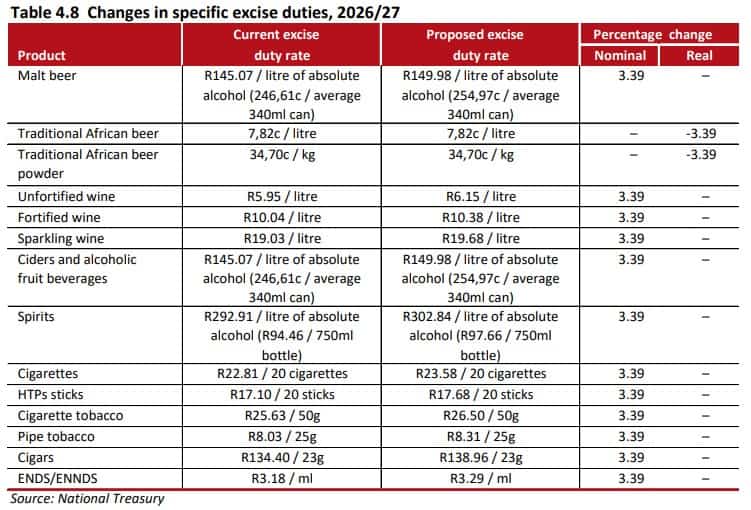
Excise duties on alcohol and cigarette products. Picture: National Treasury
Industry response
National Liquor Traders Convenor Lucky Ntimane said the increase represented “a balanced and pragmatic” stance that would ease the burden on licensed traders.
“This move demonstrates the importance of constructive engagement between government and stakeholders.
“We commend the National Treasury for its willingness to listen to industry concerns and to consider evidence-based submissions aimed at protecting jobs, sustaining township economies and preserving the integrity of the regulated alcohol value chain” Ntimane said.
He said the limited increase was a positive step in combatting the illicit trade “by restoring predictability and moderation” to the industry plagued by counterfeit products.
Ntimane said that licensed traders were not the enemy of public health, but an important part of an industry that was a strong contributor to employment and tax revenue.
“Today’s announcement signals that government is prepared to take decisions that balance revenue generation with economic sustainability,” he said.
NOW READ: SA drinks 4.5 billion litres of alcoholic beverages a year, Treasury to cash in
About the Author