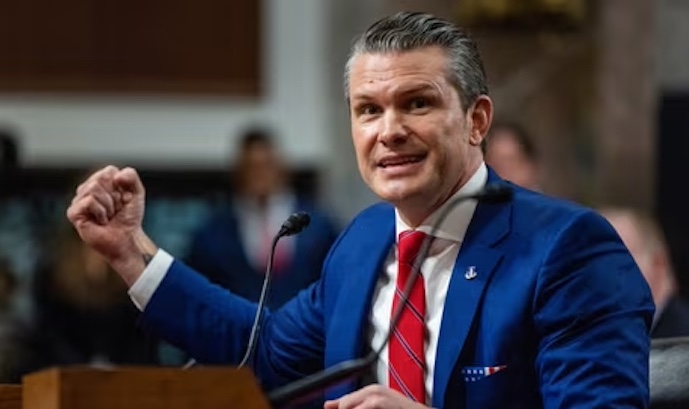
US Defence Secretary Pete Hegseth has dismissed claims that American officials underestimated the potential impact of the ongoing conflict with Iran on the Strait of Hormuz, describing such assertions as “patently ridiculous.”
Hegseth made the remarks while responding to reports suggesting that US officials had failed to adequately consider the possibility of Iran disrupting shipping in the strategic waterway.
“Of course, for decades, Iran has threatened shipping in the Strait of Hormuz,” Hegseth told reporters.
“This is always what they do—hold the Strait hostage. CNN doesn’t think we thought of that. It’s a fundamentally unserious report,” he said.
According to the defence secretary, the possibility of Iran attempting to block or disrupt traffic through the Strait has long been factored into U.S. military planning.
The Pentagon, he said, has maintained and continually updated contingency plans to address potential Iranian military actions in the vital maritime corridor.
The Strait of Hormuz is considered one of the world’s most critical energy transit routes, carrying a significant portion of global oil and liquefied natural gas shipments.
Multiple current and former U.S. officials told CNN that plans for any military action involving Iran typically account for the possibility of Tehran attempting to close the waterway.
However, officials said that during periods when global oil and LNG supplies were relatively stable, the broader risks to global markets were not always viewed as an immediate concern.
At the time, U.S. oil production had reached record highs, while Washington was also exploring expanded energy supply opportunities from countries such as Venezuela.
These developments, officials suggested, contributed to a perception that global energy markets had sufficient buffers against potential disruptions.
Nevertheless, analysts note that any prolonged closure of the Strait could significantly affect global energy markets due to the large volume of oil and gas shipments passing through the route daily.
The latest remarks by Hegseth come amid heightened tensions in the Middle East, where military confrontations and geopolitical rivalries have raised concerns about the security of global energy supply routes.
About the Author