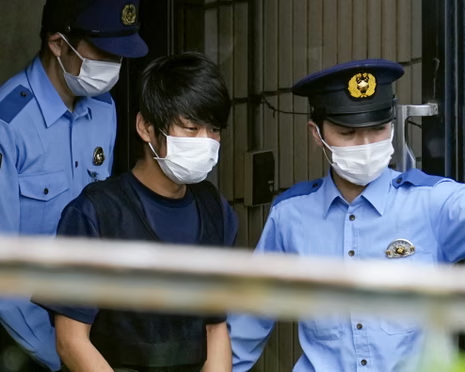
The man who assassinated Japan’s former prime minister Shinzo Abe has been sentenced to life imprisonment, with a judge describing the killing as “despicable and extremely malicious.”
Tetsuya Yamagami, 45, was found guilty by a court in the western city of Nara for the July 2022 shooting that stunned a nation largely unaccustomed to gun violence.
Abe, Japan’s longest-serving prime minister, was fatally shot from behind while delivering a campaign speech in broad daylight using a homemade firearm.
Handing down the verdict, Judge Shinichi Tanaka said Yamagami was “determined” to kill Abe and emphasized the calculated nature of the attack. Shooting the former leader “from behind when he was least expecting it,” the judge said, underscored the cruelty and malice of the act.
Public interest in the case was intense. On Wednesday morning, long queues formed outside the courthouse as people waited for tickets to observe the sentencing. Inside, Yamagami showed little emotion, keeping his head lowered as the life sentence was read for charges including murder and violations of Japan’s firearms control laws.
Yamagami had admitted to killing Abe at the opening of the trial in October. His defense team said they had not yet decided whether to appeal, noting that Japan’s legal system allows two weeks to file an appeal.
Prosecutors argued that the killing was driven by Yamagami’s desire to draw attention to and discredit the Unification Church, a controversial religious group founded in South Korea in 1954. The trial revealed how Yamagami’s mother’s extensive donations to the church — totaling roughly 100 million yen (about $1 million at the time) — bankrupted the family and deeply shaped his resentment toward the organization.
According to prosecutors, Yamagami believed that influential politicians had helped the church flourish. Abe had previously appeared at events organized by groups affiliated with the church, a fact that made him a symbolic target in Yamagami’s eyes.
Judge Tanaka acknowledged that Yamagami’s upbringing and family circumstances played a role in shaping his mindset, stating that they “undeniably influenced the formation of his personality.” However, he stressed that each criminal act was the result of Yamagami’s own decisions and “deserves strong condemnation.”
Members of the public expressed mixed reactions. Katsuya Nakatani, 60, who attended the sentencing, said the ruling convinced him that “even if there were extenuating circumstances, opening fire in a crowd is something that cannot be forgiven.” He added grimly that it was “almost a stroke of luck that only one person died.” Outside the courthouse, another man held a banner urging the judge to take Yamagami’s difficult life circumstances fully into account.
The defense portrayed Yamagami as a victim of “religious abuse,” describing a childhood marred by tragedy. After the suicide of his father and the serious illness of his brother — who later also died by suicide — his mother turned obsessively to the church in desperation, donating all her assets in the hope of saving her family. Yamagami was forced to abandon plans for higher education and, in 2005, attempted suicide himself.
Investigators revealed that Yamagami began secretly manufacturing a firearm in 2020, conducting test fires in remote mountainous areas — evidence, prosecutors said, of the highly premeditated nature of the assassination.
Abe’s killing sent shockwaves through Japan and triggered widespread scrutiny of political ties to the Unification Church. Subsequent investigations uncovered close relationships between the church and conservative lawmakers in the ruling Liberal Democratic Party, leading to the resignation of four cabinet ministers.
The assassination also exposed vulnerabilities in Japan’s security apparatus. Gun violence is so rare that officers at the scene reportedly failed to immediately recognize the sound of gunfire, delaying Abe’s rescue.
Prosecutors called the murder “unprecedented in Japan’s post-war history” and cited its profound social impact in seeking a life sentence. While Japan’s life imprisonment technically allows for parole, experts note that many inmates sentenced to life ultimately die behind bars.
About the Author