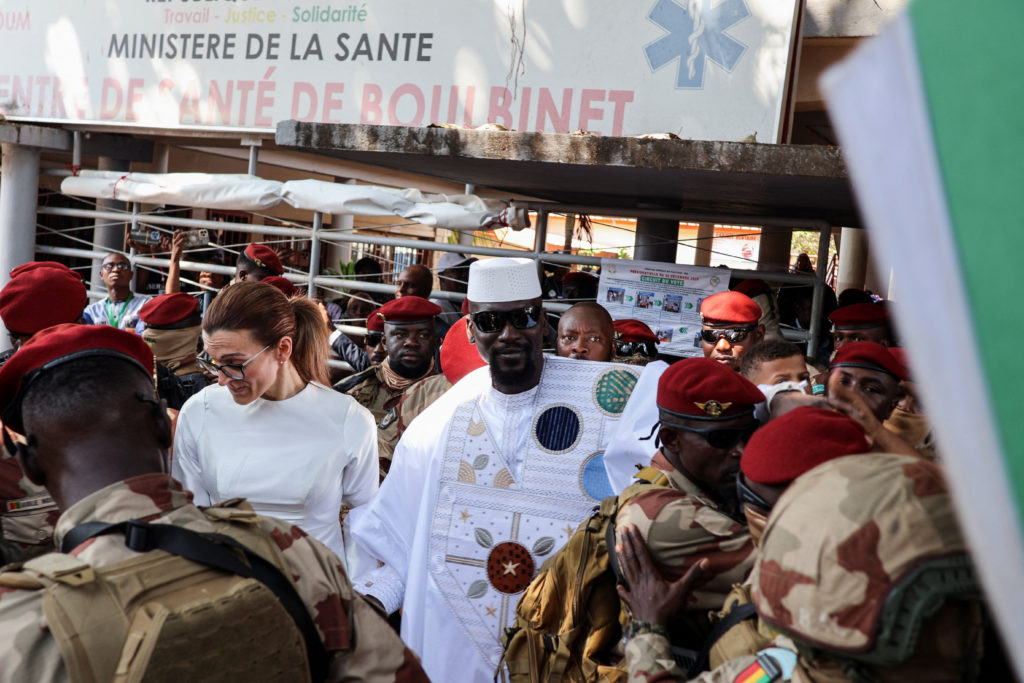
Guinean leader Mamadi Doumbouya arrives with his wife, Lauriane Darboux Doumbouya, to cast his vote during the presidential election at a polling station in Conakry, Guinea, December 28, 2025. REUTERS/ Souleymane Camar
Guinea’s military leader, General Mamady Doumbouya, appears to be heading for victory in the country’s presidential election, according to partial results released late Monday, despite earlier pledges not to seek elected office after seizing power four years ago.
Doumbouya, 41, who came to power in a September 2021 coup that ousted Guinea’s first democratically elected president, Alpha Condé, is reported to be leading by a wide margin against eight other candidates. Most prominent opposition figures were barred from contesting the poll and had urged voters to boycott the election.
Official preliminary results announced on RTG public television by Djenabou Touré, head of the General Directorate of Elections, showed Doumbouya securing more than 80 percent of the vote in several districts of the capital, Conakry. He also posted strong leads in nearby Coyah, as well as in Boffa and Fria in the west, Gaoual in the northwest, Koundara and Labé in the north, and Nzérékoré in the southeast.
Election authorities put voter turnout at 85 percent, a figure immediately disputed by opposition groups and civil society organisations.
“A huge majority of Guineans chose to boycott this electoral charade,” the National Front for the Defence of the Constitution said in a statement, questioning the credibility of the process and the official turnout figures.
Doumbouya’s candidacy marked a clear reversal of his earlier commitment to restore civilian rule by the end of 2024 and not contest elections. That pledge was effectively abandoned following the adoption of a new constitution in a referendum held in late September.
The revised constitution allows members of the ruling junta to run for office and extends presidential terms from five to seven years, renewable once—changes that paved the way for Doumbouya’s entry into the race.
The election has been marred by allegations of malpractice. Presidential candidate Abdoulaye Yero Baldé accused authorities of “serious irregularities,” including the exclusion of his representatives from vote-counting centres and alleged ballot stuffing in some areas.
Another contender, Faya Millimono, denounced what he described as “electoral banditry,” claiming that voters were subjected to undue influence.
Since taking power, Doumbouya’s government has faced criticism for curbing civil liberties, banning protests, and arresting or prosecuting political opponents, many of whom have fled into exile.
Among those barred from the election was Cellou Dalein Diallo, a former prime minister and prominent opposition leader, who was excluded under the new constitution because he resides outside Guinea. Also disqualified were former president Alpha Condé and former prime minister Sidya Touré, both living in exile and deemed ineligible for exceeding the maximum age limit of 80 years.
The final outcome of the election is expected to shape Guinea’s political future and determine whether the country’s long-promised return to civilian rule will materialise or remain elusive.
About the Author