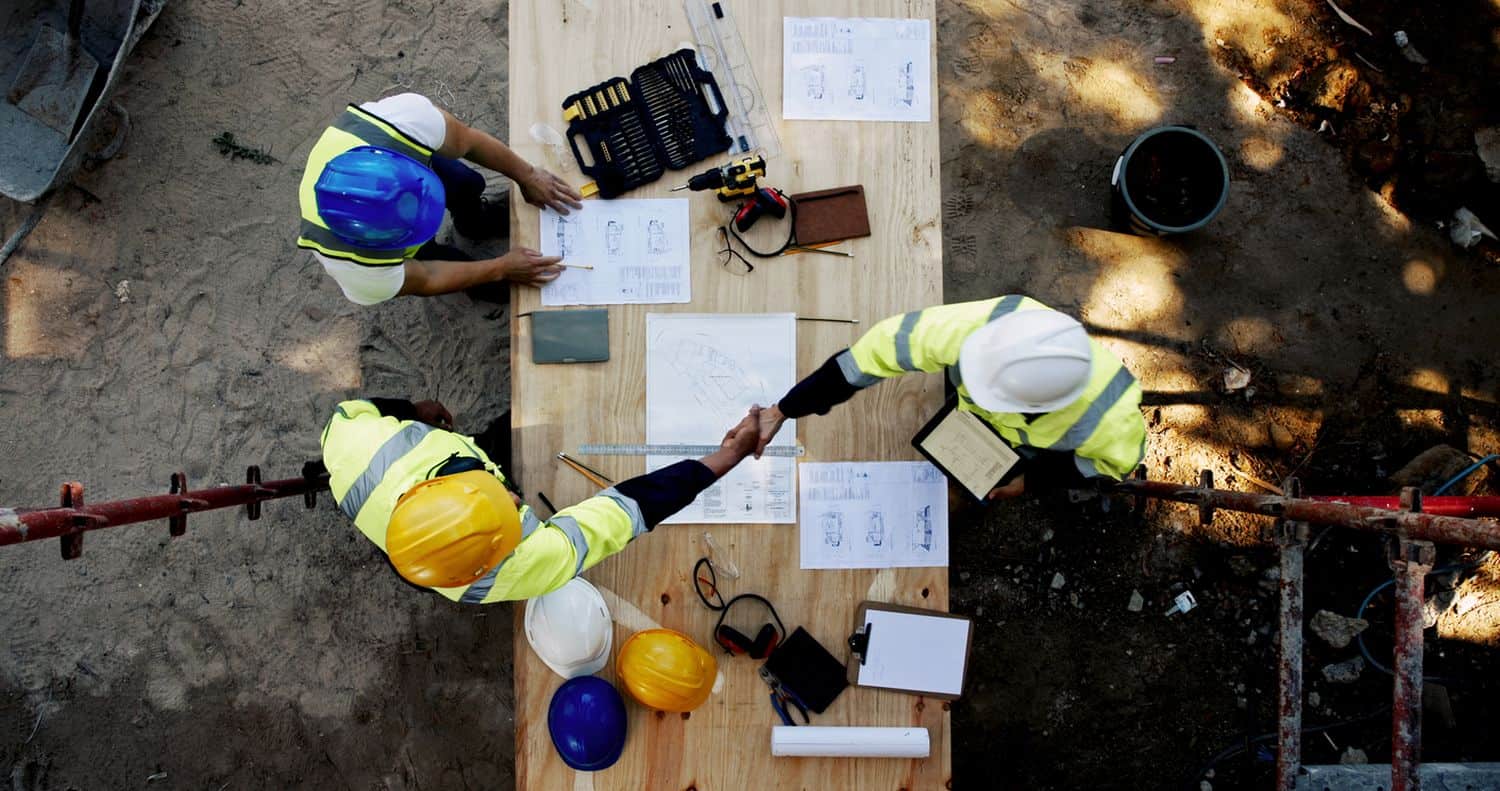
Blueprint, architecture and men at table shaking hands for collaboration, agreement and inspection from above. Construction, building team and contractor on site with floor plan, handshake and deal
The state’s enormous property portfolio of 88 000 buildings and five million hectares of land is about to get a makeover.
This week, speaking at the 2026 State of the Nation Address debate in Cape Town, Minister of Public Works and Infrastructure Dean Macpherson put flesh to the bones of a bold plan outlined a week earlier by President Cyril Ramaphosa to pool these assets in a ring-fenced, professionally managed property investment vehicle.
The ultimate aim is to use these assets to turn SA into a construction site.
Government pays R6 billion a year for property
The planned reforms will address a glaring paradox: the state, as custodian of a R155 billion portfolio, is the largest property owner in the country, yet it still pays R6 billion a year in leases to private companies.
Many of the properties it owns are run-down, poorly maintained and cursed with the architectural charm of a Tashkent prison complex.
They are graceless, barely functional and bleeding value.
“For decades, South Africa has owned the largest property portfolio in the country – yet too many assets stand vacant, vandalised, hijacked or underused,” said Macpherson.
ALSO READ: Energy, education and home affairs: A few successes and promises from 2026 Sona debate
Telkom Towers in Pretoria cost R1 billion
A case in point is Telkom Towers in Pretoria, which cost the state R1 billion yet remains unusable. The government is now finalising a request for information to turn this dead asset into productive accommodation for government departments.
It’s a story repeated across the country. The state owns prime property that stands vacant, while billions are being paid annually for plush offices in the private sector.
“We hold strategic land parcels in the metros while people live in informal settlements. We sit on an enormous asset value base, yet we don’t generate any revenue to fund asset maintenance.
“These contradictions end here,” said Macpherson.
The state’s property management model was never intended to build value, making reinvestment in maintenance and upgrades almost impossible.
More sensible approach
The new property investment vehicle is intended to change that by consolidating income-generating and strategically located assets into a single book with a mandate to unlock value for reinvestment.
As is happening with railways and electricity, the role of owner and manager of these assets is being separated.
The state will retain ownership, but will allow private sector investors to acquire development rights that could spark a wave of urban renewal in the major cities and towns. This should remove the dead hand of government and turn a property liability into an asset.
Clear project pipelines will allow private sector partners and sovereign funds to participate with certainty, adds Macpherson.
ALSO READ: Gauteng government reveals R2 billion spent on office rentals in five years
New system
The new structure includes a verified, digitised asset register serving as a “single source of truth” for ownership, condition, leases, valuations and performance.
Gone will be the clunky and fragmented spreadsheets on which the state currently relies. The new system involves real-time data management, with clear separation of roles: professional property managers will handle leases, maintenance, lifecycle planning and tenant performance.
This should spark some quick commercial successes, leading to longer-term economic gains: billions saved annually in lease payments, barren assets turned into yield generators, and hundreds of thousands of jobs created.
Improved revenue from these assets will allow for proactive, planned maintenance rather than reactive fixes.
The plan is to make these developments ready by funding bulk services and precinct preparation to turn underutilised land into bankable projects with clear pipelines for private sector and sovereign fund participation.
This opens the door to private capital for precinct upgrades, mixed-use housing, and redevelopment projects.
Flagship example
Macpherson points to some practical examples of what this approach can deliver.
The government’s Precinct Programme in Tshwane stands as a flagship: Phase 1 involves 30 projects across more than one million square metres, with roughly R33 billion in investment.
Once complete, it could eliminate over R400 million in annual lease costs and yield a portfolio valued between R45 billion and R55 billion.
This will bolster the public balance sheet instead of draining it.
Phase 2 will focus on refurbishing underutilised public buildings, reviving them as productive assets and catalysing broader urban regeneration.
The economic ripple effects are substantial. Across the delivery cycle, the programme projects nearly 100 000 direct construction jobs and indirect opportunities, potentially yielding up to R60 billion in wider urban economic activity.
ALSO READ: Public Works’ register shows only 1.5% of government properties in excellent condition
Property ownership
Similar potential exists elsewhere: well-located public land in Johannesburg’s inner city could support housing near transport and employment hubs, rather than remaining fenced off or unlawfully occupied. Hundreds of residential properties could be offered to essential workers such as nurses, police officers and teachers.
This moves the state from passive property ownership to active management.
“The state does not need to own all these assets, and neither should it,” said Macpherson.
By turning dormant properties into engines of growth, the initiative promises to reduce fiscal leaks, spur urban renewal, and reinvest in public services.
The question of hijacked buildings and corrupt cronies feeding from this trough should, in theory, be curtailed by allowing the private sector to manage large portions of this portfolio.
It’s bold and experimental, but certainly worth a try.
This article was republished from Moneyweb. Read the original here.
About the Author