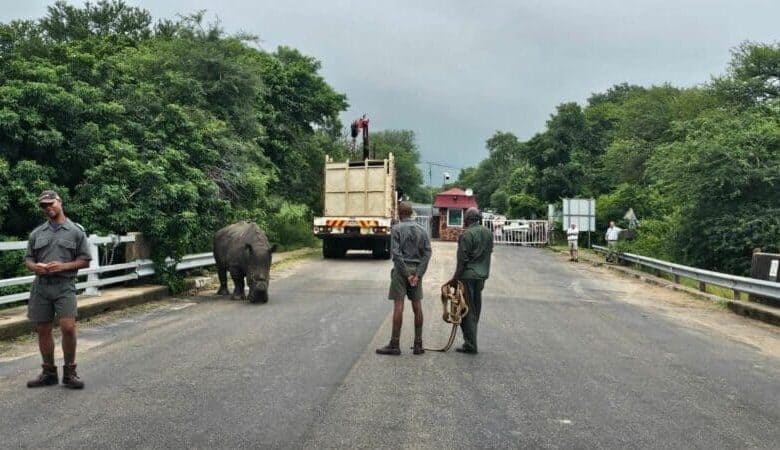
South Africa recorded a 16% decline in rhino poaching during 2025, with 352 animals killed compared to 420 in 2024, according to the Department of Forestry, Fisheries and the Environment.
However, the statistics reveal a concerning shift in poaching hotspots, with Kruger National Park experiencing its worst year on record.
Minister of Forestry, Fisheries and the Environment Willie Aucamp attributed the overall reduction to improved coordination between government agencies, private sector partners and conservation organisations.
“From January to December 2025, 352 rhinos were poached in South Africa, with 266 being killed on state properties and 86 on privately owned parks, reserves or farms. This was a decrease of 68 in comparison to 420 rhinos poached in 2024,” he said.
Kruger cases double amid integrity concerns
Mpumalanga emerged as the hardest-hit province, losing 178 rhinos compared to 92 in 2024.
The majority of these losses occurred at Kruger National Park, which reported 175 poached rhinos in 2025, nearly double the 88 recorded in 2024.
According to the data provided, poaching in Kruger has increased for three consecutive years. In 2023, the park had 78 poached rhinos.
Investigations linked the surge to internal corruption, with polygraph testing revealing connections between failed tests and increased poaching during December 2024 and 2025.
Seven Ranger Services employees at Kruger were dismissed following disciplinary action.
The park is recruiting additional field rangers and has introduced 12 operational K9 units with 11 newly trained handlers, alongside significant technology investments to support anti-poaching efforts.
ALSO READ: Suspected poacher killed by rangers in the Kruger National Park
KwaZulu-Natal poaching decreases
In stark contrast, Hluhluwe-iMfolozi Park in KwaZulu-Natal saw poaching plummet from 198 incidents in 2024 to 63 in 2025.
Ezemvelo KZN Wildlife credited the reduction to multiple complementary interventions beyond the strategic dehorning programme implemented in 2024.
“Whilst Ezemvelo recognises that the strategic dehorning programme implemented in 2024 served as a critical catalyst in stabilising rhino poaching pressures and enabled urgent, targeted interventions, analysis of the 2025 outcomes confirms that multiple complementary interventions were central to the reduction in poaching incidents,” the organisation stated.
Key factors included enhanced detection through advanced camera technologies and sensors, the Integrated Wildlife Zones Programme fostering collaboration between Ezemvelo and private rhino owners, and an Integrity Implementation Plan featuring successful polygraphing of all park law-enforcement personnel.
The department said conservation partners including WWF, Save the Rhino International, Wildlife ACT and Peace Parks Foundation provided sustained support.
Convictions and sentencing
The National Integrated Strategy to Combat Wildlife Trafficking has delivered significant prosecutions with lengthy imprisonment terms.
Notable cases include ZM Muiambo, alias Thomas Chauke, who was sentenced to 20 years in April 2025 after being found guilty on 19 charges spanning four provinces, including illegal rhino hunting, conspiracy, theft of horns, possession of illegal firearms and three counts of escaping lawful custody.
“Only through this collaboration could cases, emanating from four provinces, be centralised, and the accused was found guilty in the High Court of Makhanda,” Aucamp said, highlighting coordination between the National Prosecuting Authority, Directorate of Priority Crime Investigations, Stock Theft & Endangered Species Unit and Environmental Management Inspectorate.
Other significant sentences included 35 years for poachers who killed three white rhinos at Pilansberg National Park, and 22 years for illegal killing and conspiracy charges at Kruger.
ALSO READ: Floods: Here’s how the Kruger National Park wildlife is doing
International operations
South Africa strengthened transnational enforcement through coordinated operations.
In December 2025, a joint operation with Singapore authorities at a Kempton Park storage facility resulted in the seizure of 17 rhino horns weighing 55.4kg and 26.2kg of lion and tiger bones, skulls, and claws.
Two Nigerian suspects appeared in court on charges of contravening the National Environmental Biodiversity Act.
“South Africa continues to strengthen its international collaboration to curb rhino poaching and wildlife trafficking. These efforts led to the country receiving the Asia Environmental Enforcement Recognition of Excellence Award late last year, which celebrates excellence in enforcement by government officials, institutions and teams combating transboundary environmental crimes,” Aucamp said.
Operation Thunder 2025, organised by Interpol and the World Customs Organisation, saw South African authorities achieve multiple successes during September and October operations, including pangolin rescues, succulent trafficking arrests and firearm seizures linked to poaching syndicates.
Aucamp emphasised that sustaining the downward trend requires continued coordination.
“Working together with the South African anti-poaching and anti-trafficking organisations, we remain committed to a balanced, intelligence-driven, and partnership-based approach to rhino protection, recognising that sustained success requires constant adaptation, integrity, and cooperation across all sectors,” he said.
The department encouraged the public to report suspicious wildlife activities to the environmental crime hotline at 0800 205 005 or to Saps at 10111.
READ NEXT: Good news if you heading to the Kruger Park soon
About the Author