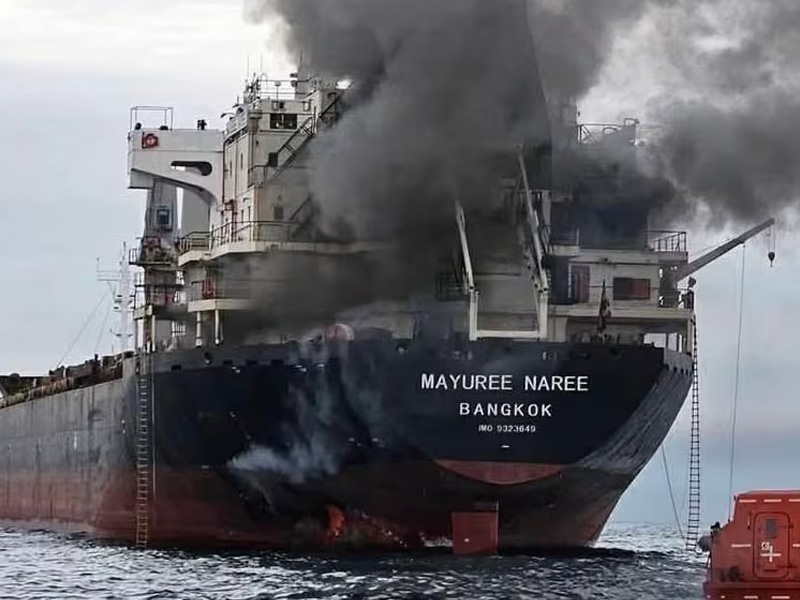
Global markets recoiled after oil prices surged above $100 a barrel following fresh Iranian strikes on shipping in the Gulf, raising fears of accelerating inflation.
Asian shares fell broadly on Thursday as oil prices jumped about 9% to break the $100 barrel mark amid reports that more vessels had been attacked in Gulf waters and key oil terminals shut down.
The surge in crude prices has heightened concerns that a fresh spike in energy costs could quickly drive up inflation and force central banks to keep borrowing costs higher for longer.
Investors appeared unconvinced by efforts to stabilise supply. The International Energy Agency announced plans to release 400 million barrels of oil from strategic reserves the largest intervention in its history while the United States said it would begin releasing 172 million barrels from next week.
Brent crude futures rose 9.2% to $100.37 a barrel, extending gains from the previous session, while US crude futures climbed 8.1% to $94.26.
Stock markets across Asia retreated sharply. MSCI’s broadest index of Asia Pacific shares outside Japan fell 1.5%, Japan’s Nikkei dropped 1.4%, Chinese bluechip stocks slipped 0.6%, and Hong Kong’s Hang Seng index lost 1.2%.
Futures markets pointed to further weakness in Western markets, with S&P 500 and Nasdaq futures both down 0.9%, while EUROSTOXX 50 futures fell 0.8% and Germany’s DAX futures dropped 1%.
Security officials in Iraq said two fuel tankers had been struck by explosive laden Iranian boats in Iraqi waters early on Thursday. An Iraqi official also told state media that the country’s oil ports had “completely stopped operations”.
Reports also indicated that Oman had evacuated vessels from its key oil export terminal at Mina Al Fahal as a precaution.
Rodrigo Catril, a senior foreign exchange strategist at NAB, said the market remained deeply concerned about developments in the Strait of Hormuz.
“The information we are getting over the past 24 hours is not encouraging,” he said, adding that there is a growing risk oil prices could continue to climb rather than ease.
Iran has stepped up attacks on merchant shipping in the Strait of Hormuz, with at least 16 vessels reportedly struck since hostilities began. Tehran has warned global markets to prepare for oil prices reaching $200 a barrel.
Further uncertainty was added when US President Donald Trump declared on Wednesday that the war with Iran had been “won”, but said the United States would remain engaged in the conflict to complete the mission.
Economic data released earlier showed US consumer prices rose 0.3% in February, in line with forecasts and higher than January’s 0.2% increase.
However, analysts said the figures were already being overshadowed by the inflationary risks created by the escalating conflict.
Bond markets reflected those concerns, with the threat of rising inflation pushing yields higher worldwide. Yields on 10years US Treasury notes rose three basis points to 4.2374% after jumping sharply overnight.
Investors also scaled back expectations for interest rate cuts, fearing central banks may have less room to ease policy if energy costs continue to rise.
Currency markets showed a flight towards the US dollar as investors avoided currencies from energy importing economies. The euro slipped 0.2% to $1.1539, its weakest level since November, while the dollar edged up to 159.12 the strongest level since January.
The Australian dollar, often viewed as a risk sensitive currency, also fell 0.4% to $0.7122 after briefly hitting a three years high the previous day.
Goodness Anunobi
About the Author