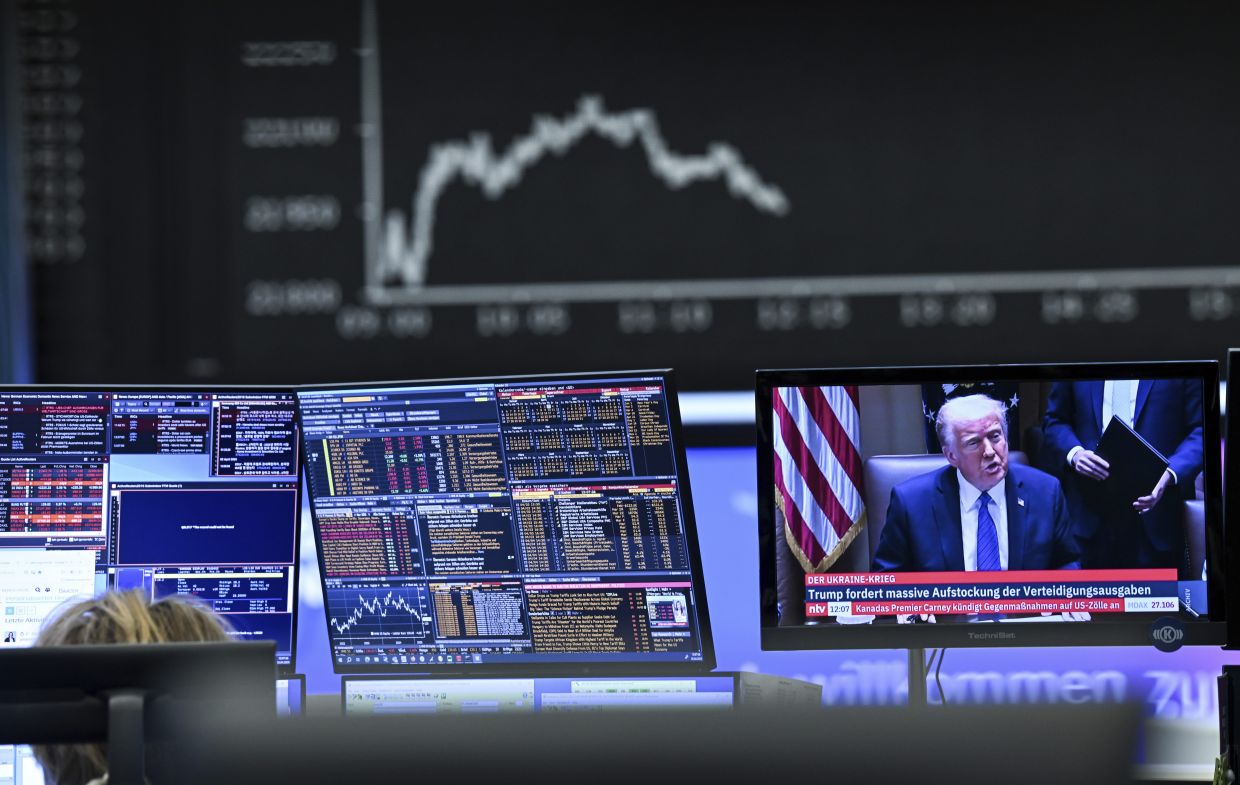
Behind a television monitor showing U.S. President Donald Trump, the display board with the Dax curve shows falling share prices, in Frankfurt, Germany, Thursday April 3, 2025, after the tariff package announced by U.S. President Trump has pushed share prices sharply into negative territory. (Arne Dedert/dpa via AP)
Global investors rushed to reduce exposure to US assets on Tuesday, as escalating tensions between President Donald Trump and European leaders over Greenland triggered sharp market reactions.
US bond prices tumbled, pushing yields higher, while the US Dollar Index — which measures the greenback against a basket of six major currencies — fell nearly 1%. The euro jumped 0.6% against the dollar. Precious metals surged, with gold and silver climbing to fresh highs. Gold, long considered a safe-haven investment during geopolitical turbulence, was on track for its largest one-day gain since 2020.
“This is ‘sell America’ again within a much broader global risk off,” Krishna Guha, head of global policy and central banking strategy at Evercore ISI, wrote in a note to clients.
US stock markets also suffered heavy losses. The Dow Jones Industrial Average slid more than 800 points, while the S&P 500 and Nasdaq Composite each fell more than 2%. Wall Street’s “fear gauge,” the Cboe Volatility Index (VIX), spiked to levels last seen in November.
The market turmoil follows Trump’s threat to impose 10% tariffs on eight European nations as part of his push to acquire Greenland, with plans for the tariff to rise to 25% by June. In response, representatives from the 27-nation European Union convened an emergency meeting.
Greenland has repeatedly rejected Trump’s proposal, with Prime Minister Jens-Frederik Nielsen stating Monday that the territory “would not be pressured” and will “stand firm on dialogue, on respect and on international law.” European officials are reportedly weighing counter-tariffs and other punitive measures in retaliation.
The recent sell-off, dubbed the “sell America” trade, signals growing investor concern over the reliability of the US as a trading partner. Some investors worry European nations could divest US assets to exert political and economic leverage.
“On the other side of trade, deficits, and trade wars, there are capital and capital wars,” Bridgewater Associates founder Ray Dalio said at the World Economic Forum in Davos, Switzerland. “If you take the conflicts, you can’t ignore the possibility of the capital wars. In other words, maybe there’s not the same inclination to buy … US debt and so on.”
Tuesday’s decline in the US Dollar Index was the steepest since Trump’s “Liberation Day” rollout of higher tariffs in April, many of which were later rolled back. Global markets had already started sliding on Monday, when US markets were closed for Martin Luther King Jr. Day, with pan-European stocks extending losses and Asian markets trending lower.
Evercore ISI’s Guha said the dollar’s weakness and the euro’s rise reflect a global attempt to “reduce or hedge their exposure to a volatile and unreliable” United States. He added that the impacts on the dollar and US assets could be long-lasting if Trump does not reverse course, referencing a market strategy jokingly known as “TACO,” or “Trump Always Chickens Out,” coined last spring.
“What remains to be determined is the magnitude and duration of these dynamics,” Guha said.
Meanwhile, investors are increasingly seeking to diversify away from US equities, which dominate global market capitalisation and hover near record highs. Russ Mould, investment director at AJ Bell, explained:
“Markets may already be pricing in full the concept of American exceptionalism, at least barring an epic, crack-up economic boom. It may therefore not take too much to persuade investors to hedge their bets and diversify.”
Boluwatife Enome
About the Author