Screenshot
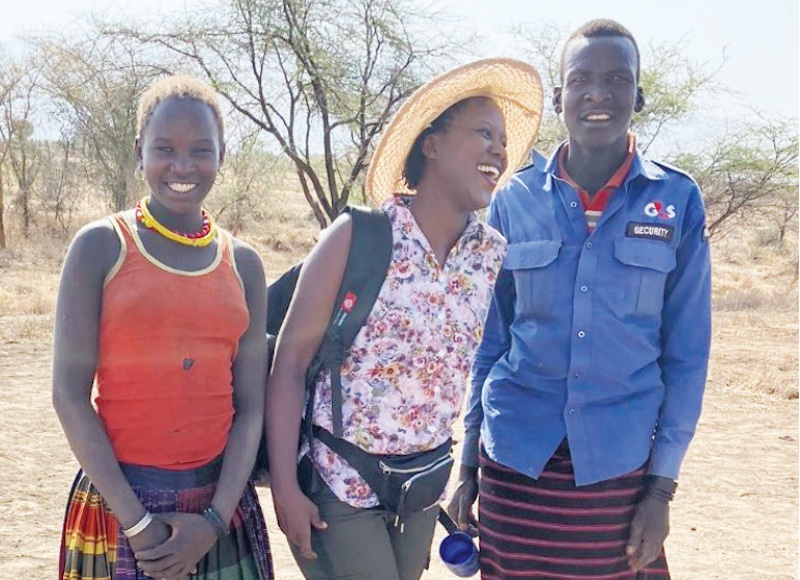
Dr GLADYS ATTO, an ophthalmologist, is one of the most celebrated Ugandans on social media.
Over the years, she has used her passion and clinical knowledge to educate the public about eye health. She does all this from Karamoja, the farthest, remotest and perhaps the poorest region of the country, something that keeps many of her followers awed by her courage and passion.
As Norah Owaraga writes, Dr Atto is a national treasure. It was in December, 2018 when Dr Gladys Atto packed her belongings from Mbarara to go and work in Karamoja as the first and only ophthalmologist there.
She says her mum was scared but eight years down the road, she is very proud of all the eyes that are seeing. Atto is an ardent user of social media, especially X, to promote eyecare.
In Karamoja, her daily routine involves moving to several hospitals and engaging in health outreach programmes. There is hardly a break in her life but the most amazing thing is that she just enjoys what she is doing.
On social media, she often shares how she gels with the communities, the jokes she shares with patients and the miracles she performs daily. If passion was a person, it would be Dr Atto.
Last October, Dr Atto shared the story of Maria, whom she met in Karamoja, where poverty and limited healthcare are intertwined. Maria’s existence was defined by lack. She could no longer work on her small farm, a vital source of food and purpose.
The simple, essential act of sorting grains was impossible. Her loss of sight meant a gut-wrenching loss of self-reliance.
“She felt a loss of dignity,” Dr Atto explained with a quiet empathy that comes from having heard this story in countless variations.
The heaviest burden, however, fell on the shoulders of Maria’s two young granddaughters. To care for their grandmother, they dropped out of school. Their days became a cycle of guiding her to the latrine, washing her clothes, preparing her food.
Their childhoods and their potential, were quietly suspended. This is the hidden, multiplicative cost of avoidable blindness and in the case of Maria, it not only disabled just one person but anchored an entire family in survival mode, thereby stripping away the very education and mobility that could break the cycle of poverty.
Then came Dr Atto and her team. The surgery to remove the cataracts is, medically speaking, a masterpiece of efficiency. But its result is anything but routine. When the bandages came off, Maria’s first sight was the face of the granddaughters she hadn’t truly seen in years.
The restoration was immediate and profound. Dr Atto chose to highlight Maria’s story on a significant day: World Sight Day, observed on the second Thursday of October. Last year, it fell on October 9, which is also Uganda’s Independence Day.
The symbolism is almost too powerful to ignore. While the nation celebrated its political freedom, Maria celebrated a deeply personal liberation. Her granddaughters, in turn, gained their own independence to return to school.
So, in just one act of healing, Dr Atto had catalyzed a cascade of liberty. Yet, for every Maria whose sight is restored, there are hundreds, thousands, still waiting in the dark. The statistics are a sobering backdrop to Dr. Atto’s daily miracles.
In the eight years she has been in Karamoja, she has restored sight to more than 5,000 people. Across sub-Saharan Africa, over 20 million people are blind. Nearly three million of them are Ugandan.
In Karamoja, as Dr Atto herself noted in a seminal Sight Savers “Rapid Assessment of Avoidable Blindness” report, the causes are starkly clear: unoperated cataracts (39.3%) and corneal opacities (32.6%) dominate.
These are not rare, complex diseases. They are, overwhelmingly, conditions we know how to cure and prevent. Their prevalence is not a medical failure, but a systemic one. Eye diseases languish among the most neglected in Uganda’s public health services.
The barriers are a brutal combination of distance, cost and deadly infrastructure. Imagine mustering the courage to seek help for your failing sight, only to face a journey of dozens of miles on roads that are already a challenge for the fully sighted.
For the blind, they are a death sentence waiting to be carried out. This is the complex ecosystem in which Dr Atto plants her flag of hope. Every day, she battles the immediate, biological cause of blindness; the cataract, the glaucoma, the infection.
But her mission, as evidenced by her passionate use of social media to educate, is to fight the deeper roots which include the lack of awareness, the resignation, the inaccessible systems.
She understands that a surgery fixes an eye, but fixing a life requires changing minds and mending the very environment that perpetuates the disability. Dr Atto’s service in the most remote area of the country is exemplary to counter the deep-seated belief that a hospital in Karamoja cannot be a place of miracles.
It challenges the notion that decline is destiny. Every time she shares such a story, with permission and profound respect, she is rebuilding public trust in a system that has often failed the most vulnerable.
Celebrating Dr Atto, then, is about more than applauding one dedicated doctor. It is about validating a holistic model of change. It is about supporting the eyecare practitioners who, against daunting odds, provide the crucial proof of concept that blindness can be beaten.
It is about joining them in the broader fight to make eyecare accessible, to make our roads and communities inclusive and to ensure that the phrase “avoidable blindness” becomes an obscenity of the past, not a description of our present.
In the clear, restored sight of someone like Maria, we don’t just see a woman reclaimed; we see a reflection of the kind of country we could all build. One that sees, values and plans for every single one of its people.
The author is managing director CPAR Uganda Ltd, a nonprofit on a mission to stimulate development, dissemination and widespread application of technologies suitable and adaptable to social cultural and economic conditions of Uganda.
About the Author