Georgia’s security forces allegedly used a World War One-era chemical agent to disperse anti-government protesters in Tbilisi last year, according to evidence uncovered. The findings point to the possible deployment of camite an obsolete and highly irritant compound abandoned nearly a century ago due to its dangerous, long-lasting effects.
Witnesses said that water cannon used during the November–December 2024 demonstrations caused intense burning sensations that could not be washed off. “You could feel the water burning,” said paediatrician and protester Dr Konstantine Chakhunashvili, who added that the sensation “was worse when trying to wash it off.”
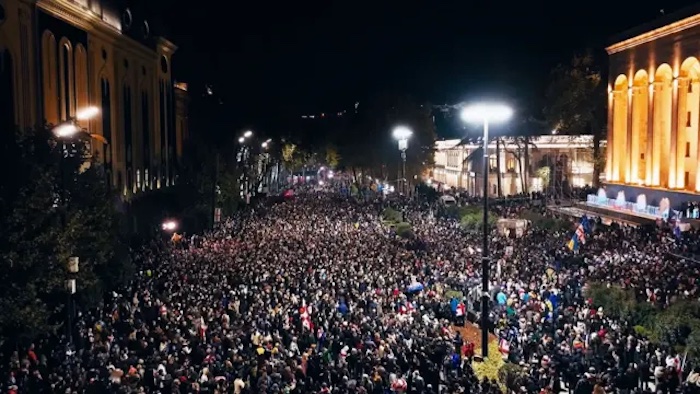
Thousands had taken to the streets after the government paused Georgia’s EU accession process, provoking widespread anger in a country where EU membership is a constitutional objective. Many of those hit by water cannon reported persistent symptoms including coughing, vomiting, headaches and shortness of breath sometimes lasting for weeks.
Dr Chakhunashvili surveyed nearly 350 demonstrators and found that almost half experienced symptoms for more than 30 days, with dozens showing abnormalities in heart electrical activity. His study has been peer-reviewed and accepted for publication by Toxicology Reports.
Whistleblowers: Water Cannon Loaded With Unknown Chemical
Multiple high-level whistleblowers from Georgia’s Special Tasks Department its riot police said that the chemical used was the same compound tested internally in 2009.
Former department weapons chief Lasha Shergelashvili, speaking from Ukraine, said the agent was “probably ten times stronger” than conventional tear gas.
“We noticed the effect was not wearing off. Even after washing with water or baking soda, we still couldn’t breathe freely.” Lasha Shergelashvili
Despite his recommendation that it never be used, Shergelashvili said water cannon vehicles continued to be loaded with the substance until at least 2022.
An internal riot-police inventory obtained by the BBC listed two unlabeled chemicals: UN1710, identified as trichloroethylene (a solvent), and UN3439, a category that includes bromobenzyl cyanide known historically as camite.
Experts Identify Camite as the Likely Agent
Chemical weapons specialist Prof Christopher Holstege reviewed the evidence and concluded that symptoms described by protesters were consistent with exposure to camite.
“The persistence of the clinical effects is not consistent with typical agents such as CS gas,”
Prof Holstege
He warned that reviving a chemical of this severity would represent a “dangerous” escalation.
Camite was developed during WW1 and abandoned by the 1930s. Under international law, riot-control agents must cause only temporary effects; a long-lasting compound could be categorised as a chemical weapon.
UN Special Rapporteur on Torture Alice Edwards said the claims raise serious human-rights concerns.
“Populations should never be subjected to experimental weapons, The symptoms described go beyond what is temporary or acceptable.”
Alice Edwards, She called for full investigations into potential torture or ill-treatment.
Georgia’s government dismissed the findings as “absurd” and “frivolous,” insisting that police acted legally in response to “illegal actions of brutal criminals.”
The protests have continued though smaller in size amid rising public anger over alleged election rigging, a perceived pro-Russian tilt, and tough new laws targeting civil society. The ruling Georgian Dream party denies pursuing Russian interests and says recent legislative changes serve public welfare.
Erizia Rubyjeana
About the Author