The number of G20 Sherpa working groups is widely unpopular among G20 members, and survey responses indicate a waning sense of the forum’s effectiveness.
South Africa’s G20 Presidency released its G20@20 report last week, in which it details the achievements, concerns and broader recommendations for the future.
The report was compiled based on feedback from members as well as guest and invitees to this and previous years’ events, making good on a directive approved at last year’s summit in Brazil.
“This review aims to support members in ensuring that the G20’s second cycle of presidencies is fit-for-purpose and calibrated to deliver effective, coordinated action on shared priorities,” the G20@20 report states.
G20 ‘somewhat effective’
In most of the metrics surveyed, members overwhelmingly agreed that the G20 had been either somewhat or very effective in achieving its desired goals.
Regarding the G20’s role in strengthening multilateralism and international cooperation, 65% of members believed the group had been effective.
When asked to rate the effectiveness of the leader’s summit, 60% stated very effective, while a further 10% indicated somewhat ineffective.
In rating the effectiveness of the G20 in monitoring and addressing global financial and economic challenges, 50% of members selected somewhat effective.
Despite positive sentiment on individual themes, 75% of members believed the G20’s overall effectiveness had decreased, while 43% of guests agreed the forum was less effective than before.
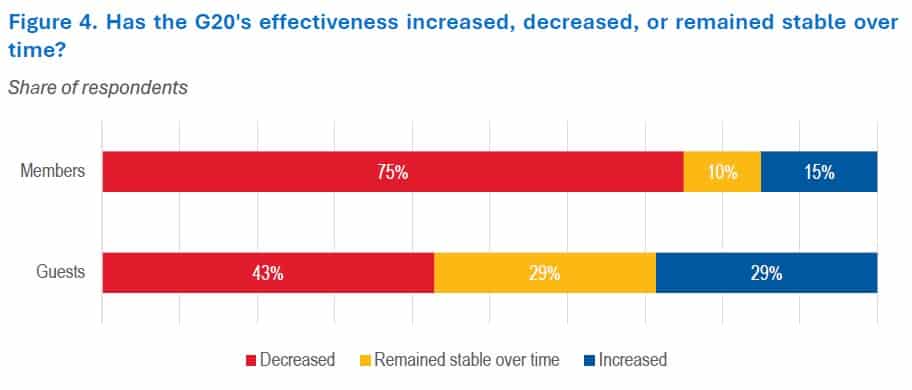
Above: An excerpt from the G20@20 survey results. Picture: G20@20
One area where members felt the G20 was falling short was education. 35% of members said the forum was not effective or somewhat ineffective, while a further 35% stated they were only somewhat effective.
Additionally, the number of Sherpa working groups did not receive glowing reviews, with 80% disagreeing that the number of working groups was adequate.
Likewise, the engagement groups — the industry-specific forums — received a mixed-reactions.
The business and think-tank groups were positively received, while seven engagement groups received 30% or less support.
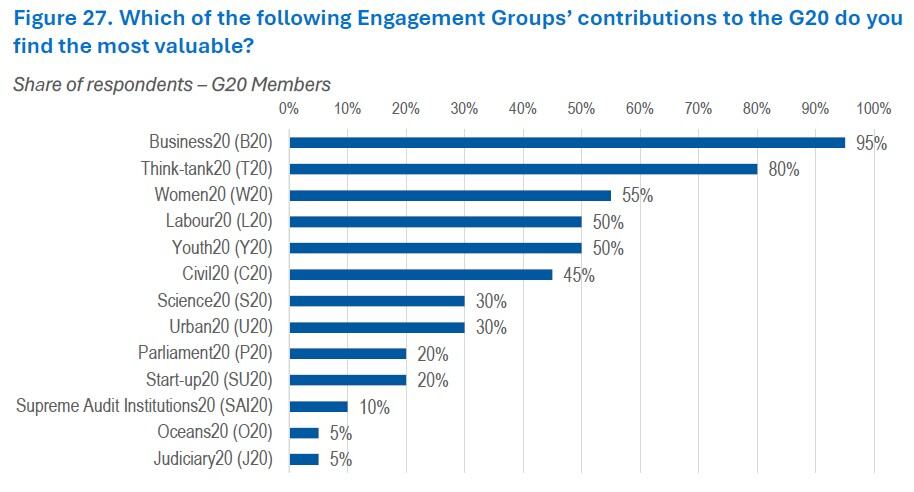
Above: A breakdown of the most popular engagement groups. Picture: G20@20
G20 status and successes
The report maintains that the G20 is the premier international forum and that it should maintain its informal, leader-led structure.
The report credits the G20 with preventing the 2008 global financial crisis and the Covid-19 health panic from “becoming deeper global downturns”.
In the wake of these events, the G20 praised itself for the establishment of the Financial Stability Board, launching pandemic funds and creating the Debt Service Suspension Initiative and Common Framework for Debt Treatments
Financial frameworks “widely regarded as having turned G20 commitments into tangible progress” include the Framework on Base Erosion and Profit Shifting, the Global Partnership for Financial Inclusion (GPFI), and the Agricultural Market Information System (AMIS).
The report states that the G20 was now operating in a global environment characterised by heightened geopolitical tensions.
ALSO READ: Trump getting his way? Finance minister confirms SA won’t participate in G20 finance track
Feedback received relayed that members felt that an increasingly broad agenda and insufficient continuity from year to year were undermining the G20’s effectiveness.
“While views differ on the exact issues that should feature on the G20’s agenda, there is broad agreement they should be directly related to its mandate of delivering broad-based and balanced global economic growth,” the report states.
“Members suggest consolidating, pausing, or shelving selected working groups to focus efforts where the G20 can deliver the greatest impact,” it explains.
All members agreed that stronger ties should be established with the United Nations, World Trade Organization, World Bank, International Fund and International Labour Organization.
USA incoming
The second 20-year cycle of the G20 begins with the United States in 2026, a year that seems increasingly unlikely to feature South Africa in any meaningful way.
US Secretary of State Marco Rubio stated in November that South Africa had “fundamentally tarnished the G20’s reputation”, but would welcome them back should they “fix its broken system”.
The themes of the 2026 G20 under the US’ leadership will revolve around innovation, entrepreneurship, and perseverance.
Rubio stated that US President Donald Trump had settled on four working groups focused on trimming regulation, improving energy supply chains and technological advancement.
“As the global economy confronts the changes driven by technologies such as Artificial Intelligence, and shakes off ideological preoccupations around green energy, the president is prepared to lead the way,” Rubio stated.
About the Author