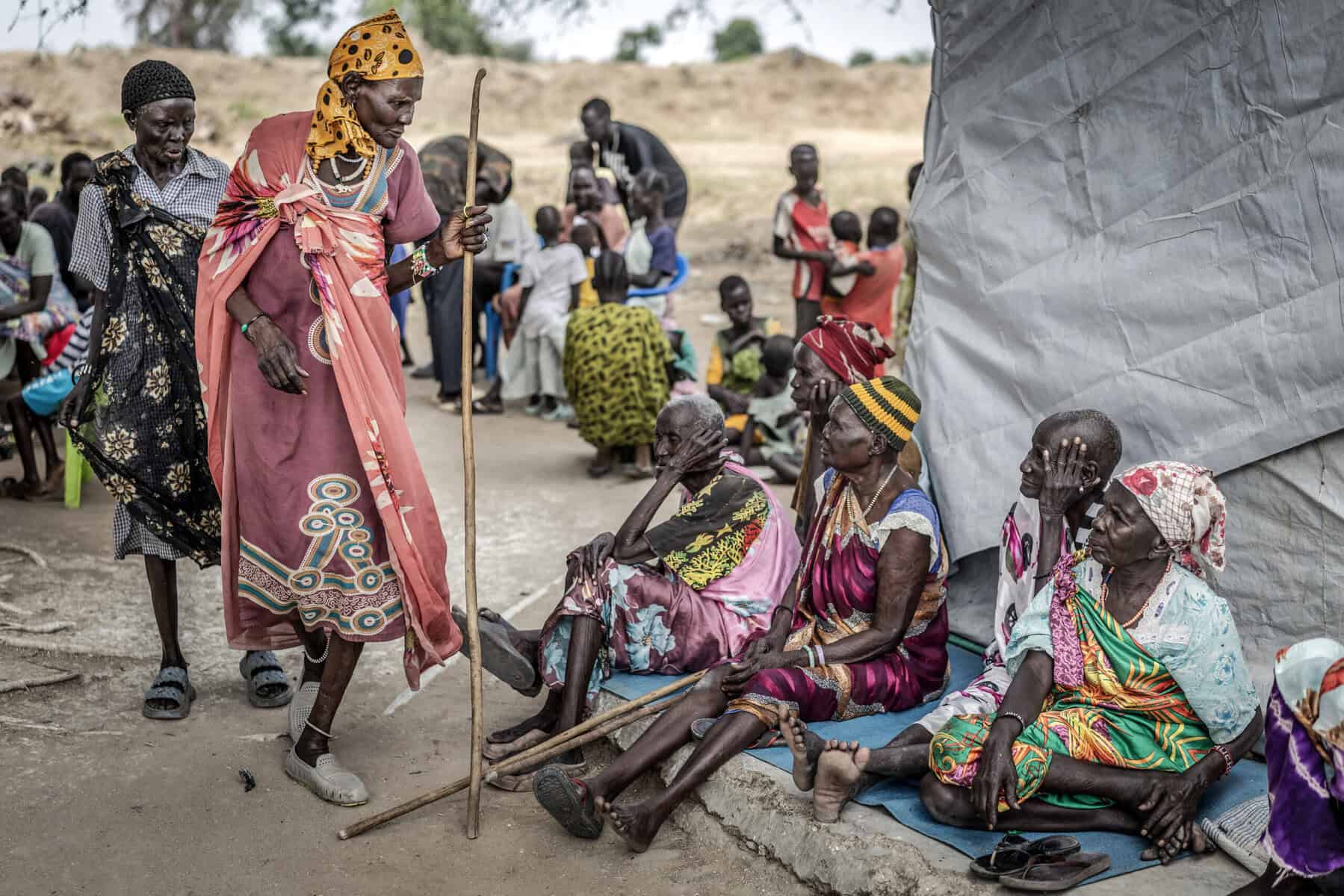
Elderly members of the Nuer community, uprooted by the conflict in Jonglei State, attend a community health session amid shortages of medical supplies in the POC IDP Camp in Bor, Jonglei State, on February 16, 2026. South Sudan gained independence in 2011 but quickly descended into civil war between rival generals, Salva Kiir and Riek Machar. A power-sharing deal in 2018 brought relative peace, with Kiir as president and Machar his deputy. But the deal was never fully implemented, their forces never unified, and elections never held. Over the past year, Machar has been jailed and violence has erupted between their forces in several areas. The worst has been in Jonglei state, where some 280,000 people have been displaced since December, according to the United Nations. (Photo by Luis TATO / AFP)
The lives of more than 1.9 million displaced people in South Sudan are being put at risk due to aid funding shortages, the UN’s migration agency said Wednesday.
The International Organization for Migration (IOM) said humanitarian needs were dramatically outstripping resources in one of the world’s most displacement-affected countries.
“Critical funding shortfalls are putting the lives of over 1.9 million displaced people in South Sudan at risk,” the agency said in a statement.
South Sudan, the world’s newest sovereign country, has been beset by civil war, poverty and massive corruption since it was formed in 2011.
Impact of Sudan war on fragile system
South Sudan is grappling with new arrivals fleeing the conflict in neighbouring Sudan, while dealing with its own displacement caused by years of conflict, flooding and instability, the IOM said.
The agency said that since the war in Sudan erupted in April 2023, more than 1.3 million people had crossed into South Sudan — two-thirds of them being South Sudanese returnees.
ALSO READ: MSF denounces denial of humanitarian access in South Sudan
The IOM said this had put “immense pressure” on border communities, and the country’s overstretched services and fragile infrastructure.
“South Sudan is carrying an extraordinary burden, and funding shortfalls risk undermining progress toward durable solutions for millions,” said Ugochi Daniels, the IOM’s deputy director general for operations.
“Displaced families and host communities are trying to rebuild their lives, but the strain is real. Without sustained support and progress toward peace, these communities could face renewed instability and displacement.”
The IOM said its 2026 response plan was $29 million short.
Aid cuts and renewed political tensions
The United States was the biggest contributor to the UN but has slashed its foreign aid funding since President Donald Trump returned to power in January 2025 — while other countries have also tightened their belts.
There has been rising violence in recent weeks between supporters of South Sudan’s President Salva Kiir and his long-time rival Riek Machar — much of it centred on Jonglei state where at least 280,000 people have been displaced, according to the UN.
The conflict in has largely pitted the two largest ethnic groups against each other — the Dinka aligned mostly with Kiir, and the Nuer mostly with Machar.
NOW READ: How much money flows from South Africa to SADC countries? Here’s the breakdown
About the Author