On a Thursday evening, I walked to Makerere University to learn the basics of the Russian language.
The tutor, Olga Andreevna Atubo, was so time-conscious and when the clock struck 5pm, class started, with the students presenting their Russian language homework on the whiteboard.
As someone who grew up with the English alphabet, I wondered how I could ever understand the Cyrillic script and understand what the other students had scribbled on the whiteboard. Andreevna emphasized the value addition in learning Russian, ranging from education opportunities to jobs in international organisations.
I was shocked that the tutor used similarities to Ugandan languages and culture while teaching, to help students understand different concepts that she put across, but also to demonstrate that just like any other language, there are similarities that encouraged the students to gain more interest in the language.
As students slowly filled the classroom, Andreevna reminded them of what they had learnt previously – pronunciations, the fact that the Cyrillic Russian alphabet has 10 vowel letters which represent five to six distinct vowel sounds, etc. She explained that Russian is particular, with names of males ending with consonants and names of females ending with vowels.
She also said Russians traditionally have three names – given name, patronymic name (middle name derived from the father’s name), and a surname, which is inherited and adjusted based on Slavic naming conventions.

At least I learnt the Russian greetings, such as Zdravstvuyte, which means hello, and is used when one is greeting strangers or professionals; Dobriy den, which means good afternoon; Dobriy vecher, which means good evening, and Kak dela, which means how are you?
When saying goodbye, we were taught phrases like Do svidaniya, and Poka which is an informal way of saying bye. Russian greetings, I learnt, vary depending on whom you are greeting.
The elementary Russian language lessons consist of 54 classes, with current students expected to master the language by the end of 2026, with all tests written in Russian!
Andreevna gave a detailed insight into aspects of Russian, like the literature, where we discussed famous scholars like Fyodor Dostoevsky, and we also read poems from Alexander Pushkin, such as Wondrous Moment of Our Meeting and I Loved You.
We explored a bit of Russian culture, with Andreevna sharing that it is a country with more than 190 ethnicities, but are all Russians. They also love soups such as borscht, shchi (cabbage soup), and rassolnik, which are typically boiled with vegetables, meats and grains.
Boiling also features in pelmeni (dumplings), where dough-wrapped fillings are boiled until they float, and in kholodets ( jellied meat) from long-simmered bone broths.
HISTORY OF RUSSIAN CULTURE IN UGANDA
Russian language and culture in Uganda began shortly after our independence on October 9, 1962, with diplomatic relations between Uganda and the Soviet Union (Russia’s predecessor) established a few days later.
Soviet scholarships enabled many Ugandan students to study in the Soviet Union (USSR), introducing them to basic Russian, although English remained the dominant language of instruction.
The cooperation between Uganda and Russia continued during the post-Soviet era through scholarships that allowed Ugandans to study at Russian universities, building on the legacies of Soviet cooperation.
Free Russian courses were launched in the 2010s through Russia’s ministry of Education and the Russian House in Kampala. The language is reportedly also being taught to the Uganda People’s Defence Forces, with some soldiers learning how to read, write, speak and translate Russian.
ROSINKA WOMEN’S ASSOCIATION
Andreevna said the need to teach Russian in Uganda was based on research by the Rosinka Russianspeaking Women’s Association in Uganda, based on the long stay most of the members have had in Uganda, which led her to volunteer and start teaching the language.
She said the language programme in Uganda is connected to St Petersburg State University through the Centre of Open Education, with the programme currently running for four months in Makerere University and at King Ceasor University; during that period, they managed to deliver a first-level class to two hundred and sixty people.

Most of the learners later proceed to apply for scholarships, which is why they do not stay for long.
“When learners are committed to learning a language, they can achieve what they want. However, many do not stay long, as most remain for only one year before leaving,” Andreevna, who is married to a Ugandan, said.
She said the programme follows international language standards, with levels such as A1, A2 and B1.
“It depends on the demand from Ugandans. If Ugandans want it, the Rosinka Russian-speaking Women’s Association is available to teach it.”
WHAT THE STUDENTS SAY
Paul, a Ugandan learning Russian currently, noted that he gained interest in the language to meet a personal goal of learning a new language.
“I wanted to learn Kiswahili or Chinese. But when I looked at the nature of my work, being a lab technologist, the schedule for learning those languages would coincide with my work schedule. I came across an advertisement on the internet inviting people to study Russian for free; I decided it was worth trying,” he said.
Paul’s motivation in learning Russian is rooted in getting education scholarships and having the opportunity to learn a new culture and meet new people. He said he has learned that Russian people are very polite and place strong emphasis on respecting one another.
Bushra, another student, said she started learning the language because of a work programme she joined called Alabuga, which required her to learn Russian. She described Russian as interesting and not hard to learn.
Bushra has been studying Russian for two weeks and has figured that in Russian, everything/word is gendered, giving the example of a car, which can either be referred to as she or he.
RUSSIAN AMBASSADOR SPEAKS
The Russian ambassador to Uganda, Vladlen Semivolos in an interview defined Russian culture as a rich tapestry shaped by historical influences, diverse traditions and artistic expressions, encompassing literature, music, dance, visual arts and social customs.
Semivolos pointed out that Russian culture and language popularization is one of the primary tasks the embassy has in Uganda, and this is done through several educational initiatives being implemented by partners including the “Russkiy Mir” Cabinet at Makerere University.

The embassy is involved in developing these courses, and supports Ugandan youth participation in Olympiads organized by Russian universities, including the RUDN Olympiad held in March 2025.
“From July to November this year, over 200 students attended free A1 Russian courses at Makerere and King Ceasor Universities through the Center for Open Education of Russia, implemented by St. Petersburg State University.
Since October 1, the Russian ministry of Education’s ‘Russian Teacher Abroad’ program has engaged more than 350 students at St. Augustine International School. Olga Atubo, head of the Rosinka Association and leader of the Coordinating Council of Russian Compatriots in Uganda, is the lead teacher across all programs.
Greenhill Academy also hosts seasonal children’s Russian language camps, offering participants a chance to explore Russian culture and language,” Semivolos said.
The ambassador underscored the global influence of Russian culture while pointing out that renowned authors such as Pushkin, Leo Tolstoy, and Dostoevsky are internationally celebrated, with their works translated into numerous languages.
Events promoting the Russian language are celebrated in Uganda, such as the Russian Language day, celebrated every June 6, which is marked by cultural activities, including this year’s exhibition “Russian Alphabet in Drawings”, by Marina Khankova at the Russkiy Mir Cabinet.
The exhibition is supported by the Russian embassy, and it is part of the joint Ministry of Foreign Affairs of Russia and Russkiy Mir Foundation project “The Fabulous Code of the Russian Soul”.
Commenting on aspects of cultural diplomacy, ambassador Semivolos noted that Russian culture is a meeting place for different cultures, and is a unique mosaic of traditions, art, and customs formed over centuries.
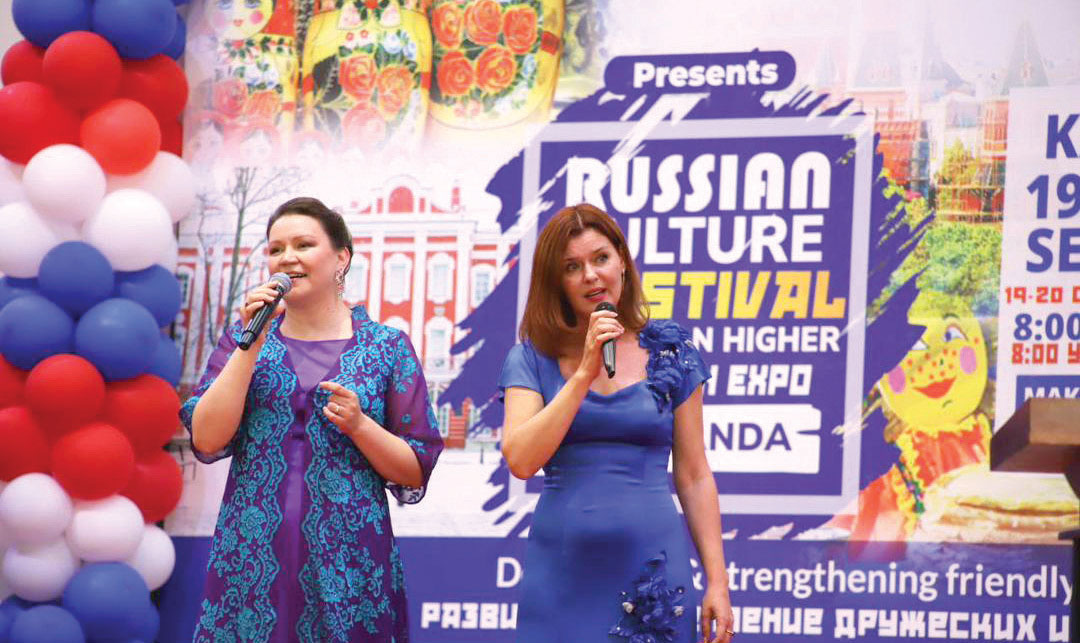
Aspects of that culture have been promoted through annual festivals in Kampala, such as the September 19 – 20 Festival of Russian Culture and a Russian Higher Education Exhibition held at Makerere University, which featured Russian cuisine, crafts workshops, performances by Russian singer Natalya Kirillova, a charity raffle supporting the Albinism House in Wakiso, and a Russian Higher Education Expo.
“Beyond culture and education, the Russian embassy continues to strengthen partnerships with Ugandan counterparts. Tourism between the two countries is growing, with increased travel flows in both directions, supported by outcomes of the Russian-Ugandan Intergovernmental Commission meetings held in Kampala in October,” he said.
ebenezernsubuga405@gmail.com
About the Author