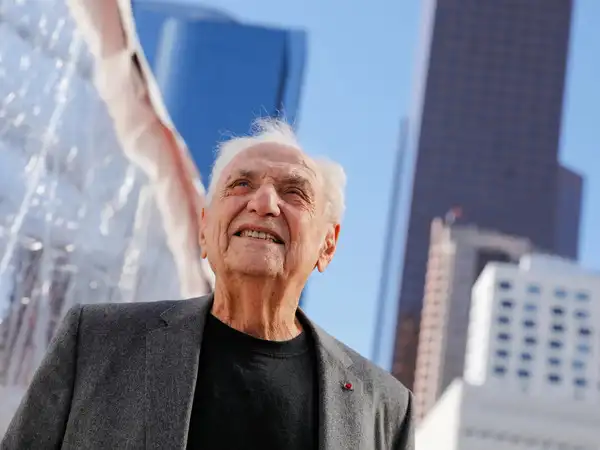
Frank Gehry, the revolutionary architect whose sculptural, boundary-pushing designs reshaped skylines and redefined contemporary architecture, has died at the age of 96. His death was confirmed by his chief of staff, Meaghan Lloyd.
Gehry gained international acclaim with his titanium-clad Guggenheim Museum in Bilbao, Spain, which opened in 1997.
The museum not only transformed the city’s skyline but also revitalized its economy, giving rise to the global term the “Bilbao effect”—the idea that bold, iconic architecture can catalyze urban renewal.
Born in Toronto in 1929, Gehry moved to Los Angeles as a teenager, studying architecture at the University of Southern California and completing postgraduate work at Harvard’s Graduate School of Design.
He quickly distinguished himself by breaking from conventional architectural norms, favoring asymmetry, unconventional materials, and raw, unfinished surfaces, a style later associated with deconstructivism.
Gehry’s early breakthrough came with his Santa Monica home, reimagined using chain-link fencing, plywood, and corrugated metal.
Later, he embraced advanced 3D modelling techniques adapted from aerospace engineering, enabling him to construct sweeping, curvaceous structures once considered impossible.
In 1989, Gehry received the Pritzker Prize, architecture’s highest honor. The jury lauded his “highly refined, sophisticated, and adventurous aesthetic,” comparing his work to jazz for its improvisational spirit.
His iconic designs span the globe: Walt Disney Concert Hall in Los Angeles, Jay Pritzker Pavilion in Chicago, Gehry Tower in Germany, Louis Vuitton Foundation in Paris, Dancing House in Prague, and Hotel Marqués de Riscal in Spain.
The Bilbao Guggenheim, with its sweeping titanium, glass, and limestone forms, remains a hallmark of modern architecture, hailed by Philip Johnson as “the greatest building of our time.”
Gehry’s inventive and unpredictable designs captured the public imagination—and occasional parody. His appearance on The Simpsons, where a crumpled piece of paper supposedly inspired a building, became a running joke he later admitted “haunted” him, despite the profound complexity of his real-world work.
Tributes have poured in worldwide. Bernard Arnault, CEO of LVMH, called Gehry’s Paris building “his greatest masterpiece.” Architecture critic Paul Goldberger described him as “one of the few architects to engage people emotionally,” noting Gehry’s dedication to creative innovation until the very end.
Canadian Prime Minister Mark Carney extended condolences to his family, saying Gehry’s vision “lives on in iconic buildings around the world.” The Bilbao Guggenheim similarly honored him, noting his legacy “will always remain connected to Bilbao.”
Gehry is survived by his wife, Berta Isabel Aguilera; two daughters from his first marriage, Leslie and Brina; and two sons, Alejandro and Samuel.
About the Author