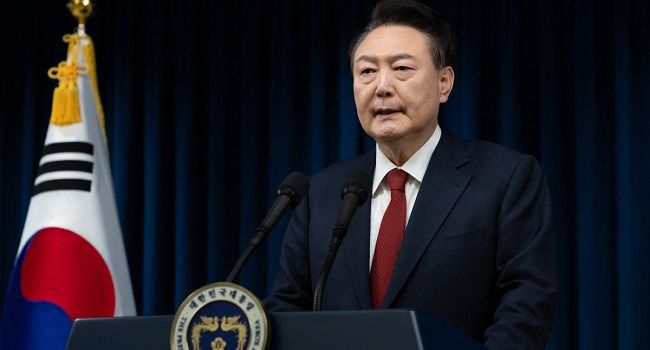
A South Korean court has sentenced former president Yoon Suk Yeol to life imprisonment after convicting him of leading an insurrection through his brief but controversial declaration of martial law in December 2024.
Delivering the verdict at the Seoul Central District Court, presiding judge Ji Gwi-yeon ruled that Yoon’s actions amounted to an attempt to paralyse the legislature and undermine constitutional order.
“The court finds that the intention was to paralyse the assembly for a considerable period,” Judge Ji said. “The declaration of martial law resulted in enormous social costs, and it is difficult to find any indication that the defendant has expressed remorse.”
“We sentence Yoon to life imprisonment.”
The Martial Law Decree
Yoon, 65, stunned the nation on December 3, 2024, when he interrupted late-night television programming to announce the suspension of civilian government and the imposition of military rule.
In his address, he cited unspecified threats from “anti-state forces” and alleged North Korean influence within the National Assembly.
Within hours, troops were dispatched to the assembly building. Lawmakers and staff scrambled to hold an emergency vote, barricading entrances with office furniture to block armed soldiers. Martial law was lifted just six hours later after parliament defied the order and voted to restore civilian authority.
The dramatic episode triggered nationwide protests, rattled financial markets, and caught key allies—including the United States—off guard.
Charges and Conviction
Following his impeachment and arrest, prosecutors charged Yoon with a range of offences, including insurrection and obstruction of justice. They accused him of acting out of a “lust for power aimed at dictatorship and long-term rule.”
Under South Korean law, insurrection carries only two possible penalties: life imprisonment or death. Prosecutors had sought the death penalty during hearings in January.
Although capital punishment remains on the statute books, South Korea has observed an unofficial moratorium since 1997. In practical terms, Yoon’s life sentence ensures he will spend the remainder of his life behind bars.
Yoon has consistently denied wrongdoing, arguing that his actions were intended to “safeguard freedom” and counter what he described as an opposition-led “legislative dictatorship.”
Broader Fallout
The crisis has reverberated across South Korea’s political establishment. Former defence minister Kim Yong-hyun was sentenced to 30 years in prison for his role in the events.
Thousands of Yoon’s supporters gathered outside the courthouse ahead of the verdict, holding placards reading “Yoon Great Again” and “Drop the Charge Against President Yoon.” Police in high-visibility jackets erected barricades of buses around the complex to prevent unrest as a blue prison bus—believed to be carrying the former president—entered the premises.
Yoon is currently being held in solitary confinement while facing additional criminal proceedings. He has already received a separate five-year sentence on lesser charges, and several senior officials implicated in the crisis are also facing substantial prison terms.
In a further blow to the former first family, Yoon’s wife, Kim Keon Hee, was sentenced earlier in January to 20 months in prison on unrelated bribery charges.
A Defining Moment for South Korean Democracy
Long regarded as a beacon of democratic stability in Asia, South Korea has not experienced such a direct challenge to civilian rule since the era of military coups between 1960 and 1980.
Yoon’s failed power bid has revived painful historical memories while underscoring the resilience of the country’s democratic institutions.
The life sentence handed down by the court marks a decisive legal reckoning—and a dramatic fall for a once-powerful leader who pledged to defend constitutional order but was ultimately found guilty of attempting to subvert it.
About the Author