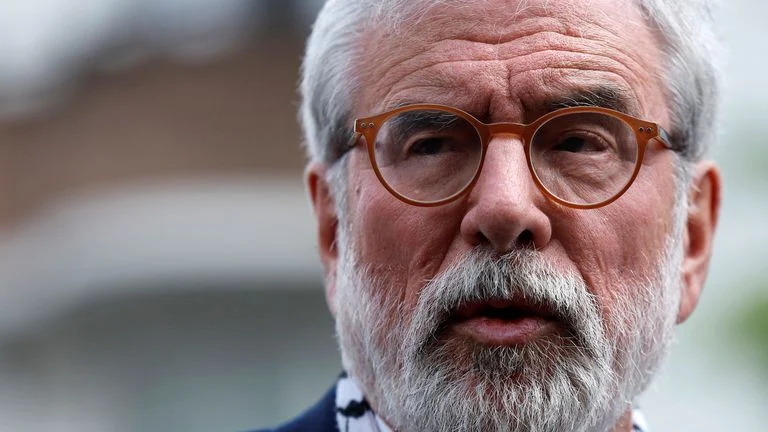
Former Sinn Féin president Gerry Adams appeared at London’s High Court on Monday for a civil lawsuit seeking to hold him accountable for Irish Republican Army (IRA) bombings in Britain, a case that could profoundly impact the legacy of the prominent republican leader.
Adams became Sinn Féin leader in 1983, at a time when the IRA served as the party’s armed wing, establishing himself as the most recognizable face of the movement advocating an end to British rule in Northern Ireland.
He later gained international acclaim as a peacemaker, playing a key role in negotiating the 1998 Good Friday Agreement, which largely ended three decades of sectarian violence known as the Troubles, during which around 3,600 people were killed.
The 77-year-old has consistently denied membership in the Provisional IRA (PIRA), though he has faced long-standing allegations—including from former paramilitary members—linking him to the IRA’s campaign of attacks.
The civil suit was filed by three individuals injured in three bombings: the 1973 attack on London’s Old Bailey, the IRA’s first bombing on the British mainland, and two 1996 blasts targeting London’s Docklands and Manchester.
The claimants are seeking a nominal £1 ($1.33) in damages and a court declaration that, on the balance of probabilities, Adams was a senior member of the IRA.
Adams’ legal team maintains that there is “no credible evidence to support the claimants’ allegation that (Adams) was a senior member of the PIRA.”
Claimants’ lawyer Anne Studd argued that Adams was “so intrinsically involved in the PIRA organisation that he is as culpable for the assaults… as the individuals who planted and detonated the bombs.” She cited his participation in high-level meetings with the British government in the early 1970s as evidence, though Adams asserts he attended solely as a Sinn Féin representative.
Studd also referenced Dolours Price, one of nine people convicted over the Old Bailey bombing, who previously accused Adams of involvement in the IRA’s bombing campaign in Britain.
The civil trial marks a rare legal challenge against Adams over alleged paramilitary activity, with the potential to reshape public perception of the former Sinn Féin leader and his role during Northern Ireland’s Troubles.
About the Author