Rising spending outpaces revenue growth, pushing government toward heavier debt financing despite new revenue measures….
Nigeria’s Federal Government has significantly increased its borrowing plan for 2026, raising fresh concerns about the country’s growing reliance on debt to fund public spending.
According to official documents, the government now plans to borrow N29.20 trillion, a sharp jump from the earlier estimate of N17.89 trillion outlined in the 2026 Abridged Budget Call Circular released in December 2025.
The revised figure, captured in the 2026 Appropriation Bill approved by the National Assembly and detailed in the House of Representatives’ Order Paper dated March 31, reflects a broader expansion in both the budget size and fiscal deficit.
Deficit widens as spending surges
At the heart of the increase is a significantly larger fiscal deficit, now projected at N31.46 trillion. Total government expenditure is expected to climb to N68.32 trillion, while projected revenue stands at N36.87 trillion.
The widening gap between earnings and spending has forced the government to lean more heavily on borrowing, which will account for the bulk of deficit financing.
Other funding sources remain relatively limited. Proceeds from asset sales and privatisation are estimated at just N189.16 billion, while multilateral and bilateral project-tied loans are expected to contribute about N2.05 trillion.
Notably, the earlier borrowing projection of N17.89 trillion was based on a deficit estimate of N20.12 trillion, underscoring the scale of the upward revision in financing needs.
Revenue growth fails to keep pace
While revenue projections have improved, they still fall short of matching the pace of expenditure growth.
Of the expected N36.87 trillion in revenue:
- 92 trillion will come from federation revenues
- 31 trillion from independent revenues
- 85 trillion from government-owned enterprises
Additional inflows include N1.37 trillion in grants and aid, as well as N300 billion from special funds.
Despite these gains, they remain insufficient to offset rising government spending, further widening the deficit.
Debt servicing weighs heavily
Debt servicing continues to place significant pressure on public finances, with N15.81 trillion earmarked for this purpose, one of the largest components of the budget.
A breakdown shows:
- 16 trillion for domestic debt servicing
- 36 trillion for foreign debt obligations
Meanwhile, recurrent (non-debt) expenditure is projected at N15.43 trillion, while capital expenditure stands at N32.29 trillion, signaling a strong focus on infrastructure and development projects. Statutory transfers are expected to reach N4.80 trillion.
Budget expansion and funding strategy
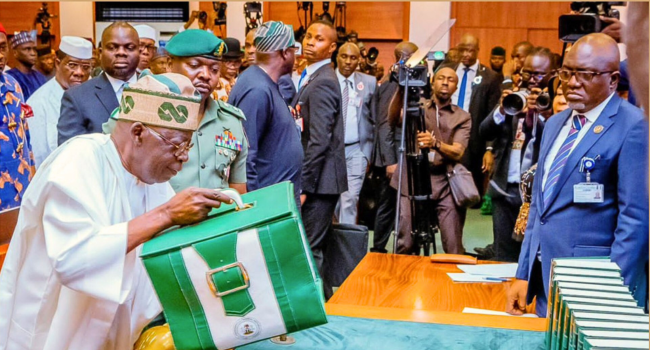
Earlier, Bola Tinubu requested legislative approval to increase the 2026 budget by N9 trillion, pushing it from N58.4 trillion to N67.4 trillion.
The proposal, conveyed to Senate President Godswill Akpabio, was accompanied by plans to boost revenue and adjust key assumptions.
Among the measures:
- A $10 per barrel increase in the oil benchmark, expected to generate about 592 trillion
- Increased tax contributions from the telecom sector
Projections indicate that MTN Nigeria could contribute N724 billion in company income tax, while Airtel Nigeria is expected to add N150 billion, bringing total additional telecom revenue to N874 billion.
Rising debt concerns persist
Despite these revenue-enhancing efforts, lawmakers approved an additional N6.163 trillion in external borrowing to close the financing gap, maintaining that Nigeria’s debt levels remain within manageable limits.
However, with borrowing set to cover the majority of the deficit, concerns are mounting over the sustainability of the country’s debt trajectory.
As Nigeria pushes forward with an ambitious spending plan, the balance between growth, investment, and fiscal stability is likely to remain a central issue in the months ahead.