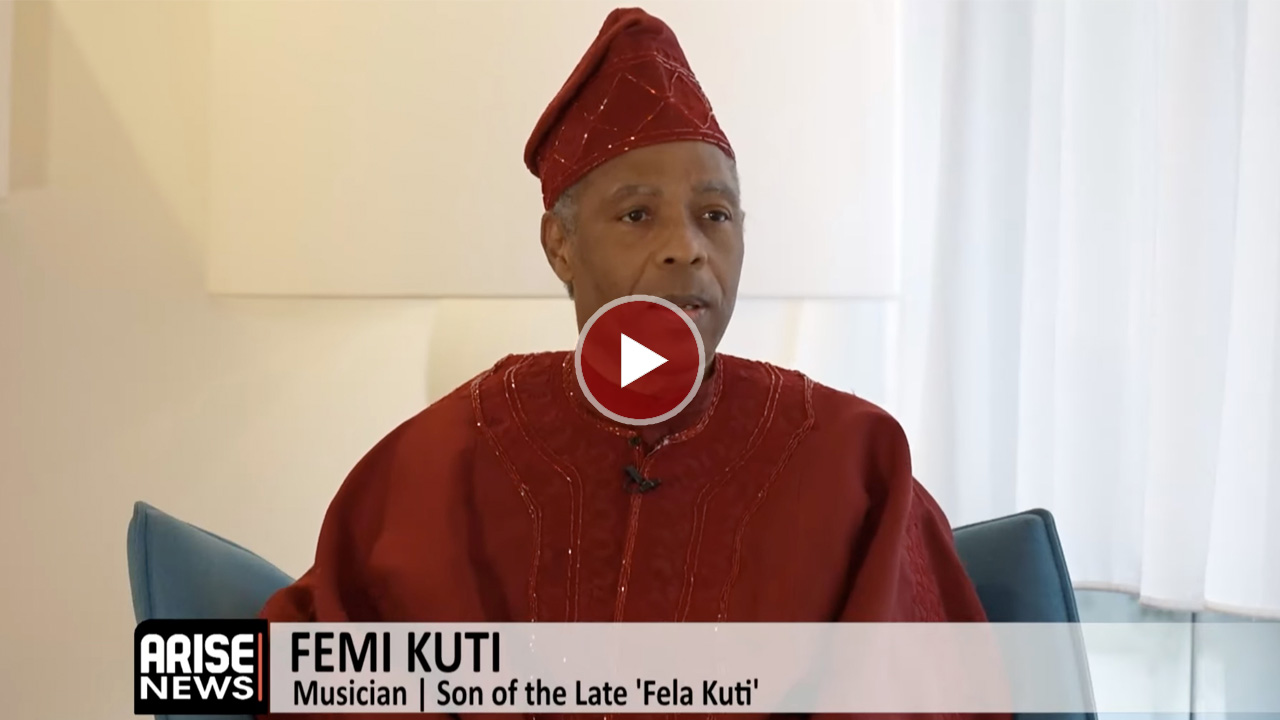
Afrobeat exponent Femi Kuti has reflected on the posthumous Grammy Lifetime Achievement Award given to his father, Afrobeat pioneer Fela Anikulapo Kuti, describing the recognition as a reward for an artist who lived and created strictly by his own rules.
Speaking to ARISE News in Los Angeles, Femi reacted to the Recording Academy’s decision to honour Fela more than three decades after his death, explaining what the moment means to the Kuti family and how his father’s influence still shapes global music and African cultural identity.
At the ceremony, the Recording Academy announced: “The honour is all ours to present a recording academy’s lifetime achievement award to Fela Kuti. Accepting on his behalf, are his children. Femi, Yeni and Kunle Kuti.”
Femi said the news came as a surprise when the Academy contacted the family. “I was surprised, because, they called us to tell us he was going to receive it and we were like….well I was shocked. And I was like, wow. Then it was awesome, Good feeling, I’ve always known my father was a genius, I’ve always respected adored.”
He explained that Fela’s music stood alongside the greatest composers of his era, even if he never embraced mainstream culture. “Growing up his music was always special, we love reggae, we love, funk, jazz, but coming back to listen to him, I felt he was on the same level as any great composer or artist at that time.”
According to Femi, while global stars dominated popular culture, Fela chose a different path. “He had great influence with mainstream musicians. He’s just, he was never mainstream. I would say he didn’t participate. He was more focused on probably what he wanted to achieve, musically.”
He said the Grammy recognition validates that independent spirit. “So, it was fantastic news that, wow, a man that stood by his own rules is rewarded.”
Femi also stressed the importance of Fela becoming the first African recipient of the honour. “Many Africans have done quite well in the music scene. So for him to be the first musician from Africa to be awarded, it’s a great deal for us and for them.”
He suggested that the Academy had to recognise Fela’s far reaching impact before making the decision. “They must have sat down to say, He deserves it, he deserves it… Beyoncé, admires him, Jay Z. Hip hop was influenced by him. So hardly any great musician, past and present, that has not heard or was influenced by his music.”

Addressing critics, Femi added bluntly:
“And if anybody is complaining, go and create your own award.”
Femi also clarified that the honour was not something the family campaigned for.
Fela’s daughter, Yeni Kuti, also described the moment as significant for the continent.
“I’m so happy that Fela who has always represented Africa, not just Nigeria, but Africa has received this award.”
She said the recognition should inspire young creatives. “It’s just a statement to African, young up and coming artists, do what’s going to go on after our lifetime that’s what we need to do so that our legacy continues.”
The award comes amid renewed public debate about Fela’s relevance following a January exchange involving his son Seun Kuti and singer Wizkid, which reignited conversations around how African music success should be measured beyond charts and awards.
Femi addressed the comparisons directly.
“Anybody who feels they are greater than fela let the person be. Time will tell, For me Fela is the greatest.”
Yeni reinforced that sentiment, urging respect for cultural pioneers. “Don’t compare chalk and cheese. Fela is a legend, give him his flowers. Compare yourself with your peers, and leave our legends alone.”
For the Kuti family, the Grammy honour is not just celebration, but confirmation of Fela’s enduring role as a musical, political and cultural force whose influence extends far beyond entertainment.
It isn’t just a trophy, but a reminder that Fela’s music, politics and resistance still speak across generations, and that the world’s biggest music institutions are only now catching up with his legacy.
Ademide Adebayo
About the Author