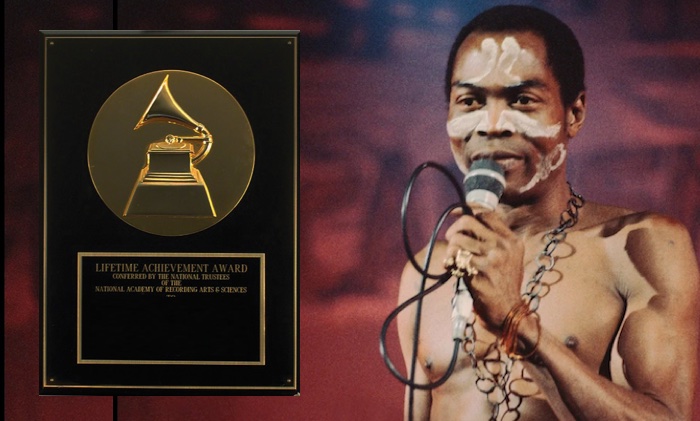
Legendary Afrobeat pioneer Fela Anikulapo Kuti is set to receive a posthumous Lifetime Achievement Award at the Grammy Awards, nearly three decades after his death, marking a historic first for an African musician, the BBC reports.
Widely celebrated as the architect of Afrobeat, Fela’s recognition comes amid growing global appreciation of African music, following the worldwide success of Afrobeats and the Grammys’ introduction of the Best African Performance category in 2024.
Reacting to the news, Fela’s son and Afrobeat musician Seun Kuti said, “Fela has been in the hearts of the people for such a long time. Now the Grammys have acknowledged it, and it’s a double victory. It’s bringing balance to a Fela story. The global human tapestry needs this, not just because it’s my father.”
Long-time friend and former manager Rikki Stein welcomed the honour as “better late than never,” noting that Africa has historically been marginalised in global music award considerations.
Stein says it is important to recognise Fela as a man who championed the cause of people who had “drawn life’s short straw”, adding that he “castigated any form of social injustice, corruption [and] mismanagement” in government. “So it would be impossible to ignore that aspect of Fela’s legacy,” he says.
Members of Fela’s family, friends, and colleagues are expected to attend the Grammy ceremony to receive the award on his behalf and celebrate a legacy that fused music with political resistance and cultural assertion.
He pioneered the Afrobeat genre alongside drummer Tony Allen, blending West African rhythms, jazz, funk, highlife, extended improvisation, call-and-response vocals and politically charged lyricism.
Across a career spanning roughly three decades until his death in 1997, Fela Kuti released more than 50 albums and built a body of work that fused music with ideology, rhythm with resistance, and performance with protest. His music incurred the wrath of Nigeria’s then-military regimes.
Beyond music, Fela was a fearless critic of social injustice, corruption, and military rule in Nigeria, using his art as a weapon against oppression. His activism reached a flashpoint in 1977 after the release of Zombie, when soldiers raided and burnt his Lagos commune, Kalakuta Republic, leading to the death of his mother, Funmilayo Ransome-Kuti, from injuries sustained during the attack.
Rather than retreat, Fela transformed personal tragedy into protest, famously carrying his mother’s coffin to government offices and releasing Coffin for Head of State, solidifying his role as a symbol of defiance and resilience in the face of oppression.
Fela’s ideology was a blend of pan-Africanism, anti-imperialism, and African-rooted socialism.
He was born Olufela Olusegun Oludoton Ransome-Kuti, but dropped Ransome because of its Western roots. In 1978, he married 27 women in a highly publicised ceremony, bringing together partners, performers, organisers and co-architects of the cultural and communal vision of Kalakuta Republic. Fela Kuti endured repeated arrests, beatings, censorship and surveillance by the security forces. Yet repression only amplified his influence.
This posthumous Grammy award not only cements Fela’s global musical legacy but also honours the enduring impact of his activism, which continues to inspire generations worldwide.
Melissa Enoch
About the Author