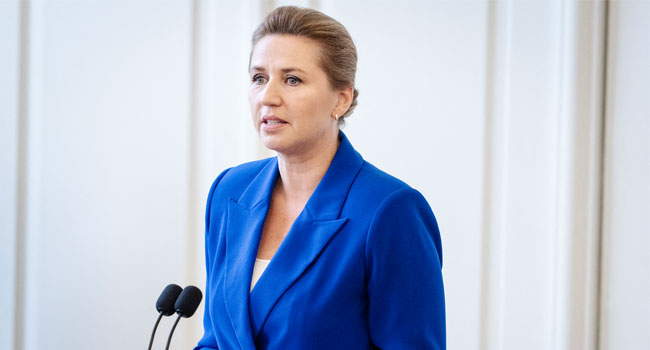
Denmark’s Prime Minister Mette Frederiksen has said “Europe will not be blackmailed” following US President Donald Trump’s threat to impose tariffs on allied nations over opposition to his proposed takeover of Greenland.
Trump has said he will introduce a new 10 percent levy on goods from 8 allied countries if they resist US control of the autonomous Danish territory. The proposed measures have drawn a sharp response from European leaders, who warned of damage to transatlantic relations.
Frederiksen and other European leaders issued a joint statement on Sunday, saying the tariffs risked “undermin[ing] transatlantic relations and risk a dangerous downward spiral”.
On Monday, Trump claimed Denmark had failed to secure Greenland against external threats.
“Nato had been telling Denmark, for 20 years, that ‘you have to get the Russian threat away from Greenland.’ Unfortunately, Denmark has been unable to do anything about it. Now it is time, and it will be done!!!” he said.
Trump has repeatedly argued that Greenland is vital to US security and has said Washington would get the territory “the easy way” or “the hard way”. He has not ruled out the use of force, prompting widespread criticism across Europe.
The tariffs would apply to Denmark, Finland, France, Germany, the Netherlands, Norway, Sweden and the UK. Trump said an initial 10 percent tariff would take effect on February 1 on “any and all goods” sent to the US, rising to 25 percent in June.
The levies would “be due and payable until such time as a Deal is reached for the Complete and Total purchase of Greenland”, he wrote on his Truth Social platform.
In their joint statement, the 8 countries reaffirmed their “full solidarity with the Kingdom of Denmark and the people of Greenland” and stressed their commitment to “strengthening Arctic security as a shared transatlantic interest”.
They added: “We stand ready to engage in a dialogue based on the principles of sovereignty and territorial integrity that we stand firmly behind.”
Writing separately on Facebook, Frederiksen said Denmark was seeking cooperation, not confrontation.
“We want to cooperate and we are not the ones seeking conflict. And I am happy for the consistent messages from the rest of the continent: Europe will not be blackmailed,” she wrote.
“It is all the more important that we stand firm on the fundamental values that created the European community.”
UK Prime Minister Keir Starmer also criticised the tariff threat, calling it “completely wrong”, and said Britain would raise the issue directly with the White House.
Greenland, which is sparsely populated but resource rich, occupies a strategic position between North America and the Arctic, making it important for missile warning systems and maritime monitoring.
US Treasury Secretary Scott Bessent said Greenland’s security depended on US control.
“Greenland can only be defended if it is part of the US, and it will not need to be defended if it is part of the US,” he said.
“I believe that the Europeans will understand that this is best for Greenland, best for Europe and best for the United States.”
Norwegian Foreign Minister Espen Barth Eide said respect for sovereignty was a “non negotiable” principle.
“If we are to live in peace and if we are to be able to co operate on shared problems, we have to start by the mutual recognition of each others sovereignty and territorial integrity,” he said.
French President Emmanuel Macron said he would seek activation of the EU Anti Coercion Instrument if Trump proceeds with the tariffs.
Trump is due to speak at the World Economic Forum in Davos on Wednesday, alongside Macron and other European leaders. Canadian Prime Minister Mark Carney said his country was “concerned by the recent escalation” and would increase Arctic security within Nato.
Public opposition in Denmark and Greenland remains strong. Demonstrations were held in Nuuk and several Danish cities, while Democratic Senator Chris Coons said Trump’s rhetoric was “not constructive”.
Greenland’s representative to the US said only 6 percent of Greenlanders supported joining the US in a January 2025 poll, with 85 percent opposed. A recent Reuters Ipsos poll found just 17 percent of Americans support US control of Greenland.
Faridah Abdulkadiri
About the Author