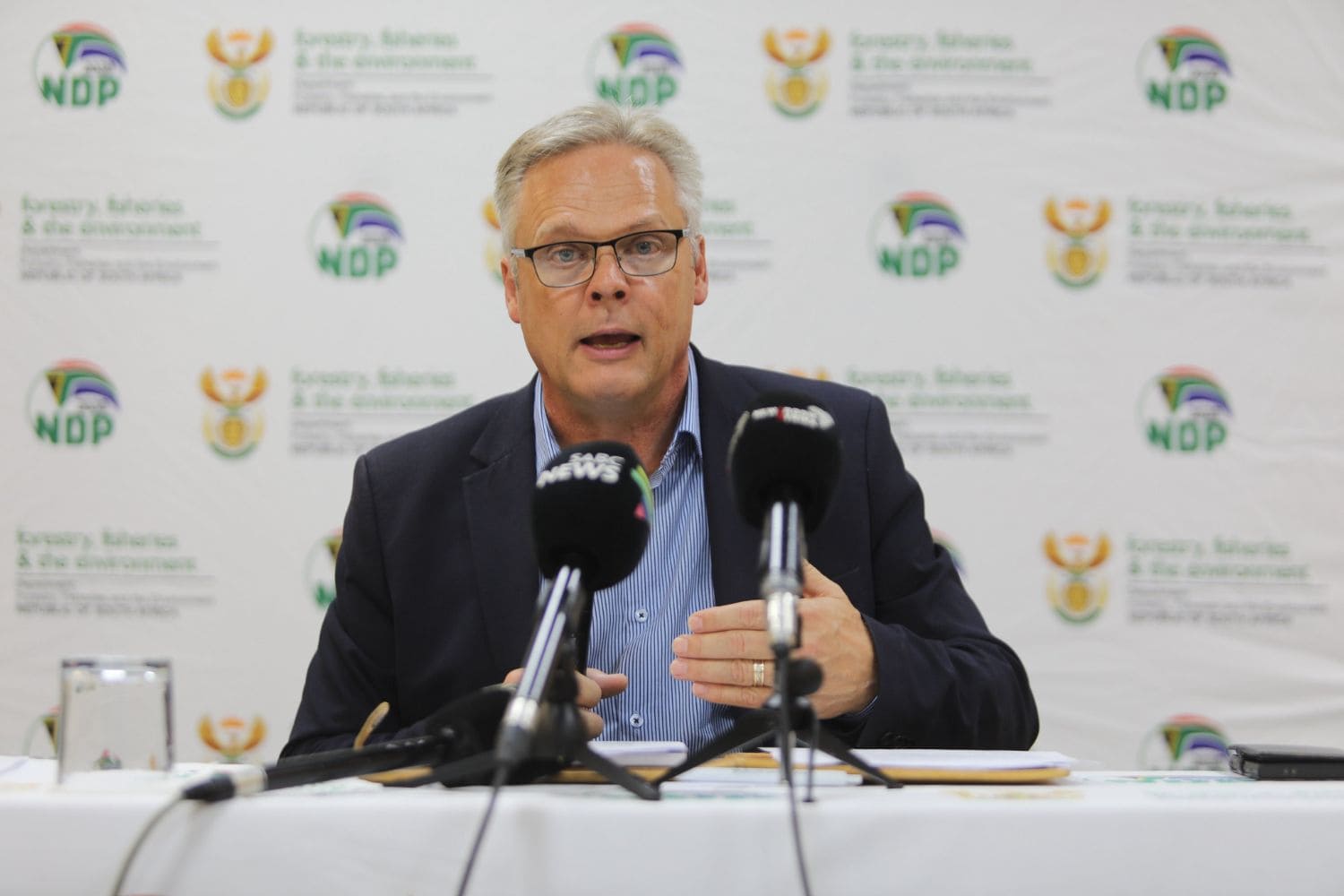
Forestry, Fisheries and the Environment Minister Willie Aucamp has used his 100-day milestone in office to outline a sweeping agenda aimed at transforming how the country manages its natural resources while simultaneously driving economic growth and job creation.
Speaking on Friday, 27 February 2026, the minister laid out seven strategic priorities designed to reshape the department’s approach to everything from climate change to coastal communities and fiscal accountability.
Minister Willie Aucamp is today in Skukuza, at the heart of the iconic @SANParksKNP, where he is briefing members of the media on his first 100 days in office.
The briefing provides an opportunity for the Minister to reflect on key milestones achieved by DFFE since his… pic.twitter.com/hkEKJQnax8
– Environmentza (@environmentza) February 27, 2026
A department with untapped economic potential
Aucamp was emphatic that the environment portfolio is far more central to South Africa’s economic future than most people recognise.
The department, he argued, sits at the intersection of conservation and opportunity.
“Environmental protection is not about creating unnecessary barriers to make it harder for businesses to operate, nor is it about making it difficult for regular people to access and enjoy our natural resources,” he stated.
He described the department’s role as protecting and conserving South Africa’s natural resources while enabling inclusive economic growth, job creation and environmental resilience, and said all seven of his updated priorities are anchored in that dual mandate.
Science-based decision-making sits at the top of that list, with Aucamp insisting that policy must be driven by data rather than emotion.
“Decisions based on emotion can’t be defended, whilst decisions based on science and data can and [are] easy to justify,” he said.
ALSO READ: Proposed Cape Town sea reclamation project to unlock 30 000 jobs and R8 billion in GDP
Progress on environmental regulation and energy infrastructure
Among the more concrete achievements of his first 100 days, Aucamp revealed that the department processed 80 Environmental Impact Assessment applications, 54 of which were linked to energy generation and transmission infrastructure.
Those approvals collectively enabled 4 861 megawatts of electricity generation capacity, a significant contribution to addressing the country’s ongoing energy crisis.
He has also concluded the adjudication of 65 statutory appeals under national environmental and marine living resources legislation, with a further 70-plus fishing industry appeals already adjudicated.
Outcomes on the latter will be announced on 5 March.
Additional legal professionals have been appointed to the appeals department to clear the backlog and speed up future processes.
“Successful environmental sustainability is not intended to obstruct development, but rather, is intended to support economic growth and development that protects and conserves our environment,” Aucamp stated.
Rhino poaching down, enforcement efforts ramped up
On wildlife crime, the minister reported that rhino poaching declined by 16% in 2025 compared to the previous year, with 352 rhinos killed nationally, down from 420 in 2024.
He credited coordinated anti-poaching efforts across state and private sectors for the improvement, and thanked rangers and private rhino farmers for their role in achieving the decline.
Several new legislative instruments were also published during his first 100 days, covering pollution prevention plans under the Climate Change Act, a draft National Waste Management Strategy for 2026, and regulations targeting persistent organic pollutants listed under the Stockholm Convention.
ALSO READ: Good news for South Africa’s rhino poaching fight, but alarm bells at Kruger National Park
Climate action and coastal communities take centre stage
Aucamp was candid about South Africa’s vulnerability to climate change, pointing to recent severe flooding in Mpumalanga and Limpopo as evidence that the threat is immediate.
“We simply do not have the luxury to pretend that climate change is still a far-flung concept,” he claimed.
He plans to visit flood-affected communities in the near future.
On the coast, the minister engaged with small-scale fishers, mayors of coastal towns, and commercial operators, including Sea Harvest.
ALSO READ: Don’t eat the seafood: Residents warned not to collect washed-up deadly crayfish
He opened a R172 million fishmeal factory in St Helena Bay and championed the CoastCare signage programme, which includes braille and QR-enabled audio content to improve coastal accessibility.
Fiscal discipline and departmental accountability
Aucamp also flagged governance improvements, including an unqualified audit outcome for the 2024-25 financial year and monthly reviews of the department’s Audit Action Plan.
He restored delegations to Deputy Directors-General that had previously been revoked, a move he said immediately improved spending in key delivery areas.
The department generated over 20 000 work opportunities through the Expanded Public Works Programme and employed 526 unemployed graduates through the Municipal Environmental Graduates Programme.
Looking ahead, he remained resolute. “If we remain guided by sustainability, inclusion and integrity, we can build a future where environmental protection and economic growth are not in competition, but in partnership,” Aucamp said.
Listen: Minister Willie Aucamp on his first 100 days in office
READ NEXT: Donations flood in as R2 million raised to save South Africa’s iconic Kruger National Park
About the Author