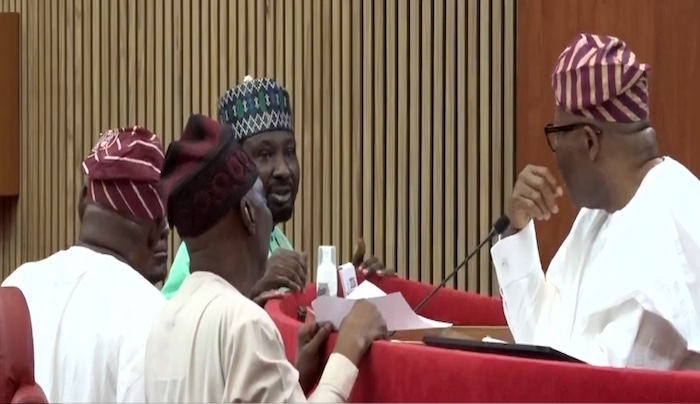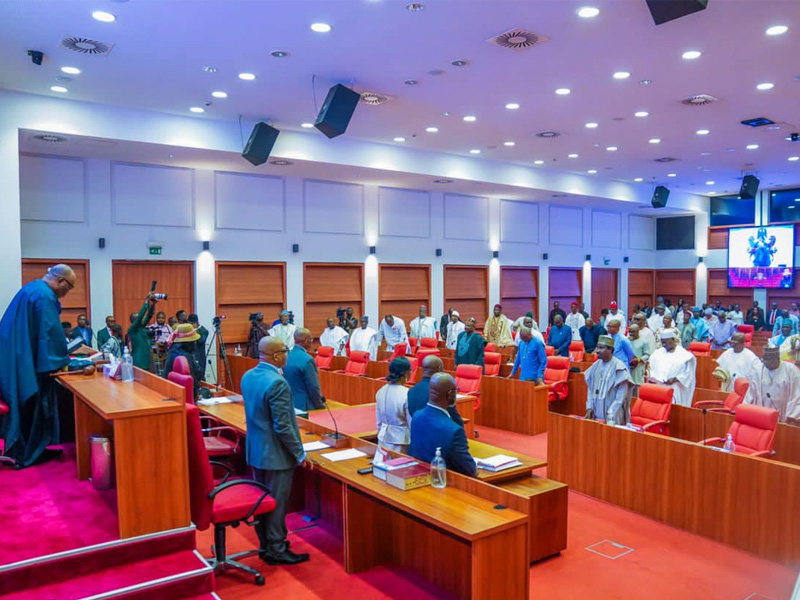
As Senate meets in an emergency session today to de-liberate over amendments to the Electoral Act, several Civil Society Organisations (CSOS) have warned that delay in conclusion of the amendment could introduce legal uncertainty that might compromise preparations for the 2027 general election.
The coalition of civil society groups called on the National Assembly Conference Committee on Electoral Act Amendment Bill to adopt the House of Representatives’ version mandating electronic transmission of electoral results ahead of the 2027 elections.
The CSOs, comprising Centre for Media Society, The Kukah Centre, International Press Centre, Elect Her, Yiaga Africa, The Albino Foundation, and Nigerian Women Trust Fund, stated that the call became urgent following Senate’s rejection of electronic transmission of election results.
Equally, on Monday, a presidential hopeful, Mr. Peter Obi, took the battle for credible elections to the National Assembly, joining hundreds of protesters in a dramatic show of defiance against what demonstrators described as a fresh attempt to rig the 2027 elections through the backdoor.
At the same time, a Senior Advocate of Nigeria (SAN), Dr. Olisa Agbakoba, threw his weight behind growing calls for the National Assembly to amend the Electoral Act to make electronic transmission of election results in real-time mandatory ahead of the 2027 general election. Agbakoba warned that failure to do so would sustain electoral disputes and weaken democratic credibility.
Similarly, Nigerian Guild of Editors (NGE) expressed concern over the controversy surrounding Senate’s position on the transmission of election results ahead of the 2027 general election.
Human Rights Writers Association of Nigeria (HURIWA) expressed “unquantifiable shock and unrelenting consternation” against the senate over the rejection of amendment to the electoral law to mandate Independent National Electoral Commission (INEC) to compulsorily implement the real-time electronic transmission of election results.
Addressing journalists in Abuja, on Monday, on behalf of the other CSOs, Mr. Jake Epelle, decried reports that Senate had removed the proposed 10-year ban for offences related to the buying and selling of Permanent Voters’ Cards (PVCs).
Epelle stated that the divergence between Senate and House of Representatives on the amendments had profound implications for the integrity of the 2027 general election.
He emphasised that the protracted amendment process had created legal uncertainty around INEC’s constitutionally mandated electoral preparations, potentially compromising the commission’s ability to conduct credible elections.
He explained that Section 28 (1) of the Electoral Act 2022 empowered INEC to issue notice of elections 360 days before the date of election.
Epelle lamented that the legal uncertainty created by ongoing amendments had prevented INEC from releasing the timetable for the 2027 elections, placing the commission in potential violation of the extant law.
He, however, maintained that the 2022 Electoral Act remained operative until amended, while insisting that the status of the Electoral Bill did not suspend INEC’s statutory obligations.
The CSOs called on the electoral body to issue the election timetable and schedule for the 2027 general election in accordance with the provisions of the Electoral Act 2022 without further delay.
They stated, “With respect to the provision on electronic transmission of results. We strongly recommend that the committee adopts the House of Representatives’ position mandating electronic transmission, with a modification addressing technological specificity.
“As currently drafted, explicit reference to the INEC Result Viewing (IReV) portal creates potential rigidity. Since electoral technology evolves, statutory references to specific platforms require legislative amendment each time technological infrastructure changes.
“This approach aligns with the existing Electoral Act provisions regarding the Bimodal Voter Accreditation System (BVAS), which permits ‘BVAS or any other technological device’ for accreditation, establishing a precedent for technology-neutral legal frameworks that combine mandatory obligations with implementation flexibility.”
The groups said, “We hereby proposed the following modification to Clause 60(3); The designated election official shall electronically transmit all election results in real time, including the number of accredited voters, directly from the polling units and collation centres to a public portal and the transmitted result shall be used to verify any other result before it is collated.
“For the avoidance of doubt, we provide clarity on the concept of ‘real-time”. Real-time electronic transmission of results means sending the official polling unit results recorded on Form EC8A electronically from the polling unit directly to a central results portal immediately after voting has ended, ballots have been counted, and the results have been publicly announced at the polling unit.”
The CSOs believed, “This transmission happens in the presence of party agents, observers, and voters at the polling unit. It ensures that the exact results recorded at the polling unit are uploaded and available for public verification before they are physically transported for collation. Real-time transmission.”
Samson Itodo, speaking at the event, maintained that if Senate did not adopt the position of the House, the upper chamber would have betrayed the trust of Nigerians.
According to him, “If they refused, what they would be telling Nigerians is that the legitimacy of the 2027 elections is thrown into jeopardy.”
The CSOs also urged the conference committee to adopt the position of the House of Representatives, which approved downloadable missing and unissued voters’ cards.
They emphasised that data from INEC’s 2023 general election cycle indicated that approximately 6.2 million registered voters failed to collect their PVCs, resulting in effective disenfranchisement despite completed registration.
They were of the opinion that downloadable PVCs eliminated such barriers to voter participation.
The groups stated, “Regarding electoral timelines, we strongly recommend retaining current provisions: 360 days for notice of elections, 180 days for submission of candidate lists, and 150 days for publication of nominations by INEC.
“Compressing these timelines increases logistical risk, constrains ballot paper production and distribution, and heightens the chances of operational failures.
“We reiterate our recommendation that the National Assembly should expeditiously conclude the amendment process and transmit the final bill to the President within two weeks.”
Mark: ADC Will Conduct Free, Fair Primary Polls Throughout Nigeria
National Chairman of ADC, Senator David Mark, said the party would conduct free, fair, and credible party primaries across the states of the federation for the emergence of candidates that would carry the party’s flags at various levels next year.
Mark assured that ADC would “be a reliable alternative to the ruling All Progressives Congress.”
He gave the assurance in Minna, the Niger State capital, in a message to an occasion marking the movement of the 2023 Labour Party (LP) governorship candidate, Mr Joshua Bawa, and other prominent members of the party to ADC.
Mark stated that ADC “is ready and prepared to take over the mantle of leadership from the APC at all levels in the country”.
Represented by ADC National Women Leader, Mrs. Naomi Lasara Abel, Mark explained that ADC members were not bothered by the defection of 30 governors and some members of the National Assembly to APC, since the Nigerian electorate did not move with them.
He stated, “What we need is the passage of transmission of election results electronically, in line with Section 60 subsection 3 of the Electoral Act, as amended.” He said, “This will serve as game changer in the politics and election in Nigeria.”
Mark appealed to Nigerian women, whom he said constituted about 70 per cent of voters in Nigeria, to come out en masse to obtain their Permanent Voters Cards (PVCs) to enable them elect credible leaders of their choice in the 2027 elections and achieve the desired positive change in the country.
In his remarks, Bawa advised members of ADC to galvanise support at the grassroots to ensure victory for the party in all elections next year.
Chuks Okocha, Adedayo Akinwale, Sunday Aborisade, John Shiklam, Sunday Ehigiator, David-Chyddy Eleke, Yemi Kosoko and Laleye Dipo
About the Author