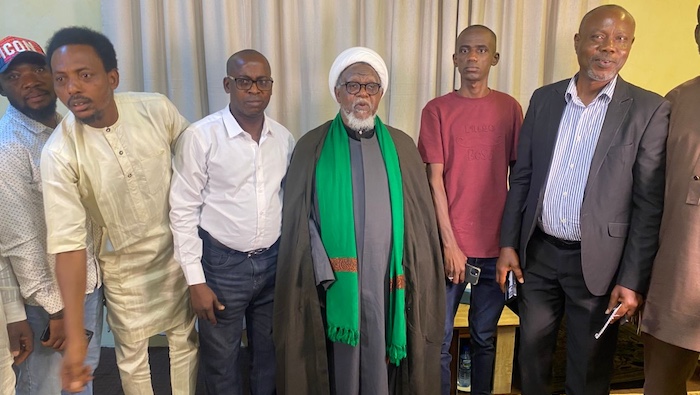
The Leader of the Islamic Movement in Nigeria (IMN), popular known as Shiites Sheikh Ibrahim El-Zakzaky, on Wednesday said that even in death, any reckoning with the late President Muhammadu Buhari over the 2015 killing of more than 1,000 of his followers in Zaria, Kaduna State, will occur on the Day of Judgment.
He also called on the government of President Bola Ahmed Tinubu to address the tragedy or provide redress to the victims.
Arise News reports that the 2015 incident, which occurred during a Maulud celebration in Zaria when IMN members occupied a major highway, took place during the administration of President Muhammadu Buhari
The incident took place when IMN members reportedly blocked the convoy of the then Chief of Army Staff, Lt-Gen. Tukur Buratai, as he made his way to a passing-out parade in Zaria.
The military described it as an assassination attempt, a claim dispelled by the IMN.
What started as a standoff quickly escalated into a violent confrontation, with soldiers opening fire on them after claiming Buratai’s life was at risk.
The IMN disputed this account, insisting they were unarmed and that the military responded with unjustifiable force.
The following hours and days, soldiers carried out coordinated operations at IMN locations, including El-Zakzaky’s residence.
Human rights organisations and international observers later reported that hundreds were killed in the crackdown, though the military contested the casualty figures.
Following years of detention and a series of court battles, El-Zakzaky and his wife, Zeenat, were eventually released from Kaduna prison in July 2021 after a State High Court discharged and acquitted them of all charges.
Speaking at a press conference in Abuja, El-Zakzaky recalled the December 2015 attack.
He responded to questions by Arise News Correspondent if he had forgiven the late President Buhari following the incident.
El-Zakzaky said, “Now, regarding Buhari, it is simple. He has passed away. We will meet on the day of judgment. One of his Ministers phoned me when I was in blood. I told the Minister, now I am waiting for my blood to drain so that I will pass and I told him my greetings to General Buhari. I hope they will do the government well. We will meet on the day of judgment.”
The leader of the Shiites movement also criticised the current administration for failing to fulfill promises made prior to taking office.
He said members of the administration visited him prior to taking over office and promised compensation.
“They made promises. They didn’t say they would punish those perpetrators, but at least they said they would compensate for properties destroyed. But when they came to power, they said nothing. So nothing has been done. They do not even acknowledge that anything has happened”, he said.
El-Zakzaky also elaborated on human rights violations while lamenting the repeated denial of freedom of assembly, freedom of speech, and other basic rights, citing incidents in Nigeria and abroad, including demonstrations in support of Palestine
“All the time, those in authority think that they have every right to do anything they so wish, and no one should question that. Therefore, they break all those rights, they deny people their own rights, and they don’t care”, he added.
He alleged that those in government should be blamed for the worsening insecurity across the country, adding that “they would end it if they want to”.
On the upcoming commemoration of the 2015 incident, El-Zakzaky said, “This year, we will remember the Zaria Massacre 10th anniversary. We will mark it with display, with pictures, motion pictures, and still picture.”
He described the event as an opportunity to document the tragedy and preserve the memory of the victims.
The IMN leader while stressing the resilience of his movement, added, “You cannot destroy an ideology with a gun. It is freedom. We are speaking, we are writing. And what we say and what we write goes to the minds of the people, and they accept it. You cannot frighten us with guns.”
He maintained that the movement will continue to assert its ideological and numerical strength while seeking recognition, accountability, and redress.
Friday Olokor
About the Author