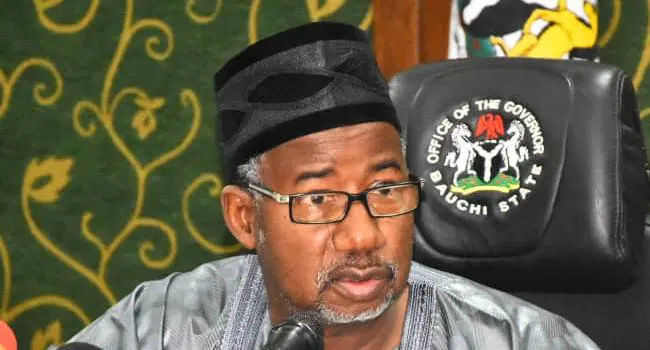
The Economic and Financial Crimes Commission (EFCC) has firmly rejected allegations by Bauchi State Governor, Bala Mohammed, that the anti-graft agency is being used by the Minister of the Federal Capital Territory, Nyesom Wike, to harass and persecute him.
Describing the claims as “as wild as they are far-fetched,” the EFCC said it was deeply displeased by attempts to portray the commission as a tool in the hands of political interests.
In a statement issued on Friday by its Head of Media and Publicity, Dele Oyewale, the EFCC stressed that it is an independent, non-partisan agency established to investigate and prosecute economic and financial crimes without fear or favour.
“The Economic and Financial Crimes Commission views with great displeasure the claims of Bauchi State Governor, Bala Mohammed, that the commission is being deployed by political opponents, particularly the Minister of the Federal Capital Territory, Nyesom Wike, to persecute him and his aides,” the statement said.
“It is mischievous and condemnable to suggest that the EFCC is a pliable agency that panders to the whims of political office holders. No political office holder is in a position to influence the investigative activities of the commission.”
The anti-graft agency described it as derogatory for Governor Mohammed to link its activities in Bauchi State to the influence of Wike, adding that such claims were intended to distract from issues of accountability.
According to the EFCC, the governor failed to disclose that he was already standing trial for money laundering at the time he won election as Bauchi State governor, noting that the case was only suspended due to the constitutional immunity attached to his current office.
“If Bala Mohammed wants to be honest, he would tell Nigerians that he was already facing money laundering charges when he became governor. Only constitutional immunity has placed that case in abeyance. Who influenced the commission to investigate him in 2016 and charge him to court?” the EFCC queried.
The commission further explained that in the current matter involving some officials of the Bauchi State Government, the facts have already been placed before the court, urging members of the public to examine the charges and determine for themselves whether the case is rooted in vendetta or in thorough and professional investigation.
It added that the charges clearly explain why Governor Mohammed, as the approving authority in the state, was mentioned.
Terrorism Financing Allegations
Addressing claims surrounding terrorism financing, the EFCC said raising alarm over such serious allegations amounted to “crying wolf.”
“The commission did not invent the law. Where offences punishable under extant laws exist, the EFCC would be failing in its responsibility if it looked the other way,” the statement said.
The agency emphasized that public accountability must remain the priority of political leaders, regardless of party affiliation, warning against what it described as selective outrage.
“It is the height of hypocrisy for opposition politicians to scream persecution whenever one of their own is called to account, yet remain silent when a member of the ruling party is arraigned for similar offences,” the EFCC stated.
It cited the recent arraignment of a senior member of the ruling party on corruption charges, noting that no claims of persecution were raised at the time.
Concluding the statement, the EFCC urged Governor Mohammed to focus on governing Bauchi State and allow the commission to carry out its statutory mandate of sanitizing the nation’s financial system.
Governor Mohammed had earlier accused the Federal Government of using the EFCC to harass him and officials of his administration over his refusal to defect to the All Progressives Congress (APC).
He also alleged that Minister Nyesom Wike was plotting to destabilize Bauchi State—an allegation the minister has since denied.
About the Author