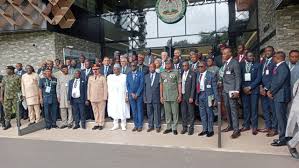
ECOWAS leaders on Sunday praised the swift mobilisation of troops and air assets, led by Nigeria, to respond to political crises in West Africa following the attempted coups in Guinea-Bissau and Benin. The action, highlighted during the 68th Ordinary Session of the ECOWAS Authority of Heads of State and Government in Abuja, underlined the bloc’s determination to defend democratic governance and ensure regional stability.
Speaking at the summit, ECOWAS Chair and Sierra Leonean President Julius Maada Bio described the coups as existential threats to West African security.
“ECOWAS does not and will not compromise on democratic governance”, he said, calling for inclusive and time-bound measures to restore constitutional order in affected states. Bio expressed solidarity with the people of Guinea-Bissau and reaffirmed support for Benin’s President Patrice Talon.
Represented by Vice President, Kashim Shettima, President Bola Ahmed Tinubu of Nigeria urged member states to confront terrorism, violent extremism, arms proliferation, cyber insecurity, climate shocks, food insecurity, and irregular migration through coordinated action.
“Our unity is not transactional but foundational. Fraternity, not force, must define the future of our community”, Tinubu said, stressing that internal divisions pose a greater risk than external threats.
While security dominated discussions, leaders also focused on economic integration. ECOWAS Commission President, Omar Alieu Touray unveiled the ECOWAS Business Council, appointing Nigerian industrialist Alhaji Aliko Dangote as its pioneer chair. Touray said the council would mobilise regional capital, strengthen intra-regional investment, and drive economic growth.
Plans for a West African Economic Investment Summit were also announced to serve as a platform for coordinating investments and tracking regional progress.
Bio emphasized that economic integration is central to ECOWAS’ vision, highlighting the bloc’s commitment to eliminating trade barriers, harmonising policies, expanding the ECOWAS Trade Liberalisation Scheme, and advancing monetary convergence within the framework of the African Continental Free Trade Area (AfCFTA).
He reiterated the goal of a single regional currency by 2027 and called for accelerated investment in infrastructure, including roads, railways, energy grids, telecommunications, and transport corridors.
In a move to enhance mobility and connectivity, Bio announced that from January 1, 2026, ECOWAS will abolish air transport taxes and cut passenger and security charges by 25 percent to encourage trade, tourism, and cross-border travel.
About the Author