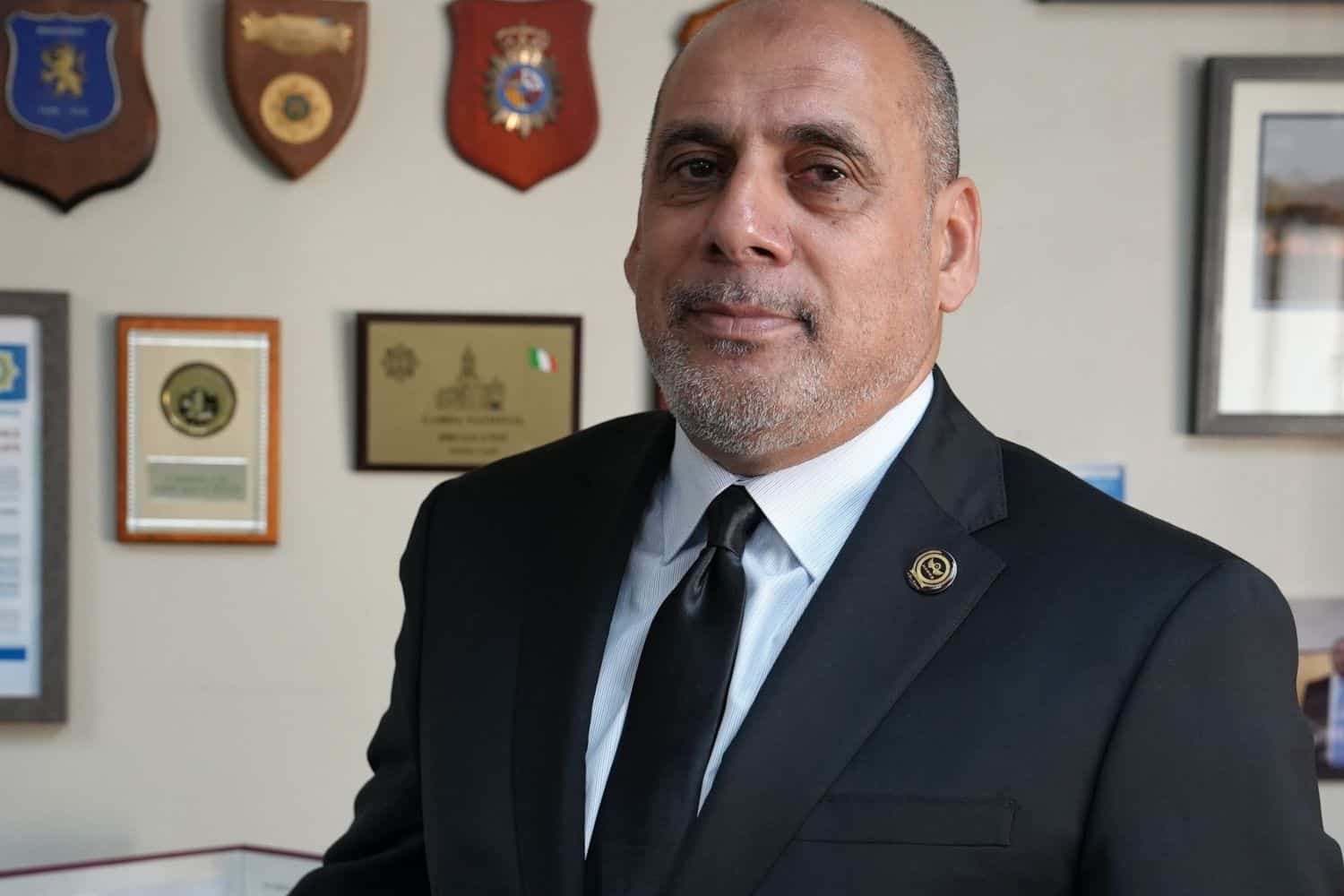
He’s a kind, soft spoken man whose days brim with serious crime. That, in short, summarises Gauteng Hawks boss Major-General Ebrahim Kadwa’s career.
From rural KwaZulu-Natal to international multi-agency raids and undercover operations, Kadwa has spent decades operating in the spaces most people only ever read about.
Listening to his achievements, anecdotes and love for his work is fascinating. Then, his purple socks paired with a black suit and tie hint at a different side to one of South Africa’s top cops, somewhat removed from the brutality of law enforcement.
Not a natural career choice for Kadwa
Kadwa was born in a small farming community in Brema, on the south coast of KwaZulu-Natal, far removed from organised crime. Law enforcement, he said, was not a natural family expectation when it came to career choices.
“All my family is in business and professional careers,” he said. “I was the odd one out having this interest in the police.”
When he joined the South African Police Service, it surprised them. His first posting was Durban Central, where his interest in specialist crime fighting was piqued early on.
“I was very fortunate to be exposed to the tracing unit,” he said.
The unit focused on housebreakers, vehicle theft and proactive hotspot operations, not reactive policing. It was the precision with which detectives worked that fascinated him more than, say, being a beat officer.
ALSO READ: NPA reaches ‘confidential’ settlement with former KZN Hawks boss
Later, Kadwa joined the security police. It was during the turbulent ’80s and a decision he acknowledged remains uncomfortable territory, decades later. But despite the institution’s past, he said that the operational skills it taught him were priceless.
“There are skills and tradecraft that we learned there that proved invaluable in dealing with serious organised crime throughout the balance of my career,” he said.
It included managing informants, handling agents and operating outside conventional policing frameworks.
At the same time, the police were pushing officers toward formal education.
“It was the first time institutions like Technikon SA and Unisa were offering professional police qualifications,” he said.
Within five years, he had completed his diploma and, at 26, qualified as a commissioned officer. By the early 1990s, he was ready to move on.
“I wanted to shed the burden and legacy of the security police,” he said.
Move into narcotics
His next leap was into narcotics, driven by both timing and instinct. “The drug trade was changing,” he said. “Narcotics seemed to be the place I could really cut my teeth.”
There, he moved into undercover and syndicate-level work. It was also a period when international trafficking networks were beginning to operate more openly in South Africa. One operation, involving an Israeli cocaine syndicate in Joburg’s northern suburbs, became a career marker.
“I posed as an undercover officer,” he said. “The legend I built worked perfectly.”
The operation succeeded because of timing and precision execution. The case cemented his reputation internally. “It gave people confidence in my ability to do undercover work,” he said.
ALSO READ: Human trafficking in SA: Hawks raise alarm in Gauteng
He said undercover work demands meticulous planning and continual threat assessment.
“You must understand your adversaries and plan accordingly,” he said.
Informants, he added, were treated with care.
Kadwa said in the early years of his career, identifying dynamics within policing played a role. “Being the first non-white officer in narcotics gave me a different kind of exposure,” he said.
He said that it mattered operationally. “At that stage, many of the big drug dealers were Indian guys. It gave me legitimacy in certain environments,” he said.
Working internationally
His work soon moved beyond South Africa. In the mid to late ’90s, Kadwa was posted to the UK as a drugs and organised crime liaison officer, becoming the first non-white South African police attaché in that office.
“We were dealing with UK and European law enforcement agencies,” he said.
He also worked closely with Dutch authorities during the rise of synthetic drugs like MDMA. Here, he was exposed to a multi-agency model, which brought in various departments to aid in investigations and crime fighting, working alongside police.
That period also saw early transnational fraud cases, including pre-e-mail Nigerian 419 scams that were executed using posted letters. Kadwa told how Scotland Yard approached him about this kind of advance-fee fraud.
“We facilitated our first highly successful undercover operation,” he said.
The impact went beyond arrests. In a bust of a 419 scam, he posed as a victim to draw out the perpetrators. The successes raised South Africa’s law enforcement profile, he said.
Despite international exposure and ascent up the ranks, Kadwa repeatedly chose operations over administration.
“They offered me a cushy job at head office,” he said. “I declined it.”
When the Hawks were established in 2009, he joined and stayed.
Today, Kadwa deals with some of the country’s most complex organised crime cases. He said modern investigations involving encrypted platforms and multi-national criminal networks demand international cooperation between law enforcement agencies.
Two weeks ago, a raid involving several international role players took down the South African branch of a cybercrime syndicate.
ALSO READ: Multibillion-rand global crime operation taken down in Bryanston
Recognition of South Africa’s prowess when it comes to investigative law enforcement work continues to this day. “I stand proud not because of what I’m doing,” he said, “but our successes are because of the team.”
About the Author