For decades Uganda’s boda-boda economy has operated in the shadows of being unregulated and largely excluded from long-term financial systems yet it remains the backbone of urban mobility.
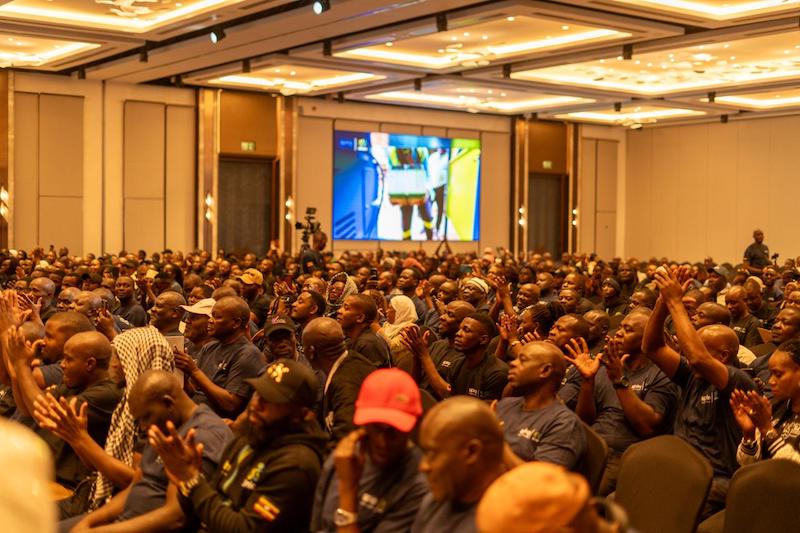
Today, that reality is rapidly changing. Last week At the International Leadership Retreat hosted in Dubai by Spiro, which is a part of the Equitane group, over 1000 industry leaders, innovators and Spiro boda boda riders came together to mark the first anniversary of the United Boda-Boda Riders Cooperative Union.
The gathering showed that Uganda’s boda-boda sector is no longer just about surviving but also professionalizing and going fully electric. The boda-boda industry is estimated to employ over two million Ugandans directly and indirectly, making it one of the country’s largest informal employers.
Rising fuel prices and climate pressure have long threatened its sustainability. Electric mobility is now emerging as a viable economic alternative. Over the past year alone 16,000 electric motorcycles were distributed across Uganda.
To support this rollout an expanding ecosystem of more than 300 battery swap stations and over 1,000 service centers where put in place to enable riders to operate continuously without challenges associated with charging.
Speaking at the retreat, Spiro chairman Gagan Gupta stated that this transition is not just environmental but also economic revealing that Battery swap operations generated 2.3 million dollars in revenue a signal that electric boda-bodas are not only operationally viable but commercially sustainable “our partnership with Union reflects a deep commitment to building solutions that balance environment responsibility with economic inclusion in Uganda” he said.
Additionally, he pointed to Uganda’s growing strategic importance in Africa’s EV transition. “Electric mobility can reduce emissions while directly improving incomes in high-usage commercial transport”, he said.
On his part, Kaushik Burman the CEO of Spiro stated that the shift is a social transformation and not only a technological one.
“The electric boda-boda is becoming a tool for dignity, predictability, and inclusion in a sector long characterized by daily uncertainty” he said.
At the centre of this evolution is the United Boda-Boda Riders Cooperative Union. Formed just a year ago, the Union has quickly become a platform for aggregation, financing, and rider protection.
Its digital Rider Union App introduces transparency and safety while rewarding productivity, offering riders a 7 per cent commission and safety gear incentives after completing set ride targets.
Beyond transport, the Union is unlocking financial mobility. Riders now access motorcycle financing, phone loans, and hrough a partnership with Housing Finance bank land loans.
For many riders, this marks the first formal interaction with structured financial products.
According to Union managing director Fred Ssenoga, the cooperative’s growth reflects a deeper shift in mindset.
“What started as an idea to professionalize boda bodas has evolved into a movement redefining what economic participation looks like for ordinary Ugandans”, he said.
At the closure of the event Spiro announced plans to distribute over 70, 000 electric motorcycles in Uganda, a scale that would fundamentally reshape urban transport economics, fuel consumption patterns, and emissions output.
About the Author