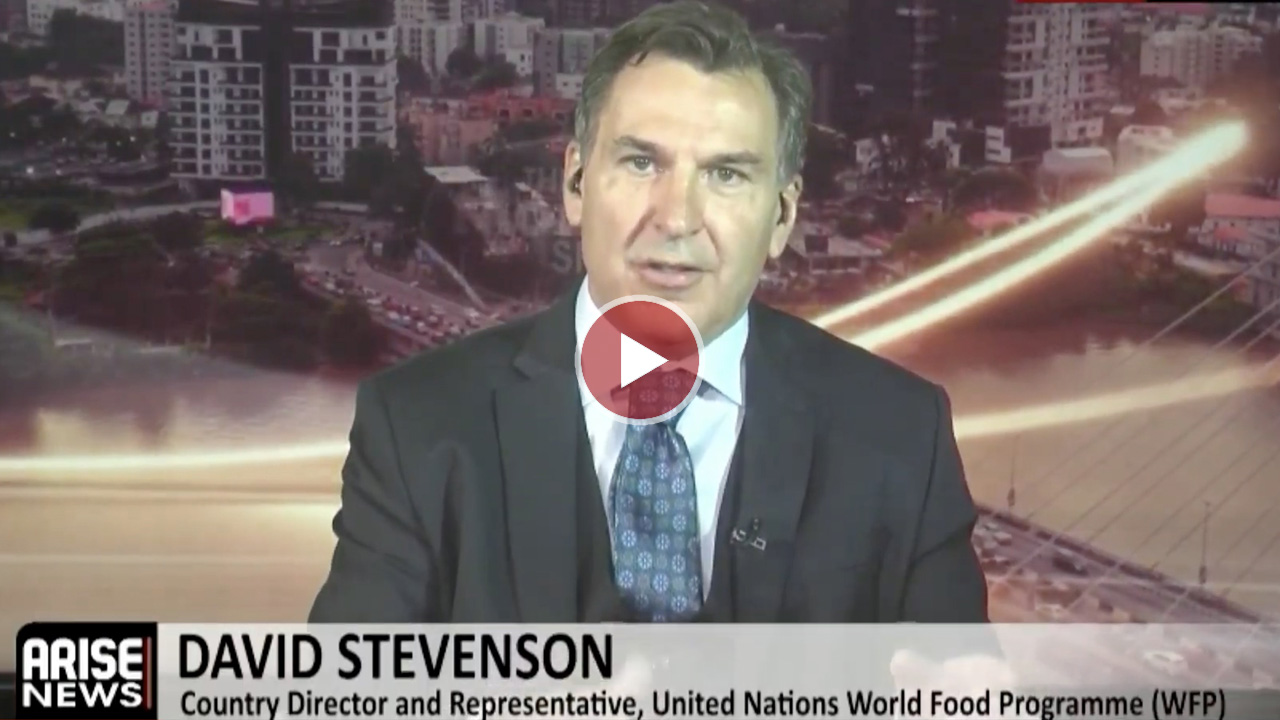
David Stevenson, Country Director Representative of the United Nations World Food Programme (WFP), has called for urgent measures to restore stability and boost agricultural production in the country’s conflict-affected North and Middle Belt regions, warning that insecurity continues to threaten food security and livelihoods.
Speaking In an interview with ARISE NEWS on Thursday Stevenson outlined the WFP’s role in Nigeria and the broader challenges facing the agricultural sector, emphasising that food security is closely linked to peace, economic reforms, and agricultural productivity.
“What I can say, I arrived in the country about three years ago and World Food Programme is primarily here because of the insecurity, the conflict-related hunger in the north of the country. We arrived in 2015 at the request of the government and our member states because of Boko Haram and ISWAP in the northeast, but we’ve spread our operations across the north into the northwest, Sokoto and other states. They’re conflict-security related, if not Boko Haram and ISWAP, banditry and so on, which you talk a lot about on your programme. So, in answering your question of prioritisation of the agricultural sector, you’re right to point out that it’s interconnected. The most important thing we can have is peace and production in the north of the country, getting farmers back on their farms because there are too many displaced farmers.”
Stevenson also addressed a common perception that food is widely available in Nigerian markets despite persistent reports of hunger. He stressed that while food may be present, affordability and access remain significant challenges. “Well, food would be a lot more available if the country could increase its yields. There is an opportunity to double or triple yields, particularly in the small-scale farming sector, increase agricultural infrastructure, including dealing with post-harvest losses, increase the markets, the functioning of the markets, so the value chain approach, and then stabilise prices. But you are right to say there are, there is food on markets. The question in the last couple of years has been at what price.”
He explained that recent government economic reforms, including the ending of fuel subsidies and attempts to stabilise the exchange rate, caused short-term spikes in food prices. “Everybody thought that was a good approach, though, because the country needed to stabilise its market and get out of the subsidy-driven waste in terms of economic development. And the good news is now prices have stabilised. In fact, they’re almost down to pre-reform levels.”
On the WFP’s direct impact in Nigeria, Stevenson highlighted measurable outcomes. “So the most important difference we’re making is helping to save lives and maintain livelihoods. So it’s a programme of food assistance for those who do not have access to food otherwise, particularly due to the conflict. And so the results on that number in the millions. We assist one, two billion Nigerians per year. And I’m pretty proud to be part of the humanitarian effort where you can see those measurable lives being saved and the prospects of returning to productivity. Now, what we want to be doing more of is helping get these people back on farms and producing.”
He stressed that humanitarian aid must move beyond immediate relief toward building self-reliance. “We need an approach, not of handouts, but of supporting people with self-reliance. So humanitarian solutions. And we’ve come together with many partners here in Nigeria on a strategy for that. It’s starting to make significant gains where there are pockets of stability to help people with livelihood. That means small-scale solar-powered irrigation to allow them to plant longer seasons, increase their yields, provide food for their families and the agricultural economy. We’re doing that more and more with the multilateral development banks. The World Bank is coming online with something called AgriConnect with UN agencies, and most importantly with the Nigerian private sector. So there is a way of co-investing so that humanitarian funding isn’t just going on the response effort, but it’s contributing with development partners on the solutions and getting the agricultural economy back to where it should be, which is the engine of growth, particularly in the North.”
Reflecting on Nigeria’s vast potential, Stevenson said, “You’ve got the biggest population, the biggest economy, the greatest potential, certainly in the agricultural sector and the food security sector, but across the board, Huge inspiration and prospects for agricultural growth. This country should be roaring in terms of the agricultural economy, feeding Nigerians, but even feeding the region. If you can get the value chain growth going, but there needs to be peace and then production. And this is the big challenge that we’re all facing.”
Drawing on over 33 years of experience in humanitarian work across Africa, he described Nigeria as” I’ve worked in this kind of work over 33 years throughout Africa. But I’ve never been in a country as diverse, as challenging and frankly, as exciting as Nigeria. You’ve got the biggest population, Unfortunately, the challenges of conflict have been persistent, We’re asking our donor partners to stay the course because dropping the ball on humanitarian assistance too quickly is a really bad idea. What you’re going to have is increased migration potential for people with no other choice to potentially join armed insurgency groups and just make it much more difficult for that positive story to play itself out.”
“Take the crunchy with the smooth a little bit,” Stevenson said, summarising his outlook. “Huge inspiration and prospects for agricultural growth. This country should be roaring in terms of the agricultural economy, but even feeding the region. If you can get the value chain growth going, but there needs to be peace and then production. And this is the big challenge that we’re all facing.”
Erizia Rubyjeana
About the Author