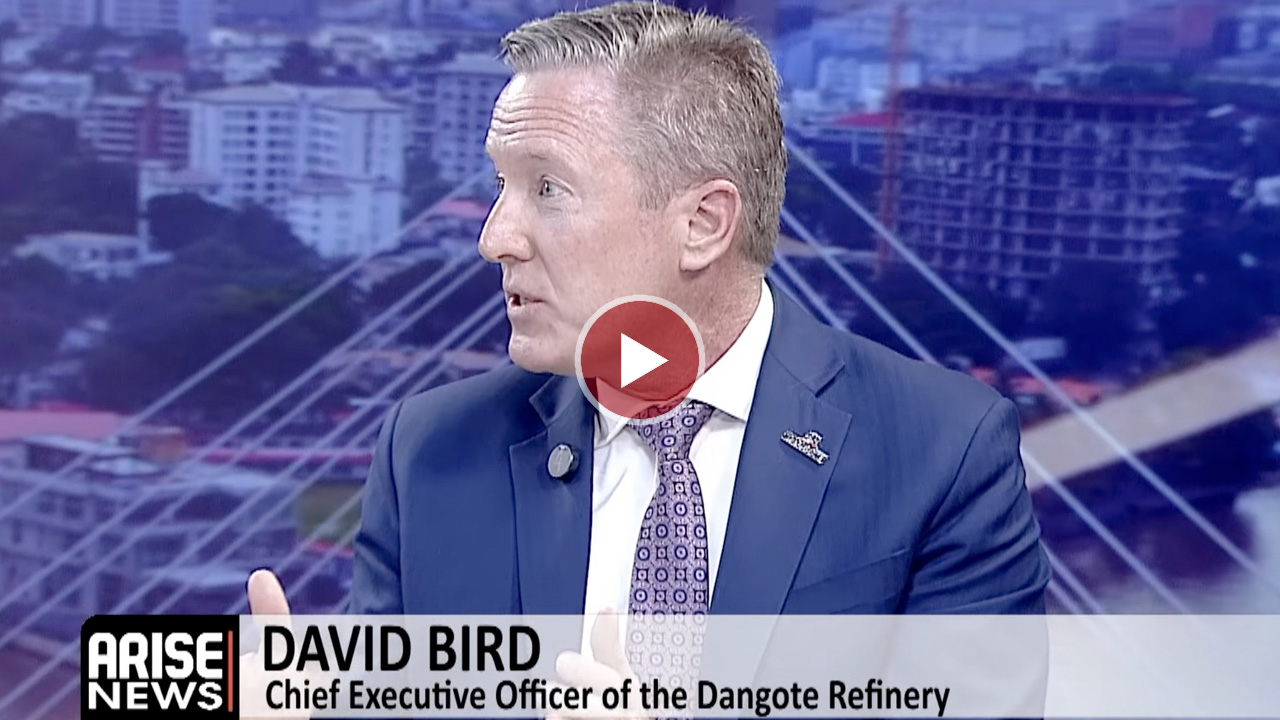

CEO of Dangote Refinery, David Bird has raised concerns over what he described as a significant loss of value for Nigeria, stemming from the way the country’s crude oil allocations are being handled.
Speaking in an interview with ARISE NEWS on Wednesday, on government support under the Crude for Naira program, Bird said the refinery is paying hefty premiums on Nigerian crude purchased on the international market, despite having allocations under a pre-agreed domestic scheme.
Bird explained that Dangote Refinery, currently operating at full capacity of 650,000 barrels per day, should be receiving 13 to 15 cargos of Nigerian crude monthly to meet domestic fuel needs. Instead, the facility is only getting five, a shortfall he described as “underperformance against that pre-agreed volume contract.” He added that the refinery also frequently receives crude grades that do not match its operational preferences, forcing it to buy the desired grades on the international market at premiums exceeding $18 per barrel.
He stressed that the current system results in Nigeria losing value to the international trading market.
Bird said, “Nigeria has a wide variety of crude grades, all exported from different terminals and we have a preference. Our hardware is designed around a certain crude slate, and we can certainly optimise the different crude grades from Nigeria. So we submit our preferences. And not only do we not get the full allocation, very often we don’t get the grades that we are highlighting as our preferences.
“So, our request is, can we get more and can we be transparent on the allocation methodology? Because then that allocates about 30% of our crude diet under the Crude for Naira program. However, given our preference for Nigerian grades, we go back into the international market and we find those very same grades that we have preferenced that were denied to us, now being offered on the international market in US dollars. And so we do purchase those. And right now, there’s obviously a global thirst for crude, no matter where it comes from. So that has meant there’s a significant premium being attached to Nigerian crude grades.
“As of now, we’re paying over $18 a barrel premium for those same Nigerian crude grades. So 30, 35% under Crude for Naira, we get allocated with no discount, no subsidy. It is international benchmark pricing. Then, we have to pay international benchmark freight rates. And freight has also been severely impacted and gone up, insurance rates, et cetera.
“There’s a misunderstanding that the Crude for Naira program is somehow a discount or a subsidy. It is not. There’s arm’s length relationship. We purchase that crude, we transport that crude, we ensure that crude as if we are fully arm’s length at international benchmark pricings. And every one of those cost inputs has been impacted by this crisis. Then we’re still finding, and so far we continue to see those other Nigerian crude grades appearing on the market. And we’re still willing to pay that premium.
“However, it’s disappointing that it’s coming back to us on the open market. And that value between the purchase price and the premium that we’re now seeing is money that Nigeria is leaking to the international trading community. And we believe that is unnecessary and would like to understand the allocation methodology.”
Melissa Enoch
About the Author