The Dangote Petroleum Refinery says it is moving beyond domestic fuel supply to build the infrastructure needed to serve markets across Africa, as rising production creates surplus volumes for regional export.
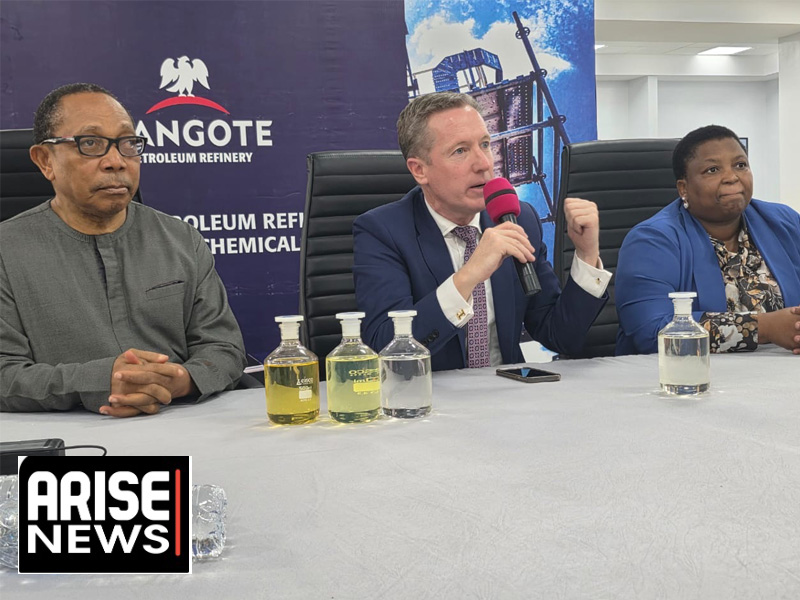
Speaking on Wednesday at the refinery, Chief Executive Officer, David Bird, said the refinery’s growing output of Premium Motor Spirit (PMS) has made it necessary to develop strategic storage and pipeline networks that can reliably deliver fuel to African countries, particularly those with limited refining capacity.
Bird explained that while the refinery currently supplies about 45 million litres of PMS daily to the Nigerian market, this figure reflects a period of planned maintenance that constrained production. With key units, including the catalytic cracker, now restarting, output is expected to rise significantly.
According to Bird, uncertainty remains around Nigeria’s true fuel consumption levels, with estimates ranging between 35 million and 50 million litres daily. Regardless of where demand ultimately settles, he said the refinery’s mandate is to ensure it can meet local needs while preparing to export excess volumes.
He said, “When we last met, I was saying that we were entering into a period of maintenance. So, we have kept our CDU at about 450,000-500,000 barrels a day and we’ve been operating at that sustainably and that’s what was allowing us to make the 45-50 million liters that I mentioned before and that’s what we’ve delivered through December.
“Now, when we finish the pit stop maintenance on the cat cracker (catalytic cracker) and some other units and we’re restarting now, so, through the first half of February, we ramp up to our full nameplate capacity of 650 (thousand), that’s when you’ll start to see the additional production of what we think getting up to 75 million liters as a sustainable target for daily PMS production. So yes, we were not fully loading the cat cracker. (There were) Periods when we went high as we were trying to understand the various unit capabilities, but with the cat cracker where it was, we were constrained at about 450,000, 485,000, 500,000 barrels and hence the 45 million liters.
“Now again, there’s also speculation on what’s the true country demand, if we’re supplying any countries, if there’s leakage to other countries, etc. I support that because it’s high quality fuel. So, if this is getting dispersed into Africa through other people’s actions, that’s not a bad thing either. We hope that by having cheap, reliable fuel supply, we will stimulate demand.
“But let’s say it’s around that 35 million litres (even though) there’s other people that might disagree. Our job is just to say no matter what you think that number is, we can supply it. Over time, we will see where it ends up and evens out as a true country demand for domestic lifting or domestic uptake and then we’ll export that surplus. That’s why we’re a little bit dependent on spot sales now, rather than being fully confident on what might be our structural surplus. But as we understand the market, as the market share settles down, as we truly understand the true country and regional demand, then we will better know our structural surplus and that’s when we’ll look to export, not just be at the mercy of the spot market but take a bit more control of our destiny.”
To achieve this, Dangote Refinery is investing in physical infrastructure across key African corridors. Bird disclosed that a tank farm is already in place in Walvis Bay, Namibia, developed in collaboration with the Namibian government. From there, the refinery plans to move fuel inland through pipeline networks.
The proposed infrastructure targets the south-western region of sub-Saharan Africa, with pipelines envisioned to run into Zambia and potentially extend to Zimbabwe, Botswana and neighbouring countries. Bird said this would help stabilise fuel supply in landlocked markets that currently rely heavily on road transport.
Similar discussions are ongoing in Central and West Africa. Bird noted that Cameroon, which no longer operates a refinery but retains legacy infrastructure, presents an opportunity to leverage existing pipeline rights-of-way to supply inland markets and neighbouring countries. Ghana and other coastal states are also being considered as part of the regional supply strategy.
He said, “Right now, it’s a tank farm in Walvis Bay. We would work very well with the Namibian government. So, really targeting that southwestern corner of Sub saharan Africa and then the pipeline up into Zambia ultimately potentially into Zimbabwe and Botswana and the other countries there. Similarly, the deeper discussions as well.
“Cameroon used to have a refinery. It doesn’t anymore but they’ve got some infrastructure there that we think we could leverage some pipeline rightaways where we could put in a pipeline to support the inland markets and also their neighboring countries. And then, similarly, Ghana etc. So what does it look like? Coastal tank farms feeding pipe up with truckloading gantry and feeding inland pipelines to serve inland markets and really try and alleviate that dependence on truck deliveries only where maybe the road infrastructure isn’t as good as it could be and a pipeline can help solve that by transporting further inland. Even looking frankly at the east coast as well, eastern Africa, but that’s probably a bit further. But what does it look like? Coastal tank farms feeding into structural pipelines that direct our product into inland markets.”
Melissa Enoch
About the Author