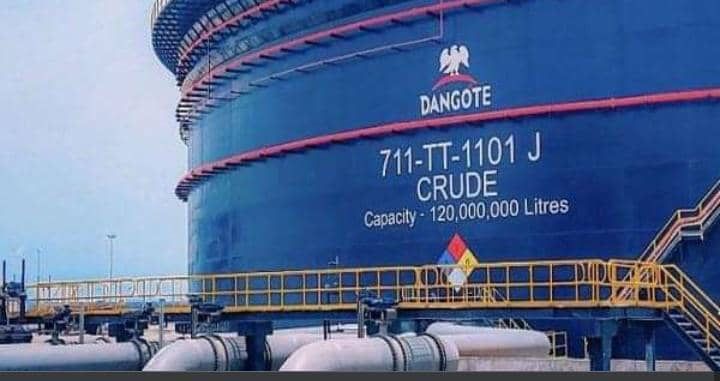
Refinery delivers Euro 5 fuel locally, backs naira stability, dismisses monopoly claims as output surges
As rising fuel prices, foreign exchange pressures and economic uncertainty continue to dominate conversations among Nigerians at home and abroad, Dangote Petroleum Refinery Plc has announced a major operational breakthrough that could reshape the country’s downstream petroleum sector.
The company says it has now reached 50 million litres of Premium Motor Spirit (PMS) supplied daily, marking a critical step toward reducing Nigeria’s long-standing dependence on imported refined fuel.
Speaking at a media briefing in Lagos on Wednesday, the newly appointed Managing Director of the refinery, David Bird, said the achievement reflects not just production capacity but the refinery’s ability to consistently move fuel into the domestic market.
“We are comfortably achieving over 1,000 trucks of daily offtake. This means it’s not only about producing fuel; it’s about successfully delivering up to 50 million litres every day,” Bird said.
He pointed to uninterrupted fuel availability during the Christmas and New Year holidays as proof that the refinery has entered a phase of operational stability.
According to Bird, while fuel demand fluctuates, especially on weekends the refinery has the capacity to sustain supply levels and export excess volumes whenever domestic demand is met.
Nigeria Now Consuming Euro 5 Standard Fuel
Beyond volume, Dangote Refinery says its output meets Euro 5 fuel standards, the same quality sold in Europe and markets such as Dubai. Bird described this as a significant upgrade from the lower-grade fuels historically imported into Nigeria and much of West Africa.
He criticised the long-standing practice of substandard fuel dumping in the region, noting that the refinery’s cleaner, low-sulphur products represent a major public health and environmental gain.
“Nigeria is now consuming world-class fuel. This is the quality that meets European specifications, with lower emissions and better environmental outcomes,” he said.
Expansion Plans and Petrochemical Push
Bird revealed that Dangote Refinery’s long-term strategy goes beyond fuel production, with plans to expand into petrochemicals and other industrial products.
The refinery currently operates an 800,000-tonne polypropylene plant, with plans underway to scale output to 2.4 million tonnes through additional Propane Dehydrogenation (PDH) units.
Future diversification may include detergents, base oils, lubricants and Liquefied Petroleum Gas (LPG), driven by population growth and import substitution.
“This expansion strategy is about lowering costs and building industries that are driven by domestic demand,” Bird explained.
Steel structures for the next phase of expansion are expected to begin rising before the end of 2026. Although the refinery is still in a stabilisation phase, Bird said several units ramped up in the second half of 2025 have already confirmed its capacity.
“Even while stabilising, we consistently supplied over 50 million litres of finished fuel daily, sometimes exceeding 52 million litres,” he said.
He attributed this performance to the refinery’s flexible design.
“Dangote Refinery is not a conventional single-crude facility. It is a highly flexible merchant refining, blending and trading platform.”
Logistics, Tracking and Export Capability
On logistics, Bird disclosed that about 4,000 trucks are currently operating within the refinery complex. The final step before full-scale rollout, he said, is the deployment of a computerised security and volume-tracking system to ensure accuracy and transparency in fuel deliveries.
He added that whenever domestic offtake falls below capacity, the refinery is positioned to export excess fuel to international markets.
Naira-for-Crude Policy Boosts Stability
The refinery also credited the Federal Government’s naira-for-crude policy with helping to stabilise the local currency and reduce pressure on foreign exchange.
Under the arrangement, which began in October 2024, local refineries are allowed to purchase crude oil from the Nigerian National Petroleum Company Limited (NNPC) in naira rather than U.S. dollars.
Bird said between 30 and 40 per cent of Dangote Refinery’s crude supply currently comes through the programme, with the balance sourced from Nigerian spot purchases and international crude grades.
“Even at that level, the impact on naira stability has been enormous,” he said, adding that the refinery could absorb additional crude volumes if allocations increase.
According to him, domestic refining helps shield Nigeria from global geopolitical shocks that often disrupt fuel supply and pricing.
Refinery Denies Anti-Competition Allegations
Dangote Refinery also dismissed allegations that its pricing structure favours specific marketers or undermines competition in the deregulated downstream market.
Responding to reports of a ₦739 per litre pump price at some filling stations, Bird clarified that the refinery sells PMS at a uniform ₦699 per litre ex-gate to all customers.
“There is no preferential treatment. Every truck leaving this refinery purchases product at the same price,” he said.
Bird stressed that retail pricing is entirely determined by marketers.
“Nigeria’s downstream market is fully deregulated. Marketers decide their pump prices, and consumers are free to choose where to buy fuel,” he added.
He also rejected claims of supply disruptions, insisting that the refinery continues to meet demand whenever marketers request additional volumes.
Nigeria Emerges as Regional Fuel Hub
Industry analysts say reaching 50 million litres of daily petrol supply moves Dangote Refinery from promise to reality, marking a turning point for Nigeria’s energy landscape.
By refining fuel locally, Nigeria reduces its dependence on imports, lowers dollar demand, supports currency stability and weakens the link between global supply shocks and local pump prices.
With the ability to export surplus fuel, Nigeria is also positioning itself as a key supplier to West and Central Africa regions that still rely heavily on imported refined products.
The development aligns with the objectives of the African Continental Free Trade Area (AfCFTA) and strengthens Nigeria’s role not just as Africa’s largest oil producer, but as one of its most influential downstream energy players.
About the Author