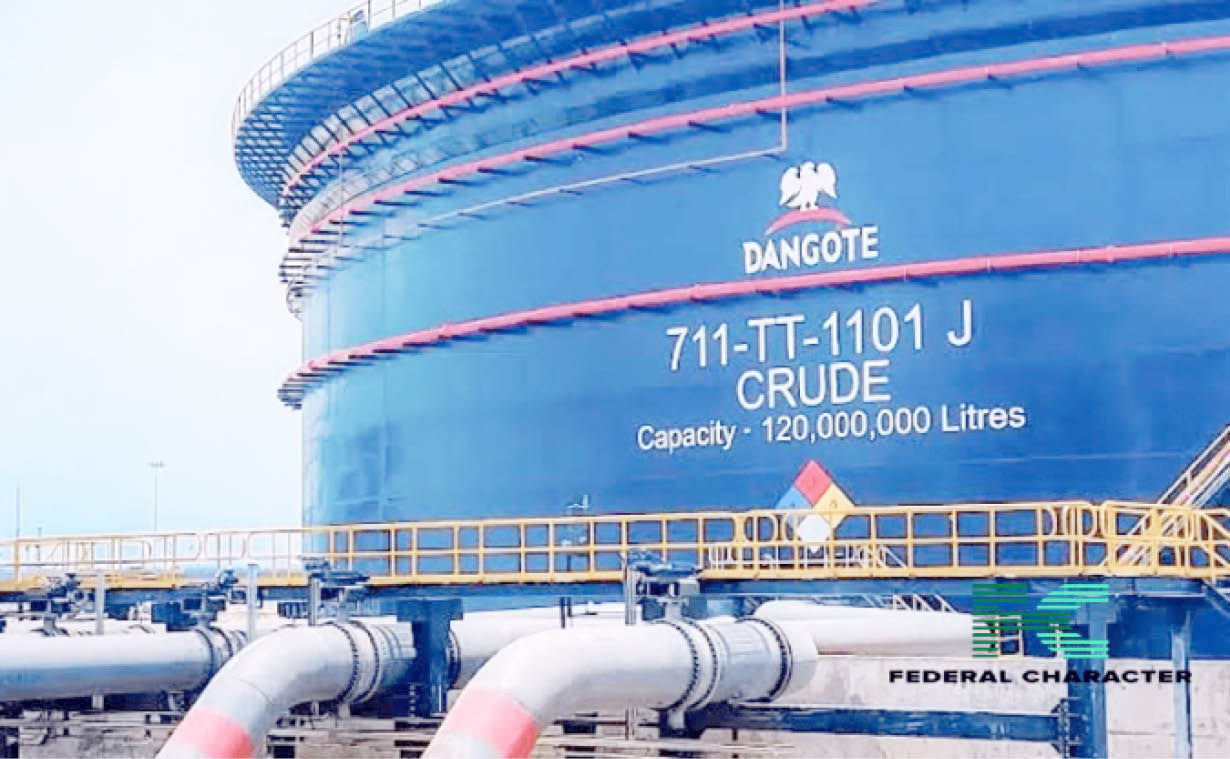
Refinery urges FG to prioritise crude supply for local refining, says it often buys Nigerian oil from international traders…
The Managing Director of Dangote Refinery, David Bird, has said the refinery bears costs from as many as 47 government agencies, a situation he noted contributes to the final pump price of petrol in Nigeria.
Bird made the disclosure during a press conference in Lagos on Monday, where he called for stronger government support for domestic refining, particularly in ensuring easier access to crude oil supplies.
According to him, multiple regulatory and operational charges from different agencies across the value chain add significant costs to refinery operations.
“I would advocate that all government agencies look at their contribution to reducing costs within the value chain. At the moment, we still face regulatory charges at almost every stage of our processing operations,” Bird said.
He explained that the refinery interacts with numerous agencies, including regulators and maritime authorities, which impose various fees that ultimately affect the cost structure of refined petroleum products.
“We deal with about 47 different government agencies and incur costs from them. Each one adds some level of cost into the supply chain,” he said.
Bird also urged the Federal Government to prioritise domestic refining by ensuring that local refineries have reliable access to crude oil, particularly in a period of global uncertainty in the oil market.
He noted that many countries are adopting protectionist policies to safeguard their domestic energy industries.
“All countries are currently acting in their own national interest. China has banned exports, and several other countries with refining industries have taken similar steps,” he said.
According to him, some countries with strategic petroleum reserves are releasing them to support domestic industries rather than selling them on the open international market.
“That is the kind of self-interest the Nigerian government should also consider. The priority should be ensuring that domestic refineries have abundant access to the right grades of crude oil,” he said.
Bird also raised concerns about crude oil allocation to the refinery, stating that the facility often struggles to obtain the grades it requests from local producers.
He explained that although the refinery submits monthly requests for certain Nigerian crude grades such as Bonny Light and Escravos, these are frequently sold to international buyers instead.
According to him, this forces the refinery to purchase the same crude oil from international traders at higher prices.
“We submit our preferred crude grades every month, but what we often see is that those same grades are allocated elsewhere first. Later, they appear back in the market through international traders, and we then have to buy them from those traders,” he said.
Bird described the situation as frustrating, noting that domestic refiners should ideally be treated as priority customers rather than “customers of last resort.”
He called for greater transparency in how crude oil allocations are handled by the government and the Nigerian National Petroleum Company (NNPC).
“We fully understand that there are existing commitments with international buyers, but there should be clarity on the allocation process and where domestic refining fits within that framework,” he said.
He also urged the government to strengthen the “crude-for-naira” programme by ensuring local refineries are prioritised before crude is sold to international traders.
According to him, the current arrangement sometimes results in Nigerian crude being sold to foreign traders who then resell it to domestic refiners after adding their own margins.
Meanwhile, Bird noted that global geopolitical developments have recently pushed up fuel prices, pointing to the spike in oil prices following tensions between the United States and Iran, which led to the temporary closure of the Strait of Hormuz.
He said such global shocks highlight the need for Nigeria to strengthen domestic refining capacity to reduce exposure to international market volatility.
About the Author