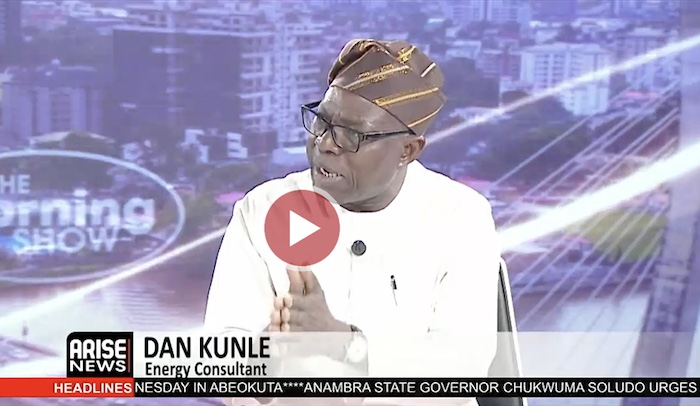
Energy consultant, Dan Kunle has criticised decades of government-led refinery rehabilitation in Nigeria, describing the effort as a colossal waste of public funds and warning against repeating what he called “known mistakes.
In an interview with ARISE NEWS on Sunday, Kunle said he felt a sense of relief after hearing the NNPC Group CEO openly acknowledge that past refinery rehabilitation programmes had failed, describing the admission as unprecedented honesty from the leadership of the national oil company.
“For the first time in my lifetime, am I hearing the truth from the seat of NNPC? He’s the first GMD from 2007 to date that will say the truth.”
Kunle said successive NNPC leaderships made grand promises about fixing Nigeria’s refineries but consistently failed to deliver. “Anybody, check, every GMD comes there, they will tell you, they will make heavens to come. Paradise will be here. One even told us that in three years, it will fix the refinery. Another one came and said, oh, the staff can fix it, refinery, they never fix it.”
He described refinery rehabilitation over the past two decades as a colossal waste, “Now to go to his statement, Bayo Ojulari’s statement that the refinery rehabilitation has been a colossal waste over the years. Yes, it’s true, They have wasted all that money, All these years, none of them have returned profit. Go and check their books.” They cannot say they didn’t know. When we warned them not to do it in 2018–19, not to go ahead, they said, oh, we are not, we are against Baba Buhari.”
“They should be in jail by now, because they cannot say they didn’t know.”
Kunle called for a full forensic audit to trace how refinery funds were spent, including payments made to consultants and subcontractors. “So now that they have wasted all that money, we should go with forensic auditor to trace where every couple has gone to because I believe Maria Technimont, the consultant, yes, will give account of how much they got. All the subcontractors, how much they got, we must know, President Tinubu must not look away from this matter.”
He strongly opposed proposals to involve Chinese firms in further refinery rehabilitation. “Sell them. Privatise them as they are, adding that the National Council on Privatisation has the legal authority to carry out the process, Sell them. Privatise them as they are to co‑investors, Sell them. Privatise them as they are to co-investors.”
Kunle cited Nigeria LNG and the privatisation of Eleme Petrochemicals as successful examples. “It privatised in 2006, 2007, to Indorama of Indonesia, They bought majority share of Eleme Petrochemical. They have turned it into a fortune, LLNG is 51% owned, owned by Shell, TOTAL, and ENI.”
According to Kunle, Nigeria’s failure is not limited to refineries. “None of the government projects were successful except LLNG, From 1960 to date, all the hotels in Nigeria owned by government, they were run down. We sold them, you will see one called Bristol? Go and see how it was run down when we wanted to liquidate or privatise it, The whole place was smelly.”
We spent $3.6 billion as of that time, $5.7 billion German standard aluminium smelter Still, as I’m talking, it has never worked.”
He said government-owned hotels, petrochemical plants and industrial projects have historically been run into the ground before being sold off. “From 1960 to date, all the hotels in Nigeria owned by government, they were run down. We sold them, It privatised in 2006, 2007, to Indorama of Indonesia, They have turned it into a fortune.”
Kunle argued that bureaucracy makes it impossible for government to run complex industrial operations. “Government cannot run refineries. Government cannot manage even government resources, “You can’t run industries and process engineering industry like refineries, Why do you have so many uncompleted rules in Nigeria? It’s bureaucracy now. The money is not there, Where is the funding? So you can’t run industries.
He dismissed claims that some refineries had recently resumed operations. “It was not working. They were blending, That refinery, they say, was working. It was not working. They were doing blending. So as to just push out something to us, which may be up to 250 or 300 ppm of sulphur.”
Kunle accused vested interests of attempting to undermine the Dangote Refinery. “There are vested interests that do not want Dangote Refinery to succeed because they make money from importing fuel. They tried to sabotage the project. But this refinery is world class. Its diesel meets international sulphur standards and is comparable with what is sold in Europe and America.”
He praised the refinery’s capacity and product quality. “This refinery is world class. Its diesel meets international sulphur standards and is comparable with what is sold in Europe and America.”
Kunle explained that Dangote Refinery has effectively secured Nigeria’s energy future and marked the end of the fuel import regime. “This refinery has secured Nigeria’s energy future. It marks the end of fuel import dependence, and the government should use its storage capacity as a strategic reserve to stabilise supply during disruptions.”
Kunle also welcomed downstream deregulation, saying it was a bold but necessary decision that coincided with the coming onstream of the Dangote Refinery. “Downstream deregulation was a bold but necessary decision, especially with the Dangote Refinery coming onstream. Without it and domestic refining capacity, our currency and economy would have faced much greater pressure.”
Looking ahead, Kunle urged NNPC leadership to focus on upstream oil and gas development. “NNPC should focus on upstream oil and gas development and the gas master plan, while downstream assets should be left to private investors. Concentrating on upstream activities will create more value for the country and reduce opportunities for waste.”
He concluded by calling for transparency across the oil and gas sector saying, “Even partial recovery of mismanaged funds could transform education, healthcare and infrastructure. Nigeria’s core challenge is not a lack of resources, but persistent failures of governance, accountability and political will.”
Erizia Rubyjeana
About the Author