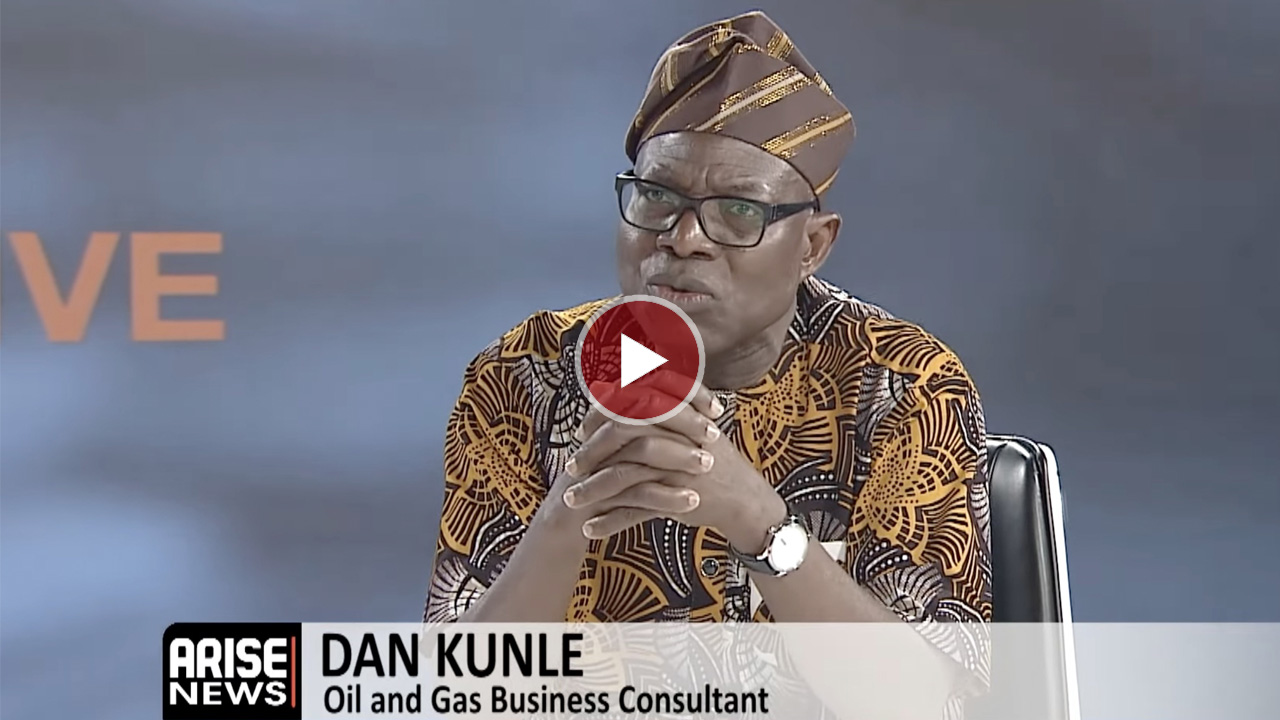

Oil and gas business consultant Dan Kunle has said the removal of senior petroleum regulators following allegations by Dangote Refinery founder, Aliko Dangote, signals the end of what he described as Nigeria’s long-standing “fraudulent oil importation regime”, praising President Bola Tinubu for finally summoning the political courage to confront entrenched interests in the sector.
Speaking in an interview with ARISE News on Sunday, Kunle said the exit of the Nigerian Midstream and Downstream Petroleum Regulatory Authority (NMDPRA) chief, Farouk Ahmed, alongside the leadership changes at the Nigerian Upstream Petroleum Regulatory Commission (NUPRC), was long overdue.
“Yes, all of the above,” Kunle said when asked whether Dangote’s petition triggered the removals. “They have come to play and it has crystallised that people have to exit from their positions and some have to suffer collateral damage.”
Describing the development as inevitable, Kunle said, “This industry is the mainstay of Nigeria — this oil and gas issue. So I want to say thank you to President Tinubu for finally summoning the courage and the political will to say enough is enough.”
He added, “Let Malam Farouk step aside and go and attend to all the personal issues with Alhaji Aliko Dangote. It is long overdue.”
Kunle said regulatory institutions were ill-equipped to oversee the scale of the Dangote Refinery.
“The regulator — the midstream and downstream regulator — was not positioned at all to regulate the size of that refinery. The capacity was not there. The experience was not there. The apparatus to regulate such a refinery was absent,” he said.
He said the shake-up confirmed what he had predicted weeks earlier.
“It has happened the way I expected it a long time ago. So I give credit to President Tinubu for taking the courage to do it,” Kunle said, adding that, “During his tenure in the last two and a half years, the revolution in the oil and gas sector has come to stay.”
According to Kunle, the removal of the regulators marks the collapse of the old rent-seeking order.
“Any old vestiges and old interests of the old order must now know that the curtain is drawn. The battle line has been drawn,” he said. “That old order that created the huge rentier cartel is gone, and it cannot come back again.”
On the exit of former NUPRC chief Gbenga Komolafe, Kunle acknowledged his efforts but said he was caught in an unavoidable political reset.
“He has tried in the last four years to realign the upstream petroleum industry. It was not an easy assignment because of what he inherited,” Kunle said.
“In the last year, he got his acts together properly and built a very good momentum. He conducted a mini bid round of offshore assets and achieved about 70 to 75 per cent success. He also built a framework to auction about 50 oil blocks.”
However, Kunle said, “I think he suffered collateral damage, I agree. But the President was in a very tight situation. Farouk Ahmed and Gbenga Komolafe were products of the same power structure at that time.”
Turning to allegations of corruption and oil importation rackets, Kunle said past policies deliberately killed Nigeria’s refineries.
“The importation was criminal,” he declared. “But that importation is based on a wrong and fraudulent system built over the last 35 years — from NNPC, PPMC, to PPPRA, and now NMDPRA.”
He alleged that powerful cartels exploited the system.
“They killed the refineries, and their collaborators saw a huge opportunity to embark on import racketeering. They made fortunes,” Kunle said.
He claimed Dangote Refinery had suffered massive losses as a result.
“They have created losses for Dangote in the last 18 months — over ₦1 trillion, close to ₦1.4 trillion,” he said. “So if those crying now have lost money, what of the abnormal profits they made in the past 30 years?”
Kunle defended Dangote against claims of intimidation, insisting the businessman would cooperate fully with anti-corruption investigators.
“Alhaji Aliko Dangote does not use power to intimidate anybody,” he said. “He respects constituted authority so much that he will personally go to offices rather than send people.”
“If he goes to the ICPC tomorrow, I will not be surprised. He is sitting on an investment of national importance and he is ready to prove his case,” Kunle added.
On Nigeria’s 2026 budget, Kunle was sharply critical of what he described as fiscal disorder and unrealistic assumptions.
“How many budgets are we going to have?” he asked. “2024 rolling into 2025, 2025 rolling into 2026 — what is the meaning of that? It is not tidy for a nation.”
He questioned Nigeria’s insistence on a January–December budget cycle.
“No law says so. It’s just a convention. Why can’t we run May to April?” Kunle said.
He also criticised the production and price benchmarks.
“If I were them, I would use 1.5 million barrels per day. I would use $55 to $57 per barrel and be conservative,” he said.
On tax reforms, Kunle said they were necessary but warned against procedural irregularities.
“Tax reform is brilliant. Good work has been done,” he said. “But this issue of discrepancies between what was passed and what was gazetted must be cleared immediately.”
He added, “When the President signs a document, that signature carries authority. How can what is gazetted be different? It affects our credibility as a nation.”
Kunle concluded by insisting that Nigeria had reached a turning point.
“The era of rent-seeking is over,” he said. “It is time to cut off every finger in that pie. The economy must now be rebuilt from zero, and there is no going back.”
Boluwatife Enome
About the Author