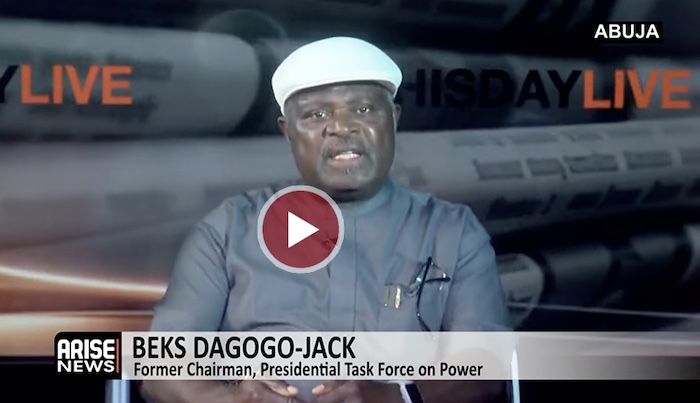

Former Chairman of the Presidential Task Force on Power, Beks Dagogo-Jack, has blamed Nigeria’s persistent electricity crisis on the abandonment of power sector reforms after 2015, weak regulation and the absence of clear political ownership, insisting that the 2010–2014 reform era under former President Goodluck Jonathan delivered measurable progress wrongly dismissed as failure.
Speaking in an interview with ARISE NEWS on Sunday, Dagogo-Jack rejected claims that the 2013 power privatisation was flawed, arguing that the reform programme was deliberately disrupted before it could mature.
“A lot of people have misunderstood what happened between 2010 and 2014, and others have chosen to politicise the narrative. Between 2010 and 2014, Nigeria moved from about 2,000 megawatts of generation capacity to over 5,000 megawatts by December 2012, with spinning reserve, and by 2014 we had installed capacity well past 10,000 megawatts,” he said.
He described the period as the most coordinated and accountable phase of power reform in Nigeria’s history, driven by direct presidential ownership.
“President Jonathan did what many leaders before and after him did not do. He took ownership of the power sector. He created the Presidential Task Force on Power and the Presidential Action Committee on Power, which he personally chaired. That showed commitment. This was his baby,” Dagogo-Jack said.
He explained that the reform architecture included clear milestones, performance metrics and institutional accountability.
“The reform journey was clearly laid out—measurable, dimensionable, with deliverables and dependencies clearly stated. Anyone who was faithful to that roadmap could see how the sector would move from one stage to the next,” he said.
Responding to criticisms that privatisation failed, Dagogo-Jack said such claims ignore the normal transition period required in complex market reforms.
“By 2013, all the successor companies had been handed over. That was only about 50 per cent of the reform journey. These investors were still learning the market rules and adapting to Nigeria’s peculiar environment when the administration ended. Elections have consequences,” he noted.
According to him, the real damage occurred after 2015 when the reform framework was undermined rather than reviewed.
“Anybody who came after President Jonathan should have asked: where are we, what needs adjustment, what should we improve? Instead, the reform was treated as a mistake. That rhetoric destabilised the sector,” he said.
Dagogo-Jack said regulatory discipline collapsed as political interference replaced market governance.
“A reformed electricity sector is regulated by an independent regulator, not by the Ministry of Power. But by 2015, the ministry had effectively become both regulator and operator, while the regulator became a subsidiary. That scared investors away,” he said.
He recalled visiting the ministry in 2016 and seeing power company executives lobbying politicians instead of engaging the regulator.
“I walked into the ministry and saw CEOs of discos and gencos waiting to see the minister. That was when I knew something had gone wrong. The regulator is supposed to be the reference point of a market-driven sector, not the minister,” he said.
On electricity subsidies and the federal government’s plan to share subsidy costs with states and local governments, Dagogo-Jack argued that sub-national governments are major contributors to sector debt.
“If you look at unpaid electricity debts today, about 30 to 40 per cent is owed by federal and state governments. They won’t pay their bills and argue that you cannot cut off government. So when it is time to pay, they cannot pretend they are not part of the problem,” he said.
He defended the federal government’s decision to retain a 40 per cent stake in power assets during privatisation, describing it as standard global practice.
“You don’t exit at 100 per cent immediately. Government retains equity to stabilise the reform and later democratises ownership through the stock market. That model has positive value,” he explained.
However, Dagogo-Jack criticised Nigeria’s subsidy structure, saying it rewards inefficiency and theft.
“We are subsidising electricity theft. We are subsidising 40-year-old substations that have never been maintained. That is the wrong subsidy model,” he said.
Instead, he advocated cross-subsidisation.
“Subsidy should be cross-subsidy. Those who can pay should pay more—industries, high-end users—so that the vulnerable are protected. That is how it works globally,” he added.
Addressing grid collapses and infrastructure decay, Dagogo-Jack said Nigeria’s problems are not technical impossibilities but leadership failures.
“If the President decides today that his only goal is to stop grid collapse—not to add one megawatt, just to stabilise what we have—you will see a clear technical and financial programme emerge. It is not impossible,” he said.
He dismissed vandalism as an excuse often used to mask deeper failures.
“Vandalism is one of Nigeria’s favourite excuses. Telecom infrastructure faces similar risks, yet it works. The truth is that the system is dysfunctional and keeps looking for excuses,” he said.
Dagogo-Jack concluded that without decisive leadership and accountability, the sector will remain trapped in crisis.
“The power sector needs someone who will own the problem, not just talk about it. There is a difference between political opportunity and national mission. Until someone takes ownership, the problem will not go away,” he said.
Boluwatife Enome
About the Author