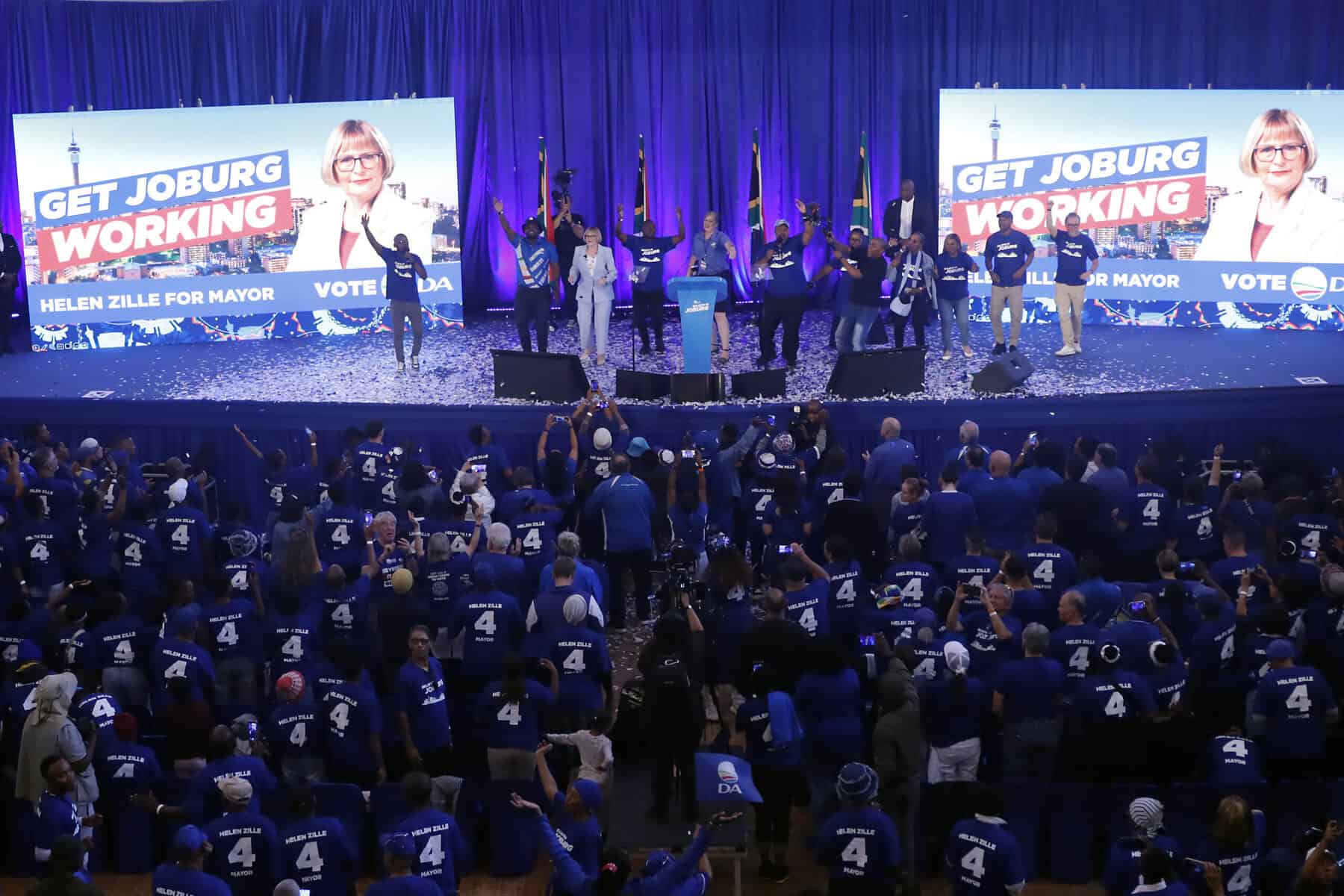
JOHANNESBURG, SOUTH AFRICA - MARCH 07: DA supporters at the unveiling of the Joburg mayoral candidate manifesto at Johannesburg City Hall on March 07, 2026 in Johannesburg, South Africa. The DA stated that the vision of this campaign is to unite the people of Joburg who believe in a City that works, run by a government that cares. (Photo by Gallo Images/Sharon Seretlo)
An analysis of the DA’s election results since 2000 shows a party that has stabilised its electoral performance and is beginning to recover across national, provincial and local government levels.
When the results are examined across all three spheres of government, the picture that emerges is not one of decline – as many competing parties would have it – but of a party that has absorbed a setback, consolidated its support and getting ready for renewed growth.
National trajectory shows recovery after setback
At national level, the trajectory has remained consistent over time. The DA increased its representation from 50 seats in 2004, to 67 in 2009, then reaching 89 seats in 2014.
The decline to 84 seats in 2019 marked a reversal of fortune. But the 2024 result had the party return to 87 seats.
This, said the party faithful, showed a recovery and re-establishment of its national base under the leadership of outgoing party boss John Steenhuisen.
At provincial level, the trend was more visible. The DA’s share of seats across provincial legislatures has grown from 65 out of 430 seats in 2004, just over 15%, to 100 out of 430 seats in 2024, or about 23.3%.
This suggests organisational growth and a widening footprint beyond its traditional strongholds.
Strongholds and key provinces remain crucial
Political analyst Theo Neethling said the next phase for the party will hinge on leadership and positioning.
“Much will depend on who’s going to be the next DA leader,” he said, adding that leadership choices could directly influence the party’s ability to grow beyond a perceived “non-black” voter ceiling.
The Western Cape remains the party’s strongest base, where it holds 24 of 42 seats, maintaining a clear majority.
Gauteng continues to be a key province, with the DA holding 22 of 73 seats in 2024, up from 20 in 2019. Neethling said the party’s governance record is a differentiator in these areas.
“What alternative do other opposition parties offer?” he said. “Politics is the business of alternatives. When you compare it to the DA, what can they offer differently?”
In the Eastern Cape, the DA has grown from six seats in 2004, to 12 in 2024, while in the Northern Cape it increased from three to nine seats over the same period. The Free State showed a similar pattern, rising from three seats in 2004 to eight in 2024.
KwaZulu-Natal is more competitive. The DA increased its representation from eight seats in 2004, to 13 in 2019, before declining to 11 in 2024.
Local government reflects increased competition
In Limpopo, Mpumalanga and North West, the party remains present with smaller, but consistent visibility. Local government results showed greater variation over time.
The DA’s total representation across municipalities in the dataset analysed increased from 376 seats in 2000, to 599 seats in 2016, marking its strongest performance at local level. By 2021, this declined to 484 seats out of 1 503, or about 32.2%.
This indicates increased competition from newer parties like ActionSA and the Patriotic Alliance, with growth for the Freedom Front Plus.
Cape Town, like the Western Cape, remains a mainstay of the party’s local government strength, where it holds 136 of 225 seats. Although this is down from 154 seats in 2016, it still represents a clear governing majority.
Midvaal in Gauteng also remains under DA control. In Gauteng metros, the DA’s gains and subsequent consolidation are evident.
In Johannesburg, the party increased from 55 seats in 2000, to 104 in 2016, before settling at 71 in 2021. In Tshwane, it rose from 58 seats in 2000, to 93 in 2016, and then adjusted to 69 in 2021.
Ekurhuleni shows a similar pattern, growing from 45 seats in 2000, to 77 in 2016, before declining to 64 in 2021.
Hill-Lewis tipped as potential future leader
Neethling said the coalition politics the 2021 elections forced will continue to shape outcomes at this level.
“That’s literally what we’re going to have for the foreseeable future. Coalitions are here to stay,” he said.
Neethling said leadership will be key to converting the party’s base into further gains. He’s backing Cape Town mayor Geordin Hill-Lewis.
“He’s someone who listens, he is approachable and not controversial,” he said, suggesting this could strengthen the DA’s appeal going forward.