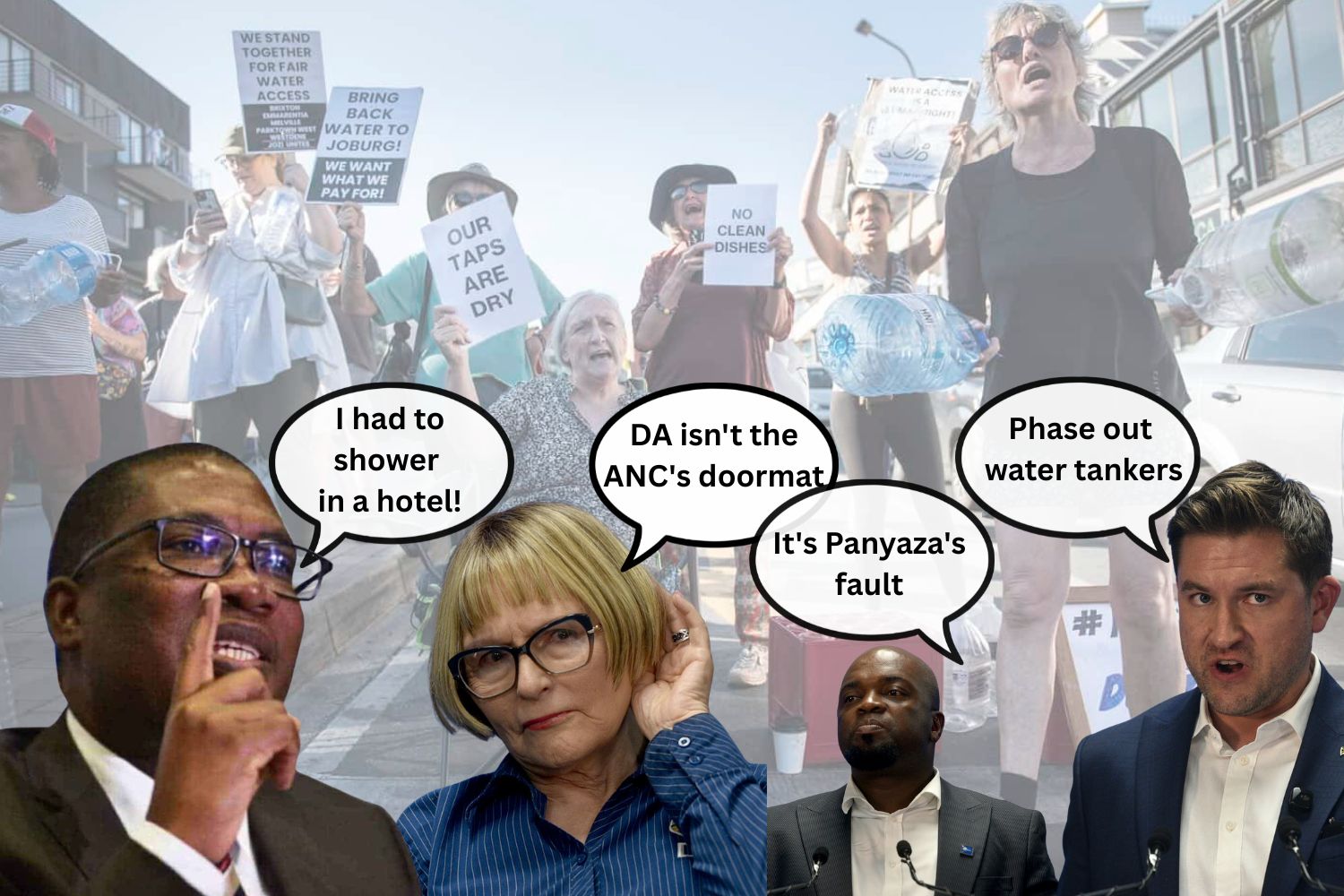
The DA launched a scathing attack on Gauteng Premier Panyaza Lesufi over the province’s escalating water crisis, even as the party faces criticism for having its own senior member serving as deputy minister of water and sanitation.
During a press briefing on Wednesday, DA Gauteng leader Solly Msimanga revealed that Lesufi’s office claimed to be “completely unaware of any kind of water crisis in the City of Johannesburg”.
This came after multiple areas across Gauteng had been without water for weeks, with residents in Midrand, Atteridgeville, Laudium and parts of Ekurhuleni among those affected.
“I just had an unbelievable call from the office of the premier, where his spokesperson, or PA, or whoever he is, told me that the premier’s office is completely unaware of any kind of water crisis in the City of Johannesburg,” a voice note allegedly sent to the DA by a resident said.
Msimanga insisted that the premier bears responsibility: “I think the premier has a responsibility as the head of the province to call municipalities and to say what the plan [is] within the municipalities.”
However, water expert Carin Bosman challenged this narrative, pointing out fundamental misunderstandings about water governance.
“The DA should be fully aware that the premier of Gauteng bears no responsibility and has no authority over the management of water or the provision of water services by municipalities in the Gauteng province,” Bosman said.
She elaborated on the limited role available to the premier: “The only ‘route’ for the premier to get involved is through a constitutional process, following a request from the national government, aimed at placing a municipality under administrative control of the province.”
Contradictions in accountability
The DA’s criticism becomes more complex, given that their own party member, Sello Seitlholo, serves as deputy minister of water and sanitation.
When The Citizen questioned this apparent contradiction, Msimanga acknowledged Seitlholo’s involvement, but distanced himself from knowing the full extent of the deputy minister’s actions.
“Deputy minister Seitlholo has been here on a number of occasions, [and he] has taken this matter up with the minister.
“Now, what happens in between the two offices, I am not too sure what is happening at the national level,” Msimanga said.
Political analyst Kenneth Kgwadi did not mince words about this deflection.
“The DA has been an opposition party for many years, in that they are subconsciously continuing the role of competing with the ANC for state power.
“Besides being in government, the DA is responsible for the mess in all metros in Gauteng (Joburg, Ekurhuleni and Tshwane),” Kgwadi said.
Kgwadi emphasised the fundamental problem with the DA’s approach.
“There is no fundamental distinction between the ANC and the DA, as they all abhor a culture of accountability. The only slight difference is that the ANC blames apartheid while the DA blames the latter.”
On the issue of depoliticising water services, Kgwadi was unequivocal.
“Water and other essential services that ought to be provided by the government should be completely depoliticised because they are human rights essentials.
He said that political parties, including the ANC and DA, should cease playing “a political football with sensitive issues such as water”.
Kgwadi pointed to a broader pattern of ministerial dysfunction, stating that “it has been said that the deputy ministerial positions are useless, and this is a textbook example because they just have no work to do”.
Technical solutions or political posturing?
During Wednesday’s briefing, DA MP Stephen Moore outlined several technical proposals, including allowing Rand Water to extract more water from the Vaal Dam when it exceeds 100% capacity, ringfencing water budgets, and activating emergency disaster funding.
“Right now, the Vaal Dam is sitting at 101.6% full. It is over capacity and water is pouring over the dam wall,” Moore said.
He added, “We’re going to call on DWS to allow Rand Water to pump more water from the dam only when it is over 100% capacity.”
ALSO READ: Vaal Dam levels drop slightly but remain above capacity
However, Bosman dismissed these proposals as demonstrating “the absolute lack of knowledge by whoever drafted the briefing in respect of water governance”.
She explained that if Rand Water abstracts more water, it would not have the capacity to treat more water.
“The problem is not the availability and the amount of water; it is unrelated to the activities of Rand Water, and absolutely related to the lack of maintenance of water infrastructure in the municipalities,” Bosman said.
She elaborated on the flaws in the DA’s proposed solutions: “Ringfencing of water budgets is an excellent idea, but there was little complaint from the DA councillors in the City of Joburg when the budget allocation for Joburg Water was ‘transferred’ to other allocations, which directly contributed to the resulting lack of maintenance that caused this problem.
“Moreover, although Joburg Water is supposed to be ‘independent’, they do not have any control over the vehicle fleet required to do the maintenance, as this is still seen as ‘outside’ the water budgets.”
Let experts do their job
Kgwadi addressed the question of where primary responsibility lies for the province’s water governance and management.
“In this case, it should be the City of Johannesburg, Rand Water and the national government.
“When the municipality, as in this case, is unable to undertake its constitutional obligations, it is the national government which should take over to ensure that the residents are not at the receiving end of the human-created crisis.”
However, he noted the political complications about whether the national government’s intervention approach may be influenced by which party controls a municipality.
“I don’t foresee the minister Majodina acting against the city because it is under the ANC at the moment.
“There are a lot of municipalities in the North West and Free State which have failed to perform their constitutional mandate, but nothing has happened simply because they are ANC.
“Look at Emfuleni municipality, it collapsed in front of everyone, but the ANC kept quiet because it is their executive in charge there.”
Kgwadi warned against political interference in water affairs, saying Rand Water should be left to do its work.
“It is the water engineers and experts who will bring about technical solutions to the challenges engulfing the water resources management.
“Politicians are supposed to create a conducive environment for technicians to do their work through legislative powers and financial resources.”
ALSO READ: SAHRC calls for water crisis to be declared a national disaster
Legal action and coalition tensions
Helen Zille, the DA’s mayoral candidate for Johannesburg, announced the party would take Joburg Water and the City of Johannesburg (CoJ) to court for violating residents’ constitutional right to water.
She cited a maintenance backlog of approximately R200 billion in Johannesburg alone.
These numbers clash with Water and Sanitation Minister Pemmy Majodina’s estimate of R400 billion.
“The first point is that water is an actual constitutional right. It’s not a right, it’s not a nice to have, it’s a right that a local government must make sure that every one of its citizens realises,” Zille said.
Yet Bosman questioned the logic of this approach: “The legal action against the CoJ ultimately has to be paid for by the ratepayers of the CoJ – the legal action by the DA is, therefore, directly contributing to less funding available for the maintenance of infrastructure needed by the citizens of the CoJ, while costing those very same citizens money.”
However, she noted the lack of effective oversight.
“Unfortunately, with a Minister of Water Affairs who is trying to wash her hands of the crisis like a Pontius Pilate, there is no real oversight – if the DA wants to actually improve the situation, they should focus their efforts on the minister, and well as the deputy ministers, one of which is from their own party.
“They, however, won’t do it, because it is much easier to create a scapegoat in the premier of Gauteng, and they can launch disingenuous attacks such as this because they are fully aware of the ignorance of most voters on how the different responsibilities work.”
DA not ANC’s doormat
Zille also addressed the DA’s position within the government of national unity (GNU).
“I don’t believe the DA is there just to make up the ANC’s numbers and to become a doormat for the ANC.
“We promised our voters certain things, and in the GNU, we need to stand up for those things, and we need to be very muscular in government and muscular in our position.”
She added: “And I’m not saying we’ll be in the GNU forever… if the ANC thinks that it’s still governing alone and doesn’t have to take its biggest coalition partners seriously, then we’ll have to make absolutely sure that we aren’t taking things seriously.”
Bosman characterised Zille’s approach as problematic.
“The non- but de facto ‘leader’ of the DA always acts like a ‘Trumpian bully’ (the 5-year-old mentality of ‘give me what I want, or I won’t play with you anymore’).
“It is really immature and not at all conducive to better water governance, which is intrinsically dependent on collaborative efforts and adult, open and honest conversations. It simply muddies the waters.”
Expert criticism of DA track record
Former Tshwane mayor Cilliers Brink raised particular concerns about the Hammanskraal water crisis and the stalled clean-water project.
“The people of Hammanskral need an explanation of when the Hammanskral water project is going to be completed.
“Makgalie’s water has spent hundreds of millions of rands to build a state-of-the-art modular treatment plant on the Pienaars River,” he said.
Kgwadi countered Brink’s take on the matter.
He noted that his party “went on political deflection and omitted accountability” when people died in Hammanskraal due to waterborne diseases under Brink’s tenure.
He added that “to this day, there has not been some form of consequence management.”
Bosman shared the same sentiments about the DA’s record in governing the Gauteng metros.
She highlighted how flawed tender processes under DA control led to the appointment of “wholly unqualified and unscrupulous ‘contractors’ (Edwin Sodi and Rudolf Schoeman)” for the Rooiwal wastewater treatment works, contributing to the cholera outbreak in Hammanskraal that killed at least 30 people.
“When the DA was in charge of Tshwane, and failed to procure the chemicals to disinfect the final effluent from the Daspoort sewage works for more than 18 months, they were not that much concerned about water governance or the health of the citizens of Tshwane,” she added.
“The above two failures at Daspoort and Rooiwal directly contributed to the outbreak of cholera in Hammankraal, which killed at least 30 people,” Bosman said.
The Citizen reached out to the DA and ANC for comment. This article will be updated once responses are received.
Lesufi’s controversial response
Meanwhile, Lesufi faced his own backlash after suggesting during a Wednesday evening water briefing that residents without water could shower at hotels, as he had done.
“I had to go shower at a hotel…there [are] no special pipes,” Lesufi said, claiming officials don’t get “special water”.
The comment sparked outrage on social media, with residents calling him insensitive. By Thursday morning, Lesufi had apologised to Johannesburg residents.
The crisis continues as the State of the Nation Address (Sona) approaches, with multiple areas across Gauteng still experiencing severe water shortages and no immediate resolution in sight.
READ NEXT: Lesufi apologises for ‘bath at a hotel’ remark amid Joburg water crisis – [VIDEO]
About the Author