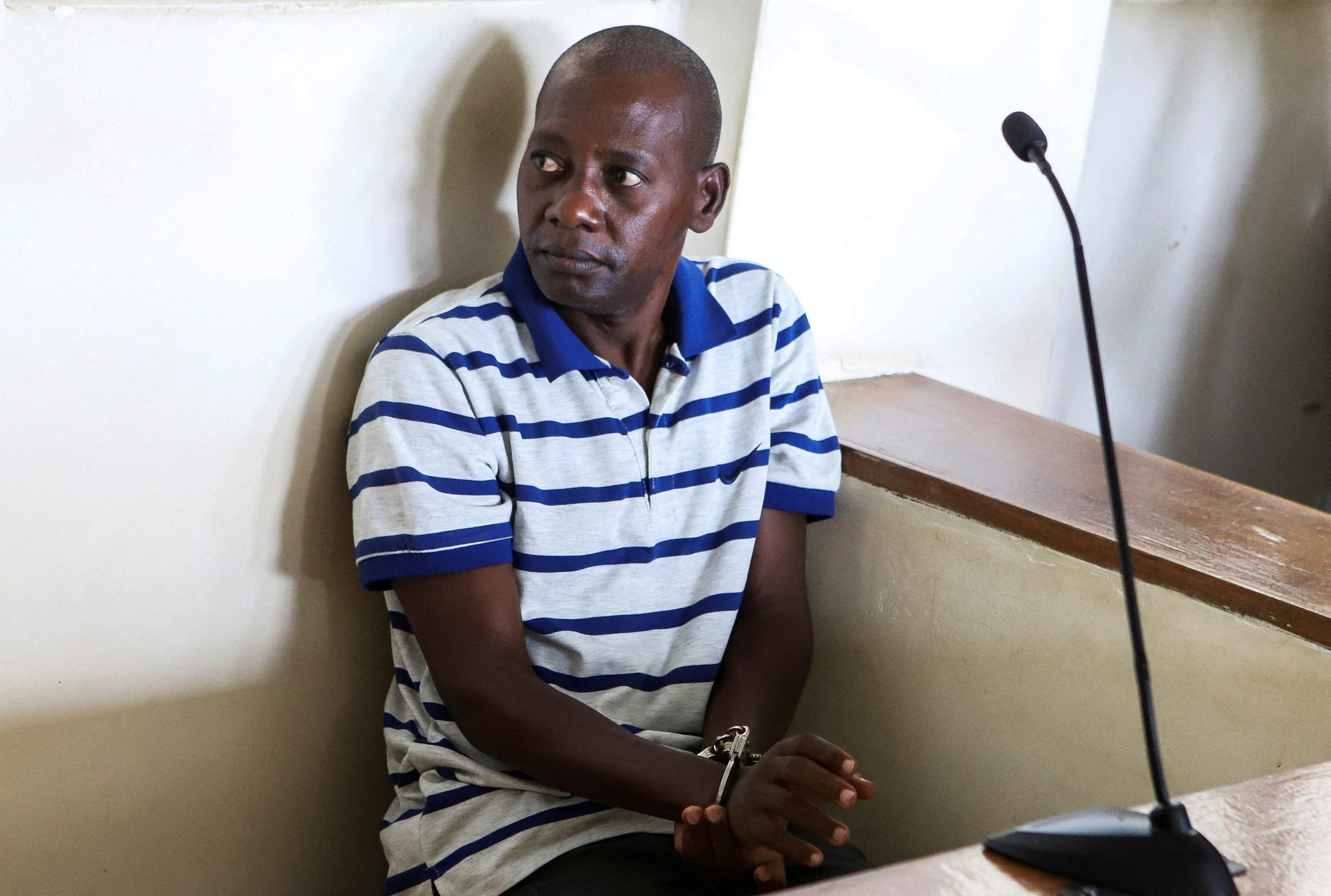
The Director of Public Prosecutions (ODPP) has suffered a setback after the High Court in Mombasa declined to re-open the murder trial against controversial preacher Paul Mackenzie and 29 co-accused over the deaths of 191 children in Shakahola forest.
The court rejected the prosecution’s bid, holding that although it has jurisdiction to recall witnesses where their evidence is essential to a just determination, that discretion cannot be used to help a party fill gaps, repair omissions or strengthen a case after it has voluntarily closed it.
“Although the application is presented as an attempt to cure a procedural misstep, it is in substance a strategy intended to assist the prosecution to fill gaps in its case through the re-examination of the convict,” the judge ruled.
The prosecution had sought to recall Enos Amanya for questioning over the contents of a confession detailing what transpired in Shakahola.
Amanya, who served as head of security in Shakahola forest, changed his plea earlier this year, admitted 191 counts of murder and recorded a detailed confession describing his role and that of others in the killings between 2021 and 2023.
However, the court noted that Amanya did not testify as a prosecution witness in the main trial and that his confession is not a substantive prosecution exhibit capable of founding liability against his co-accused.
“In the premises, I find the application to be ill conceived and devoid of merit,” the judge said.
On January 22, the prosecution asked the court to reopen its case for the limited purpose of allowing the remaining accused persons to cross-examine Amanya on a confession he recorded on January16, 2026. This was after the state had closed its case, having called 119 witnesses to support the 191 murder charges.
The state argued that the law permits a confession to be considered not only against its maker but also against co-accused persons. It maintained that allowing the confession to stand without cross-examination would raise serious fair trial concerns and could compromise the integrity of the proceedings, warning that failure to correct the oversight might result in grave consequences, including a mistrial.
The defence opposed the application, arguing that the reasons advanced by the prosecution were framed as concern for Amanya but were in truth an attempt to cure its own omission in failing to call him as a witness.
They told the court that although the prosecution had earlier indicated Amanya would testify after recording his confession, only the recording officer was called and examined on the voluntariness of the statement.
“Amanya had been available and present in court when the prosecution elected to close its case,” they said
The court agreed, noting that the confession was recorded after all prosecution witnesses had testified and ,therefore, did not form part of the prosecution’s evidence.
It described the confession as a mere interlude that briefly interrupted the closure of the state’s case.
“The confession cannot be treated as part of the evidence led by the prosecution and must be considered separately, without influencing the assessment of the prosecution’s case,” the judge said.
The court reiterated that the confession of a co-accused must first be disregarded and may only be used to support an already existing conclusion, not to create one, adding that If the independent evidence against an accused is weak, such a confession must be wholly ignored.
“Even assuming that Amanya incriminated the co-accused, such evidence would be of the weakest kind and incapable of sustaining a conviction without independent corroboration,” the judge added.
The court further observed that a co-accused’s confession is not substantive evidence against others and may only be considered as supplementary material.
“Even then, the court must be satisfied on independent evidence that the parties were acting pursuant to a joint criminal enterprise,” the court said.
More significantly, the judge noted that the trial has not yet reached the defence stage and no accused person has been placed on his defence.
“If that stage is reached, the implicated accused may, with leave of the court, call Amanya as a witness and examine him in accordance with the law,” the court added.
The ruling clears the way for Amanya to be sentenced and for the court to proceed to determine whether the remaining accused have a case to answer after receiving submissions from both sides.
In his confession, Amanya ,51, recounted how he abandoned his evangelical church after encountering Mackenzie’s teachings on television and eventually relocated with his family from Nairobi to Malindi and later to Shakahola forest.
What began as religious devotion, he said, gradually drew him deeper into Mackenzie’s inner circle, separating him from his former life and placing him at the centre of events that would later unfold in the forest.
He told the court that in mid-2022 Mackenzie introduced fasting to death as a divine directive, claiming he had received dreams that children should fast first, followed by women and then men, with Mackenzie to be the last to die.
Amanya said he was appointed head of security in the forest, where his duties included guarding the settlement, preventing followers from escaping, enforcing fasting orders, digging graves and burying bodies as deaths increased. Food was declared evil and mass graves were dug as more followers succumbed.
He described a system of violence and intimidation used to crush resistance and enforce obedience. Armed enforcers beat and restrained those who questioned the teachings or refused to fast, subjecting some to torture, including being tied with binding wire, squeezed with pliers or left bound to trees until they died.
Coded language was used to normalise death, with bodies referred to as fertiliser and burials described as planting.
About the Author