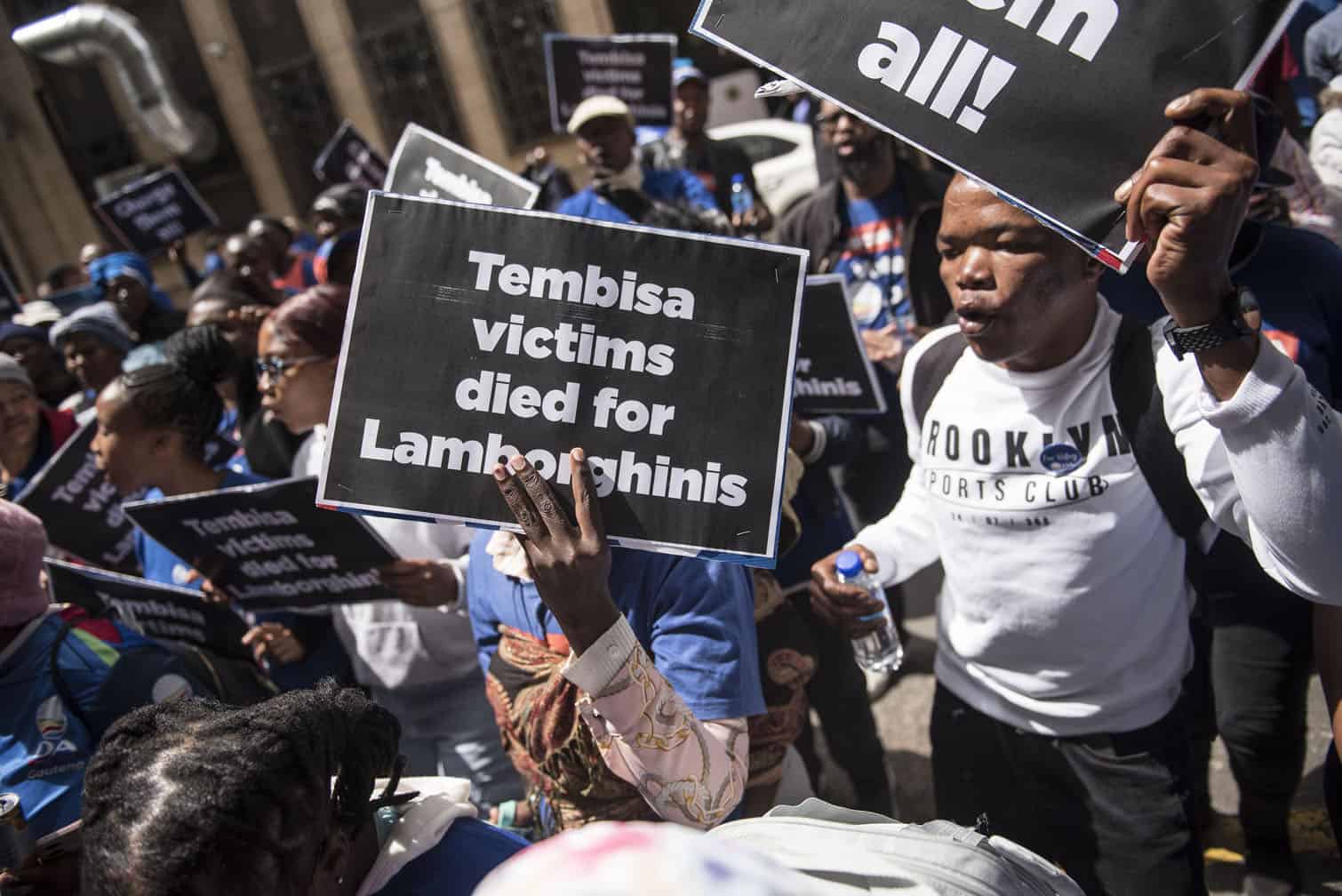
Supporters of the Democratic Alliance (DA) demonstrate, 20 November 2025, outside Gauteng Premier Panyaza Lesufi's office in Johannesburg calling for arrests and the return of the looted Tembisa Hospital R2billion. DA Gauteng Shadow MEC for Health Jack Bloom handed over a memorandum of demands. Picture: Michel Bega/The Citizen
Corruption remains one of South Africa’s most pressing challenges, undermining public trust, draining state resources, and weakening the institutions meant to serve citizens.
Each year, the Special Investigating Unit (SIU) uncovers new layers of misconduct across government departments, state-owned entities, and municipal structures, revealing how deeply maladministration and financial irregularities have taken root.
The Auditor-General and SIU have repeatedly exposed corruption across various government sectors, yet nothing seems to be done about it.
The ongoing Madlanga Commission has also exposed corruption in law enforcement, leaving South Africans wondering if there is an end in sight for this ill.
Tembisa Hospital
In September, the SIU revealed a devastating plunder of the public purse, uncovered in its probe into Tembisa Hospital, which identified three coordinated syndicates responsible for looting over R2 billion.
The billions were siphoned off through a complex web of fraud and corruption.
It identified three major syndicates that misappropriated R2 billion intended for healthcare at Tembisa Hospital. An analysis of 2 207 procurement bundles revealed serious maladministration and procurement fraud.
ALSO READ: SIU is not done with NLC yet, as more corruption allegations emerge
Key officials from the Gauteng Department of Health (GDOH) and Tembisa Hospital are accused of benefiting from corrupt payments that facilitated the irregular appointment of service providers.
Syndicates
The SIU classified three syndicates accused of these crimes. These include the Maumela Syndicate, linked to Hangwani Morgan Maumela. The SIU reviewed 1 728 bundles worth R816.5 million and uncovered significant irregularities.
The SIU has traced 41 suppliers or service providers linked to Maumela. Three of the companies awarded contracts valued at R13 538 292 in this syndicate are linked to Vusimuzi Matlala.
Maumela’s identified assets amount to around R520 million, including luxury vehicles and properties valued at R293.4 million.
ALSO READ: Pre-1994 cops ‘were feared and respected’, some now ‘partakers of corruption and criminality’
Notable properties include a R75 million property in Bantry Bay and various others in Gauteng.
The Mazibuko syndicate is linked to Rudolph Mazibuko. The SIU’s investigation revealed assets worth R42.6 million, including multiple properties in the Western Cape and Gauteng.
The SIU’s evidence revealed that the total value of corrupt payments linked to officials and employees of GDOH and Tembisa Hospital is R122 million.
R600 million settlement agreement between Nedbank and Transnet
In November, Nedbank and Transnet SOC Limited reached an agreement regarding the interest rate swap transactions.
As part of the settlement agreement, Nedbank will pay Transnet R600 million, and the SIU and Transnet will withdraw their court application to review and set aside interest rate swap transactions concluded in 2015 and 2016.
The SIU had investigated the transactions featured in the Judicial Commission of Inquiry’s report into allegations of State Capture, corruption, and fraud in the public sector.
The transactions were part of a larger scheme designed to misappropriate and divert public funds from Transnet for the benefit of entities linked to the Gupta family.
The SIU is currently investigating similar interest rate swap agreements at another state institution. This investigation aims to address allegations of maladministration and financial mismanagement in relation to interest rate swap agreements with various banking institutions, as highlighted by the Judicial Commission of Inquiry into State Capture.
Transport corruption
In early December, the SIU announced it had successfully recovered and returned R14.7 million to six Provincial Departments of Transport.
The funds were irregularly diverted from the Nationwide Rolling Stock Fleet (NRSF) project.
The SIU investigated serious maladministration and corruption within the transportation sector, with a focus on vehicle registration, driver licensing, and the eNaTIS system.
In the investigation’s first phase, the SIU uncovered extensive fraud and maladministration within Driving License Testing Centres (DLTCs) and the eNaTIS system.
Critical systemic vulnerabilities included the conversion of foreign licenses using unverified documents, stemming from a lack of integration between eNaTIS and the Department of Home Affairs, which led to the mass cancellation of licenses.
The SIU investigated the diversion of project funds and identified irregular expenditures totalling R16.7 million.
ALSO READ: 27 Home Affairs officials dismissed for fraud and corruption since July 2024
Of the R9.5 million recovered for the Mpumalanga Department of Transport, R6.9 million came from Optimum Coal Mine for outstanding motor licensing fees and penalties in respect of the trucks and smaller vehicles owned by Optimum for the period January 2018 to November 2022.
Officials also manipulated eNaTIS to unjustly transfer outstanding fees and penalties to deceased individuals or unsuspecting citizens, enabling some vehicle owners, particularly those of heavy motor vehicles, to evade state debts.
‘War on Leaks’ programme
In June, the SIU appeared before the Standing Committee on Public Accounts to provide an update on its investigations into the Department of Water and Sanitation.
The War on Leaks Artisan Training programme was launched by then-president Jacob Zuma in 2015 to train 15 000 youth to reduce water losses through leaks.
The project was signed in 2015 by then Water and Sanitation Minister Nomvula Mokonyane and Rand Water to curb about R7 billion in water leaks nationwide.
The approved budget for the programme was R2.2 billion. However, the SIU identified that R4.7 billion had been paid out.
From 2008, the SIU has received 14 proclamations relating to the water and sanitation sector.
NLC corruption
In November 2020, President Cyril Ramaphosa signed a proclamation authorising the SIU to investigate the National Lotteries Commission (NLC) and recover any losses.
In May, SIU head Andy Mothibi briefed the standing committee on public accounts on the investigation into the NLC.
The SIU divided its investigations into three phases.
The estimated value of the matters investigated in the first and second phases is R279.7 million and R246.6 million, respectively. The SIU has completed investigations in these phases.
Phase three, which is ongoing, has an estimated value of R905.9 million. It is estimated to be completed by 31 December 2025.
The value of contracts under investigation with potential civil litigation is about R2 billion.
Is there an end in sight?
IRS forensic investigator Chad Thomas says no.
“South Africa is battling a tsunami of corruption which impacts on each and every citizen, especially in respect of service delivery (or rather the lack thereof), and the lack of consequences when it comes to holding criminals to account,” Thomas told The Citizen.
“Sadly, it seems to be worsening, especially with the so-called ‘mafias’ also known as ‘business forums’ which are delaying service delivery projects for the most needy and sabotaging infrastructure to get contracts.”
There is little to no accountability, he says, and the kingpins of these criminal syndicates are never caught.
This has eroded public trust, as many believe the government is only paying lip service.
“Trust was eroded a long time ago. It’s going to take a while for the public to believe that the government has their best interests at heart,” says Thomas.
Although the SIU has played its role, Thomas believes it is limited in what it can actually achieve.
“The SIU does incredible work, but the mandate is limited. They can only investigate under a Presidential Proclamation and target funds stolen from the public purse.
“They are brilliant at obtaining financial restitution but lack prosecutorial powers and refer cases to DPCI and NPA for further investigation and prosecution,” says Thomas.
“An overhaul [of the tender system] is required. Although the PFMA and MFMA are good pieces of legislation, there needs to be amendments as criminal syndicates have found and exploited loopholes in the respective acts.”
READ NEXT: SA borrowing too much, spending inefficiently and losing money to corruption – Scopa chair
About the Author