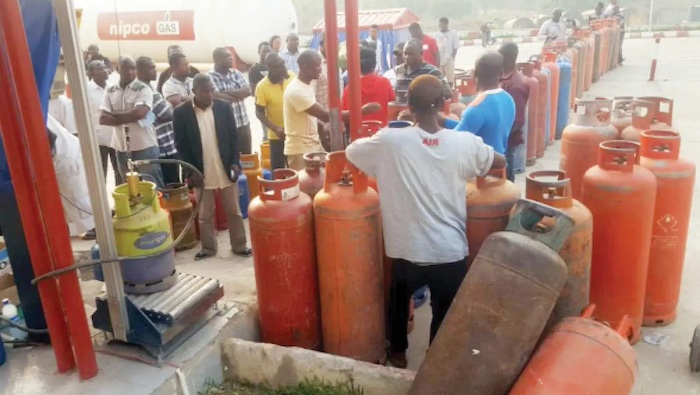
The Nigerian Association of Liquefied Petroleum Gas Marketers (NALPGAM) has raised the alarm over a fresh spike in cooking gas prices and erratic supply, warning that millions of households and small businesses face imminent hardship if urgent intervention was not taken.
In a statement issued yesterday, jointly signed by its National President, Edu Inyang and the Executive Secretary, Bassey Essien, NALPGAM complained that Nigerians were now paying over N1,500 per kilogram of Liquefied Petroleum Gas (LPG), while marketers were forced to buy 20 metric tons at N25.2 million to N26.2 million, depending on location.
“It is sad and rather very pathetic to inform the general public that the citizens of Nigeria have woken up to buy cooking gas which should be a social item at a prohibitive cost of over N1,500 per kg,” the association said.
The group warned the situation could spark public backlash against gas filling stations if not addressed immediately, adding that the citizens may rise against the owners of gas filling stations if the situation was not immediately checked.
According to NALPGAM, members nationwide are struggling with persistent supply shortages, high depot prices, logistics bottlenecks, and rising operational costs, and that where product was available, it was sold at rates far beyond the reach of average Nigerians.
The association pointed out that the crisis was reversing years of progress made under the federal government’s clean energy transition agenda.
It noted that millions of households that switched from kerosene, charcoal, and firewood were now struggling to refill cylinders or reverting to dirtier fuels.
“Households are struggling to refill cylinders, small businesses are folding under rising energy costs while many families are reverting to firewood and charcoal despite the serious implications for public health, environmental degradation, and deforestation,” the statement read.
The warning comes as Nigeria’s LPG market shows mixed signals as domestic supply had previously improved significantly, with local refineries and gas plants, led by Dangote Refinery and the Nigeria Liquefied Natural Gas (NLNG) Limited, supplying 87 per cent of Nigeria’s cooking gas in 2025.
Nigeria’s LPG consumption also rose from 900,000 metric tonnes in 2021 to two million metric tonnes in 2025, making it the fastest-growing market in Africa.
With the latest relapse, NALPGAM said the crisis threatens broader economic stability.
“If urgent and coordinated actions are not taken immediately, the current crisis could trigger broader consequences, including accelerated food inflation, the collapse of small-scale LPG retail businesses, job losses, reduced investor confidence, and a significant setback to Nigeria’s clean energy and climate commitments”, it said.
THISDAY’s checks showed that Nigeria’s per capita LPG consumption remains low at 1.8kg, compared to nearly 500kg in Saudi Arabia.
The association has called on relevant industry stakeholders including the federal government, Ministry of Petroleum Resources, Nigerian Midstream and Downstream Petroleum Regulatory Authority (NMDPRA), NNPC Ltd, domestic producers, and terminal operators to act decisively to address the situation.
It recommended among others, that domestic LPG allocation be increased to the Nigerian market; ensure transparent and equitable distribution across regions, reduce bottlenecks in importation, storage, and distribution, and implement strategic interventions to stabilize retail prices.
NALPGAM also urged companies with adequate investible capital to invest in storage and distribution infrastructure to prevent future shocks.
It added that immediate measures to improve the availability and accessibility of LPG nationwide were needed, adding that the current crisis undermines policies and investments aimed at deepening LPG penetration.
“We cannot stand by and watch millions of Nigerian families suffer in silence while access to clean cooking energy becomes increasingly difficult and unaffordable,” it said.
“For years, government and industry operators have worked to move Nigerians away from unsafe fuels. Those gains are now under serious threat”, NALPGAM stated.
It said it remains ready to collaborate with all stakeholders but stressed that decisive action was needed now to stabilize supply and pricing.
Peter Uzoho