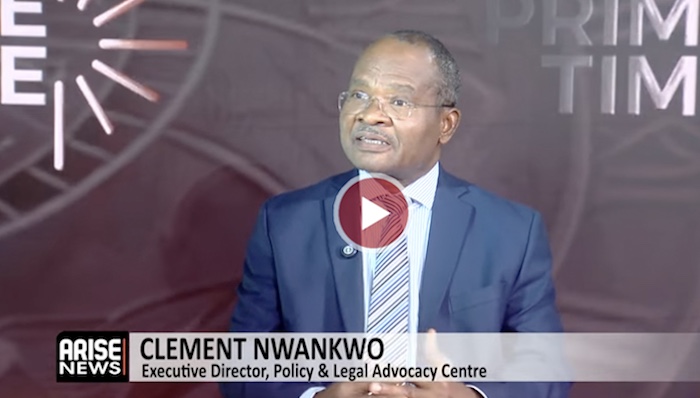
Executive Director of the Policy and Legal Advocacy Centre (PLAC), Clement Nwankwo, has warned that delays by the National Assembly in passing a new Electoral Act could undermine the credibility, certainty and public trust required for Nigeria’s 2027 general elections.
Speaking in an interview with ARISE News on Wednesday, Nwankwo said electoral laws were not last-minute instruments and cautioned that approaching another election cycle without completing the legal framework would leave democratic institutions operating under uncertainty.
“We do need time for preparations for the elections. We do need certainty in the electoral laws and legal framework,” he said.
Nwankwo noted that international instruments, ECOWAS protocols, the Nigerian Constitution and the Electoral Act all emphasise the importance of certainty in electoral law, particularly ahead of elections.
“When you look at the Constitution and you look at the Electoral Act, the Electoral Act is quite clear in saying that you must give notice of election 360 days before the elections,” he said. “Those 360 days are still in the current 2022 Electoral Act, so it’s not a problem. But there are announcements and pronouncements and stipulations you need to put out in terms of that notice being issued.”
He explained that extensive work had already gone into the proposed amendments, describing the collaboration between the Senate and House of Representatives committees on electoral matters as unprecedented.
“I must say that the National Assembly has been fantastic — the Senate and the House — going through a process of deliberations, review, conversations, and actually do have a document,” Nwankwo said. “The House has now passed it. The Senate has not passed it.”
According to him, the issue was no longer content but urgency.
“For us, it’s really to say to the National Assembly, please prioritise this. You can’t continue to delay,” he said. “If you look at the legislative agenda of the Senate and the House of Representatives, it’s quite clear that this would be one of the bills that should be passed as quickly as possible.”
He added that the leadership of both chambers had publicly committed to the bill.
“The Senate President has spoken to it. The Speaker of the House of Representatives has spoken to it. The chairmen of the two committees, Senator Abdulfatai Buhari and Honourable Adebayo Balogun, have all worked very assiduously to get the two committees to come up with a draft document,” he said. “So really, it’s just to say, we will prioritise this.”
On how much time remained before electoral reform became ineffective, Nwankwo said the window was narrowing rapidly.
“There are just about 12 and a half months to go,” he said. “That’s assuming that elections will be conducted in February and March 2027, as happened previously. You really have to have certainty.”
He stressed that the bill should be concluded this year.
“That certainty means that both houses should have passed the Electoral Act in 2025, and the president should have assented to it no later than December 2025,” he said. “I can’t project any further time for the National Assembly to consider this.”
Addressing speculation that the Senate’s delay reflected political reluctance, Nwankwo dismissed such claims.
“I don’t see any reluctance. I don’t see any malice. I don’t see any political shenanigans going on,” he said. “I see an issue of prioritisation.”
He pointed to the swift confirmation of ambassadorial nominees shortly before the recess as evidence.
“When you see those types of prioritisation, it means that the Senate has not given the electorate the priority that it deserves,” he said. “That’s why we’re saying: come back to work, deal with this immediately so that the commission, which is headed by a new chairman, has certainty of the legal framework to do its work.”
Nwankwo said the Independent National Electoral Commission (INEC) could still conduct elections under the 2022 Electoral Act but noted that the proposed amendments would improve clarity and administration.
“There is no default in terms of INEC continuing its preparations,” he said. “It is still able to use the 2022 Electoral Act to announce and give notice for the elections, which it must give 360 days.”
He added that the proposed 2026 Electoral Act would strengthen processes and improve outcomes beyond the 2023 experience.
“The draft that the National Assembly has today is good enough to help the commission conduct a credible election better than 2023,” he said. “Usually, the problem is with those who are conducting the elections. The legal framework is there. Implementation is a different thing.”
Drawing lessons from past delays, Nwankwo recalled the refusal of former President Muhammadu Buhari to assent to the Electoral Act on three occasions.
“We did see a failure to assent to the Electoral Act on three consecutive occasions, and we knew how incompetent that administration was,” he said. “On the last occasion, the advice was that we had gone too late towards the elections, and so we could not be signing a new electoral act with only a few months to elections.”
He said that scenario must be avoided.
“That’s what we’re trying to avoid, because a lot of work has been put into this particular bill,” he said. “It would be a shame if it is not taken as seriously as the work that has gone into it.”
Outlining key reforms in the proposed law, Nwankwo said many changes focused on clarity rather than wholesale overhaul.
“It’s really just dotting the i’s and crossing the t’s,” he said. “Clarifying a whole lot of things.”
He cited issues around party agents, electronic transmission of results, voter registration requirements and safeguards against underage voting and foreign nationals obtaining voter cards.
Turning to constitutional reform, Nwankwo urged the National Assembly to prioritise the bill on special seats for women, describing Nigeria’s representation figures as embarrassing.
“If you look at the seats for women in the National and State Houses of Assembly, it’s 999 seats. Only 54 are women,” he said. “That’s pathetic. Fifteen states do not have women represented at all.”
He warned that failure to pass the bill would damage the legislature’s credibility.
“The National Assembly should decide that special seats for women would be its legacy,” he said. “It will lose a lot of credibility if it fails to pass this bill.”
On governance, Nwankwo said Nigerians’ expectations of the current administration had not been met, citing rising hardship following economic reforms.
“The removal of fuel subsidy was welcome, but it was done in a way that created incredible hardship,” he said. “Combined with currency devaluation, these factors have created massive inflation.”
He questioned the use of increased government revenue.
“People are asking, where is the money going to?” he said. “They are seeing government officials squander money and not tighten their own belts.”
Despite his criticism, Nwankwo said his organisation remained committed to supporting democratic institutions.
“The difference between dictatorship and democracy is the National Assembly,” he said. “That’s why PLAC supports legislative reform, constitutional review and legal reform — because if you improve policy at that level, you can salvage democracy.”
Boluwatife Enome
About the Author