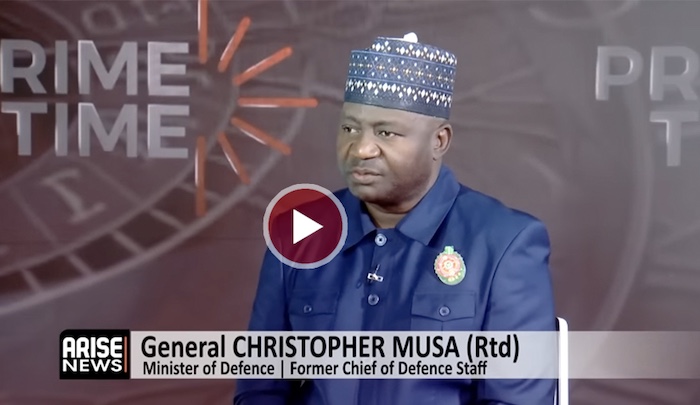

Nigeria’s Minister of Defence and former Chief of Defence Staff, General Christopher Musa (Rtd), has declared that military coups must never be contemplated again in Nigeria, insisting that the country is closer to lasting security than at any point in recent years, despite persistent insurgency, banditry and global scrutiny.
Speaking in an interview with ARISE News on Thursday to mark January 15 — a date that commemorates fallen Nigerian soldiers but also recalls the country’s first military coup in 1966 — Musa said the lesson of history was clear and irreversible.
“January 15, 1966, was an unfortunate incident that occurred, and like we said, it’s part of the history of Nigeria, and so we can’t do away with it. And now, I think the important thing is, what do we do after that? How do we prevent repeating such mistakes in the future?” he said.
Musa stressed that the Armed Forces of Nigeria have firmly embraced democratic civilian control and are better positioned under democracy than military rule.
“That’s one thing I’m very proud of. The Nigerian military have stood up to its responsibility, subjecting itself to civilian rule. And you can see that the military actually thrives better in a democracy. For us in Nigeria, it’s always been very better when we have a democratic government in place,” he said.
He warned unequivocally against any future coup attempts, describing them as unacceptable under any circumstance.
“First and foremost, to know that coup is wrong. Nobody should ever have that in mind. From now onwards, nobody should ever think of carrying out a coup or something in Nigeria. We must all put our hands together to support the democratic norms in place,” Musa stated.
Addressing Nigeria’s ongoing security challenges, the defence minister said the country had made significant progress but noted that insurgents survive largely due to civilian support networks.
“I think we’re closer now than ever before. Broadly, the atmosphere is getting a lot better than how it used to be. But we need to do more,” he said.
Musa added: “What we see is why these guys are thriving is because we have some certain individuals that still support them — trying to trade with them, giving them food, logistics and information about troop movements. If Nigerians decide today not to support them, communities that have done so are free.”
He emphasised that security agencies alone could not defeat terrorism.
“The security man cannot be everywhere. Everybody has a responsibility. Once you see something going wrong, report as quickly as possible,” he urged.
Responding to criticism about intelligence failures, Musa explained operational constraints faced by troops.
“Because of IEDs, if you have information and you want to move 10 kilometres, it could take you more than five hours. If you make a mistake and step on an IED, everybody is dead. These are the challenges we have,” he said.
Musa stressed that Nigeria’s security crisis is not purely military.
“The kinetic aspect cannot solve all the problems. It will only provide an enabling environment for other aspects to take place — justice, fairness, equity, infrastructure development,” he said.
He described terrorism as a global phenomenon requiring international cooperation.
“What’s going on now is a world challenge. Look at Mozambique, Burkina Faso, Mali, Nigeria. Just like ISIS, the entire world must come together to fight it,” Musa said.
Reacting to comments attributed to former US President Donald Trump suggesting military action in Nigeria, Musa dismissed such rhetoric.
“The rhetoric was overblown. Nigeria is a sovereign country. No country will just fly into Nigeria and do whatever it feels like doing. Whatever America does with Nigeria will be discussed, planned and executed together. It won’t happen that way,” he said.
On religious violence narratives, Musa rejected claims of state-sponsored persecution.
“Nigerians are being killed — Christians, Muslims, non-Christians, non-Muslims. It is not a federal government policy to go after Christians. These are criminal elements,” he said.
He acknowledged fear among communities but warned against inflaming religious divisions.
“Fear is natural. Perception exists. I grew up in Sokoto, and I had one of the best upbringings of my life. Sometimes we take religion to the extreme. But we’re getting better at understanding each other,” Musa said.
The minister issued a strong warning to individuals who rationalise or encourage terrorists.
“Anybody who supports a criminal is a criminal. Whether you give them funds, logistics, information or encourage them through the media — you are part of them,” he said.
He cautioned opinion leaders and religious figures.
“We should be careful what we say. Your freedom should not infringe on others. Once you cross the red line, action will be taken. Nobody is above the government. Nobody is above the law,” Musa warned.
On US military support, Musa said recent equipment deliveries were both previously paid-for assets and new assistance.
“It’s good. It makes a lot of difference to us. American equipment is tested and trusted. You get the best of the best,” he said.
He also highlighted Nigeria’s growing defence manufacturing capacity.
“With the signing of the DICON Bill, companies are now producing drones, APCs, MRAPs in Nigeria. Economically and operationally, this will enhance our capabilities,” he said.
Musa said border security remains a priority, combining technology and manpower.
“Not everywhere needs a physical fence. We have electronic fences, drones, satellites. The federal government is taking it very seriously,” he said.
He also blamed weak local governance for worsening insecurity.
“Local government chairmen must hold weekly security meetings. If 20 local governments are active, I can bet you things will get better,” Musa said.
Asked how Nigerians should judge his tenure, Musa said success would be felt in daily life.
“Success is Nigerians sleeping with their eyes closed. Students going to school without fear. Markets flourishing. Visitors coming into Nigeria without fear,” he said.
He concluded: “Things have changed, and things are going to change. But we need everybody on board. That is very critical for us.”
Boluwatife Enome
About the Author